
Asia Pacific Flat Glass Market Outlook
The report titled "Asia Pacific Flat Glass Market Size, Share, Trends and Forecast by Technology, Product Type, Raw Material, End Use, Type, End Use Industry, and Country, 2026–2034" comprises a comprehensive analysis of the regional market, covering its size, growth trends, key drivers, country-wise insights, and other critical metrics defining Asia Pacific's construction, automotive, and solar glazing ecosystem.
How Big is the Flat Glass Market in Asia Pacific?
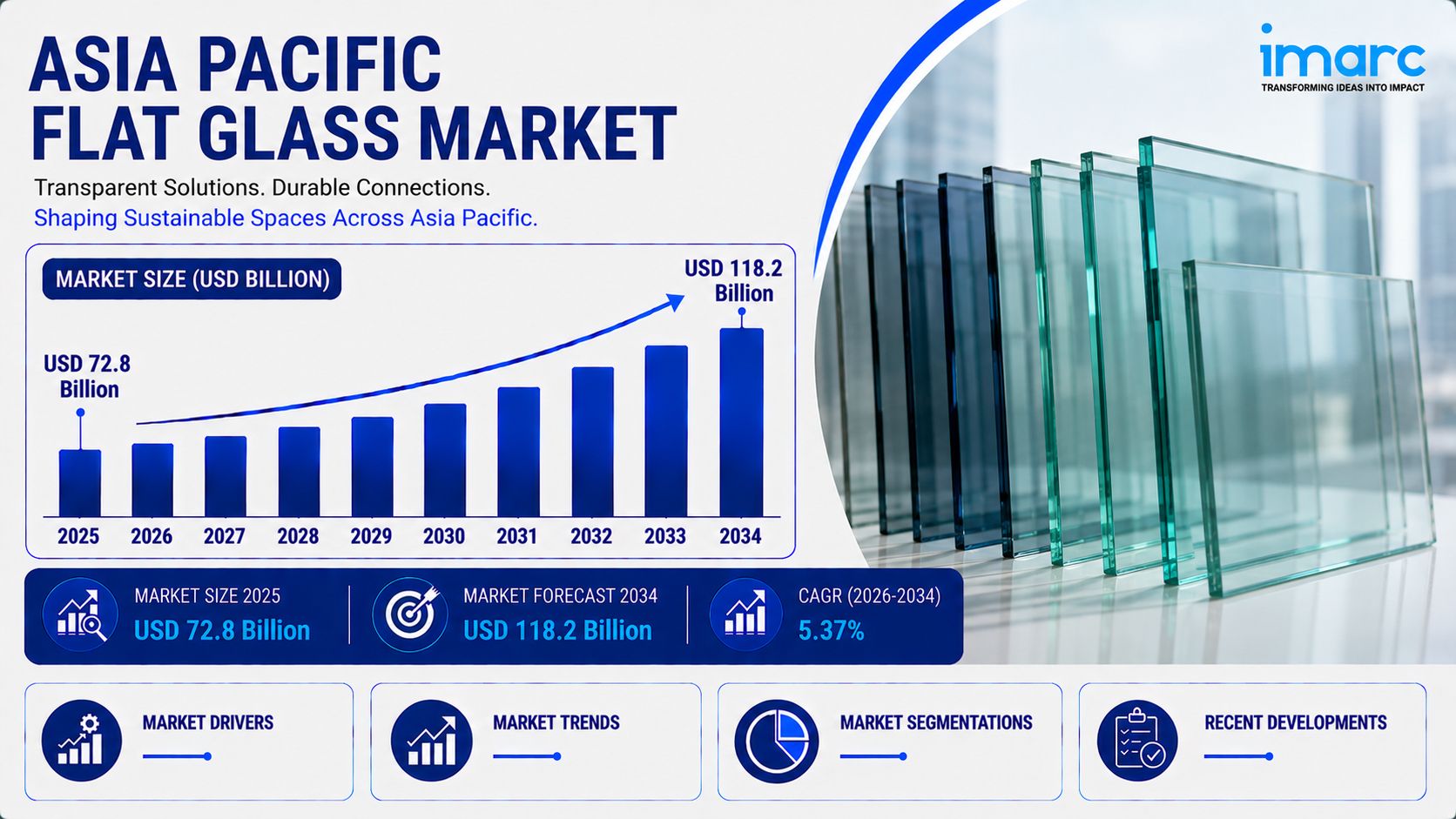
The Asia Pacific flat glass market size was valued at USD 72.8 Billion in 2025. Looking forward, IMARC Group estimates the market to reach USD 118.2 Billion by 2034, exhibiting a growth rate (CAGR) of 5.37% during 2026–2034. The market is expanding due to rising construction, automotive, and solar energy demand, with urbanization, infrastructure growth, and energy-efficient building initiatives driving adoption across the region, reinforcing Asia Pacific's leadership in global flat glass production.
Emerging Trends in the Asia Pacific Flat Glass Market:
- Rising Adoption of Energy-Efficient and Smart Glazing Technologies:
Stricter building regulations and the push for sustainable construction are driving demand for low-emissivity glass, which minimizes heat transfer and improves insulation in residential and commercial buildings. Solar control glass is becoming a preferred choice for high-rise structures, blocking excess heat while maintaining natural light transmission, while smart glass incorporating electrochromic and thermochromic technology is being integrated into modern designs for dynamic light and heat control. Government-backed green building certification initiatives across the region are accelerating adoption of these advanced glazing technologies, pushing manufacturers to continuously innovate rather than rely on basic float glass alone.
- Solar Energy Expansion Creating Structural Demand for Specialized Solar Glass:
The region's intensifying focus on renewable energy is driving rapid expansion of photovoltaic projects across China, India, and Japan, with India alone having added 15 GW of solar capacity in 2024, a 282% increase, as it targets 500 GW of renewable energy by 2030. This specialized glass, engineered specifically to enhance panel energy conversion efficiency and durability, is becoming an increasingly distinct product category from standard architectural glass, and government manufacturing incentives are directly channeling capital toward dedicated solar glass production lines across the region's largest markets.
- Automotive Sector Shifting Toward Lightweight, Advanced Glazing Solutions:
Rising production of electric and lightweight vehicles is driving automakers across China, India, and Japan to increasingly specify laminated and tempered glass that improves safety, aerodynamics, and fuel efficiency. Lightweight glazing materials directly help reduce vehicle weight, which meaningfully improves battery efficiency in electric vehicles, while solar control and acoustic glass are simultaneously improving cabin comfort. This is converting automotive glazing from a largely standardized component into a differentiated, engineering-intensive product line, as regulatory mandates on fuel efficiency and safety continue to tighten across the region's major vehicle-producing economies.
Request Sample Report – TOC, Charts & Key Insights: https://www.imarcgroup.com/asia-pacific-flat-glass-market/requestsample
Growth Factors Driving the Asia Pacific Flat Glass Market:
- Rapid Urbanization and Large-Scale Infrastructure Development:
Fast urbanization across China and India is directly increasing adoption of energy-efficient glazing solutions, with India alone expecting 600 million urban residents by 2036, up from 31% in 2011, and requiring an estimated USD 840 billion in infrastructure investment through that period. This scale of urban expansion is generating sustained demand for tempered and laminated glass across airports, metro stations, and commercial complexes, and because infrastructure build-out tends to unfold over multiple decades rather than short cycles, it creates a durable, long-horizon demand base for flat glass manufacturers across the region.
- Expanding Automotive Production Volumes Across the Region:
China's automotive industry alone reported record production of 31.28 million vehicles and sales of 31.44 million units in 2024, increases of 3.7% and 4.5% year-on-year respectively, directly translating into higher consumption of windshield and side-window glass. As vehicle exports also rose sharply, with Chinese-branded vehicles leading at nearly 18 million units, this growing production base is reinforcing flat glass demand not just domestically but through the broader regional and global automotive supply chains that Asia Pacific manufacturers increasingly serve.
- Government Policy Support for Renewable Energy and Green Buildings:
Supportive policies in China, India, and Japan are directly fueling solar glass demand, with India's PLI scheme allocating ₹24,000 crore to develop 48 GW of solar manufacturing capacity by 2026 alone. Parallel government regulations mandating green building standards and energy conservation are compelling developers to prioritize low-E, solar control, and insulated glass solutions, meaning policy support is driving demand simultaneously from the energy generation side and the building construction side of the flat glass market.
Industry Value Chain Analysis:
- Raw Material Sourcing: Sand, soda ash, recycled glass, dolomite, and limestone suppliers provide the core inputs, with high-purity silica sand remaining the dominant raw material due to its wide availability and essential role in float glass production.
- Flat Glass Manufacturing: Manufacturers use float, sheet, and rolled glass technologies to convert raw materials into basic, toughened, coated, and laminated glass products suited to different applications.
- Fabrication and Value Addition: Fabricators process basic float glass into tempered, insulated, coated, and extra-clear glass variants that meet the enhanced strength, safety, and energy-efficiency requirements of specific end uses.
- Distribution and Trade: Distributors and trading networks move finished flat glass products from manufacturing hubs to construction sites, automotive assembly plants, and solar panel producers across the region and for export.
- End-Use Application: Construction companies, automotive OEMs, and solar panel manufacturers integrate flat glass into finished buildings, vehicles, and photovoltaic systems across residential, commercial, and industrial projects.
Deep-Dive Segment Insights
- By Technology: Float glass holds the largest share, favored for its uniform thickness, high optical clarity, and cost-effective production process, with the booming construction sector across China, India, and Southeast Asia driving demand in windows, facades, and interior applications.
- By Product Type: Basic float glass dominates due to its affordability, versatility, and extensive use across construction, automotive, and solar energy industries, with its ease of further processing into tempered, laminated, or coated glass reinforcing its market leadership.
- By Raw Material: Sand is the primary input, dominating production due to its high silica content and widespread regional availability, with China, India, and Southeast Asian countries relying on both domestic and imported sand for large-scale glass manufacturing.
- By End Use: Safety and security applications lead the market, driven by urbanization, high-rise construction, and stringent building codes increasing demand for tempered, laminated, and impact-resistant glass across residential, commercial, and automotive applications.
- By Type: Fabricated flat glass dominates due to its enhanced properties for high-performance applications, including tempered, laminated, insulated, and coated variants suited to construction, automotive, and solar industries.
- By End Use Industry: Construction leads the market, driven by rapid urbanization and infrastructure expansion across China, India, and Indonesia, with green building initiatives and large-scale projects like airports and smart cities reinforcing its dominant position.
- By Country: China dominates the market, benefiting from abundant raw material availability, advanced manufacturing capabilities, and strong government support for infrastructure and renewable energy projects.
Competitive Landscape:
The Asia Pacific flat glass market is highly competitive, with numerous manufacturers operating across the region to meet growing demand from construction, automotive, and solar industries. Companies are expanding production capacities, investing in advanced manufacturing technologies, and developing high-performance glass solutions such as low-emissivity, solar control, and smart glass. Sustainability has become a key focus, driving innovation in low-carbon and energy-efficient glass production, while intense competition has led to price fluctuations as raw material costs and supply chain disruptions influence market dynamics. Strategic partnerships, mergers, and acquisitions remain common as companies work to strengthen their regional market presence and technological capabilities.
Latest Recent Developments in the Asia Pacific Flat Glass Market:
- Saint-Gobain's Nearly USD 1 Billion India Investment Plan (July 2026): Saint-Gobain announced plans to invest close to USD 1 billion in India to expand manufacturing capacity, R&D centers, and export operations, positioning the country as a production base for exports to Southeast Asia and Australia, with exports expected to rise from around 5% to 15% of India output over the next five years.
- Saint-Gobain Begins Construction of Seventh Float Glass Line in Chennai (2026): Saint-Gobain commenced construction of its seventh float glass line and fifth mineral wool insulation line at its Oragadam site near Chennai, with the new float facility offering a production capacity of 1,000 tonnes per day and the insulation plant representing the company's largest investment in insulation across the Asia-Pacific region.
- Gold Plus Glass Commissions New Karnataka Facility (January 2025): Gold Plus Glass Industry Limited announced the commissioning of its new manufacturing facility in Karnataka, enhancing its float glass capacity to over 1 million tons annually and introducing solar glass production, backed by a ₹2,500 crore investment aligned with India's demand for quality glass and renewable energy solutions.
Note: If you need specific information that is not currently within the scope of the report, we can provide it to you as a part of the customization.
Frequently Asked Questions (FAQs)
Q1. How big is the flat glass market in the Asia Pacific?
The flat glass market was valued at USD 72.8 Billion in 2025.
Q2. What factors are driving the growth of the Asia Pacific flat glass market?
Key drivers include rapid urbanization and infrastructure development, rising demand for energy-efficient glazing in buildings, expansion of solar energy projects, and increasing adoption of advanced glazing solutions in the automotive sector, further accelerated by government policies supporting green buildings, smart cities, and renewable energy.
Q3. What is the forecast for the flat glass market in the Asia Pacific?
IMARC estimates the Asia Pacific flat glass market to exhibit a CAGR of 5.37% from 2026–2034, reaching USD 118.2 Billion by 2034.
Q4. Which country dominates the Asia Pacific flat glass market?
China dominates the market, supported by its massive construction, automotive, and solar energy sectors, abundant raw material availability, advanced manufacturing capabilities, and strong government backing for infrastructure and renewable energy projects.
Q5. What are the key end-use industries in the Asia Pacific flat glass market?
The key end-use industries covered in the report include construction, automotive, solar energy, and electronics, with construction leading the market due to rapid urbanization and large-scale infrastructure projects across the region.