
Market Overview & Summary
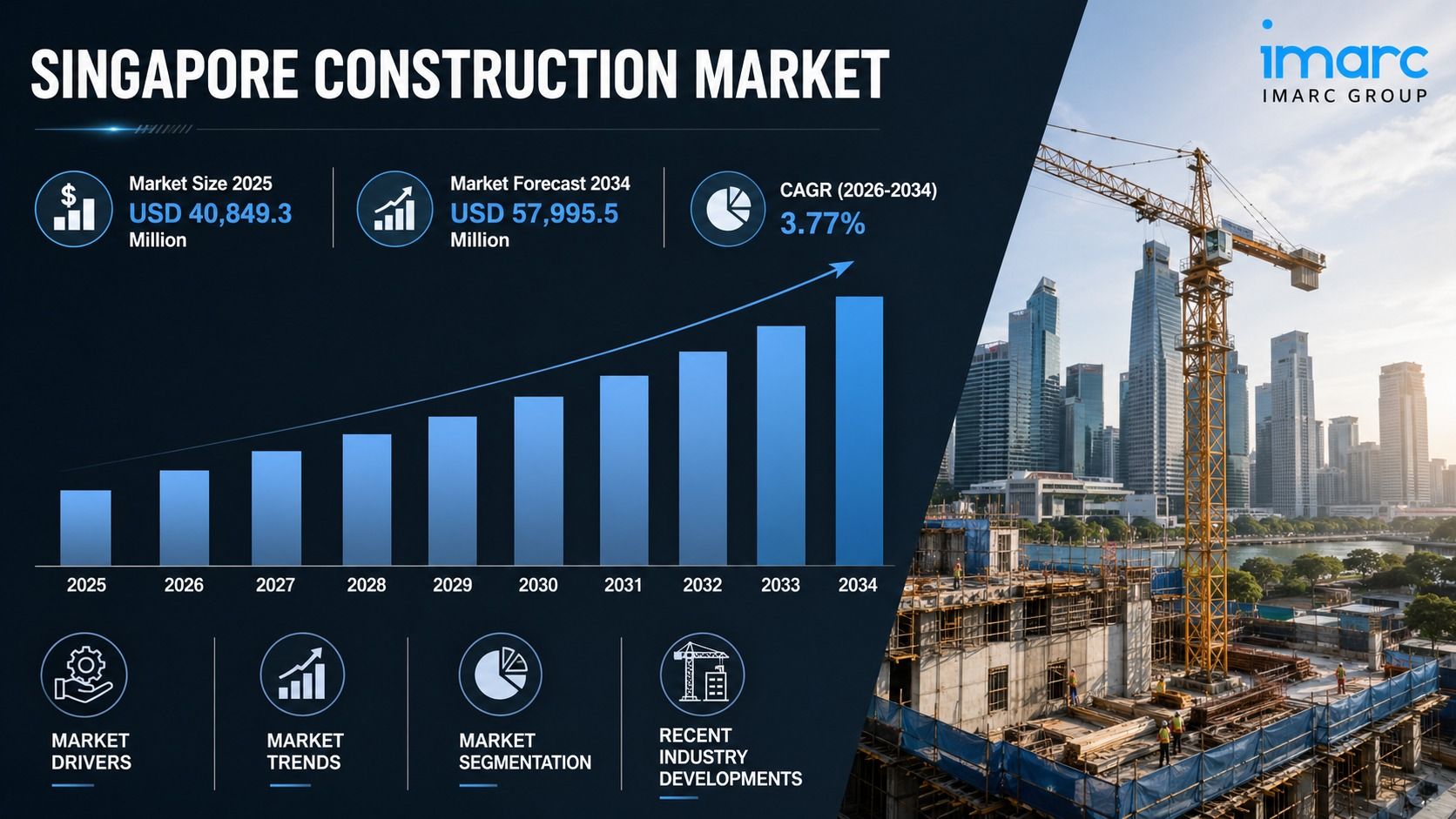
The Singapore construction market size reached USD 40,849.3 Million in 2025 and is projected to reach USD 57,995.5 Million by 2034, exhibiting a steady compound annual growth rate (CAGR) of 3.77% during the 2026–2034 forecast period.
The domestic built environment is navigating a period of historically elevated demand, transitioning rapidly from labor-intensive traditional building practices toward highly automated, digitally integrated construction methodologies. Driven by a robust pipeline of generational infrastructure megaprojects, aggressive public housing (HDB) rollouts, and comprehensive healthcare facility expansions, construction demand reached an impressive SGD 50.5 billion in 2025. With the Building and Construction Authority (BCA) projecting continued demand between SGD 47 billion and SGD 53 billion in 2026, the sector remains a primary economic multiplier for the nation. As contractors grapple with chronic skilled labor shortages and tightening foreign-worker quotas, the market is aggressively pivoting toward prefabrication, robotics, and advanced building information modeling (BIM) to sustain operational margins and execute complex urban developments.
Market Size & Forecast
- Market Size (2025): USD 40,849.3 Million
- Projected Market Size (2034): USD 57,995.5 Million
- CAGR (2026 - 2034): 3.77%
- Leading Sector: Residential
- Fastest Growing Sector: Infrastructure (Transportation)
- Leading Region: Outside Central Region (North/West/East expansion corridors)
What Is the Outlook for the Singapore Construction Market?
The outlook for the Singapore construction market remains closely linked to continued infrastructure development, urban redevelopment, public-sector construction activity, and demand for modern residential, commercial, industrial, and institutional facilities. Singapore's position as a highly developed urban economy creates an ongoing need to maintain, upgrade, and expand its built environment while accommodating changing requirements across different sectors.
Public infrastructure development is an important factor shaping the market outlook. Investments in transportation networks, utilities, healthcare facilities, educational infrastructure, and other public projects support construction activity and create opportunities across the project lifecycle. At the same time, residential development and redevelopment initiatives continue to influence demand as Singapore manages land constraints and evolving housing requirements.
The market is also being influenced by the increasing adoption of digital construction technologies and modern building methods. Building Information Modelling (BIM), prefabrication, modular construction, automation, and data-driven project management are helping industry participants improve construction efficiency, coordination, and productivity. These technologies are particularly relevant in a market where land, labor, and project timelines require careful management.
Sustainability is another key consideration for the industry's future. Developers and contractors are increasingly focusing on energy-efficient buildings, environmentally responsible materials, green construction practices, and solutions that can reduce resource consumption throughout a building's lifecycle.
Overall, the Singapore construction market outlook is shaped by infrastructure investment, urban redevelopment, housing demand, technological advancement, and the growing emphasis on sustainable construction. These factors are expected to continue influencing construction activity and industry development over the coming years.
Key Market Trends
Acceleration of Modern Methods of Construction (MMC) and Automation:
The Singaporean construction ecosystem is aggressively adopting Modern Methods of Construction, specifically Prefabricated Prefinished Volumetric Construction (PPVC), to offset acute foreign labor constraints. To further catalyze this transformation, the government enhanced the Productivity Solutions Grant (PSG) in April 2026. This initiative heavily subsidizes the procurement of advanced robotics and automated equipment capable of achieving up to 50% manpower savings per construction trade activity. As a result, Tier-1 contractors are rapidly deploying AI-powered site inspection systems and automated guided vehicles, fundamentally shifting the sector from a low-skill, labor-dependent model to a high-skill, capital-intensive manufacturing approach.
Sustained Investment in Generational Megaprojects:
The market is currently anchored by several highly visible, multi-billion-dollar infrastructure developments that guarantee long-term project pipelines for civil engineering firms. The ongoing contract awards for the massive Changi Airport Terminal 5 (T5) development and the Marina Bay Sands Integrated Resort (MBS IR2) expansion are injecting unprecedented capital into the sector. These one-off megaprojects, coupled with continuous MRT network expansions such as the Downtown Line 2 and Thomson-East Coast Line extensions, ensure that heavy civil engineering capacity remains fully utilized through the end of the decade.
Advancements in Green Building and Sustainable Procurement:
Aligned with the Singapore Green Plan 2030, environmental sustainability is now a non-negotiable prerequisite for securing public sector tenders. The BCA’s Green Mark certification scheme heavily influences material procurement, forcing developers to utilize low-carbon concrete, energy-efficient HVAC systems, and sustainable structural steel. Public-private partnerships (PPPs) are increasingly embedding lifecycle carbon assessments into their initial bids, driving a lucrative sub-industry dedicated to green retrofitting and the decarbonization of aging commercial building stocks within the Central Business District.
Download Sample Report – TOC & Key Insights: https://www.imarcgroup.com/singapore-construction-market/requestsample
Strategic Market Dynamics
Growth Drivers
Execution of Generational Megaprojects and Transit Infrastructure:
The market is experiencing a profound demand cycle heavily driven by the awarding of multi-billion-dollar generational infrastructure contracts. Flagship megaprojects, prominently including the massive Changi Airport Terminal 5 development and the Marina Bay Sands Integrated Resort (MBS IR2) expansion, serve as the primary commercial engines. Furthermore, heavy civil engineering activity is sustained by complex underground mass rapid transit (MRT) extensions, such as the Downtown Line 2 and the Thomson-East Coast Line, ensuring continuous, multi-year project visibility for Tier-1 civil engineering contractors across both public and private sectors.
Robust Public Housing Pipeline and Healthcare Facility Expansion:
Singapore’s unwavering commitment to social infrastructure provides a highly stable baseline for construction output. The Housing & Development Board (HDB) aggressively maintains its Build-To-Order (BTO) program, committing to launch approximately 55,000 flats between 2025 and 2027, including 19,600 units specifically in 2026. Concurrently, the healthcare sector is undergoing significant capacity expansion to support an aging demographic, with massive project awards dedicated to the New Tengah General & Community Hospital and the comprehensive redevelopment of the National University Hospital (NUH) at Kent Ridge.
Government Grants Spurring Digital and Robotic Automation:
To actively counteract severe domestic labor constraints, the government is financially incentivizing the aggressive digitalization of the Built Environment sector. The enhancement of the Productivity Solutions Grant (PSG), effective April 2026, provides vital capital support for small and medium enterprises (SMEs) to adopt advanced robotics, artificial intelligence, and automated equipment. By partially funding technologies capable of achieving up to 50% manpower savings per trade activity, the state is structurally forcing the industry to transition from highly labor-intensive legacy practices toward capital-intensive, high-productivity modern construction methods.
Market Restraints
Severe Shortages in Skilled Technical Talent and Labor Quotas:
The domestic construction sector is severely constrained by a critical scarcity of highly skilled technical personnel, particularly Building Information Modeling (BIM) coordinators and Mechanical & Electrical (M&E) project engineers. With massive data center developments and integrated resort expansions competing for the exact same talent pool, specialized salaries are rapidly drifting upward mid-cycle. Additionally, tight foreign-worker dependency ratios and rising S-Pass minimum qualifying salaries restrict the sheer volume of labor contractors can import, creating project execution bottlenecks.
Land Scarcity and Vertical Build Complexity:
As a highly land-scarce island nation, new developments in Singapore increasingly require complex deep-basement excavations and ultra-slender high-rise structural engineering. The logistical complexities of operating heavy cranes and coordinating concrete pours in extremely congested urban environments inherently inflate project timelines and site management costs. This acute land constraint forces developers to accept higher upfront risk profiles and restricts the pace at which new commercial floor space can be physically delivered to the market.
Competitive Landscape & Key Company Insights
The Singapore construction market is highly competitive and moderately concentrated at the Tier-1 main contractor level, featuring a mix of massive domestic conglomerates and specialized international engineering firms.
Deep-Dive Segment Insights
Sector Insights
- Residential (Leading Segment by Volume)
- Infrastructure (Transportation) (Fastest Growing Segment)
- Commercial
- Industrial
- Energy and Utilities
Key Insight: The Residential sector acts as the market's volume baseline, heavily supported by HDB's aggressive BTO commitments to alleviate housing wait times. Conversely, Infrastructure (Transportation) represents the highest-value growth engine, driven by long-term megaprojects like Changi T5 and comprehensive subterranean MRT network expansions that require highly specialized civil engineering capabilities.
Regional Insights
- Outside Central Region (North/West/East) (Leading Segment)
- Core Central Region
- Rest of Central Region
Key Insight: Geographic expansion into the Outside Central Region (OCR) dictates market volume, capturing the vast majority of greenfield HDB township developments, industrial park expansions in the West, and airport-related infrastructure in the East. The Core Central Region remains defined by highly complex, premium-yield commercial retrofits and luxury mixed-use skyscrapers.
Recent News and Developments:
- Robust BCA Demand Forecasts (January 2026): The Building and Construction Authority (BCA) officially announced that Singapore's total construction demand is projected to reach between SGD 47 billion and SGD 53 billion in 2026, sustaining the historically elevated levels seen in 2025 (SGD 50.5 billion).
- Enhancement of the Productivity Solutions Grant (April 2026): To drastically improve sector productivity, the government expanded the PSG to subsidize advanced robotic and automation solutions for Built Environment SMEs. This tranche allows firms to adopt technologies capable of cutting specific trade manpower needs by up to 50%.
- Aggressive HDB Housing Launch Commitments (2026): The Ministry of National Development confirmed the launch of 19,600 Build-To-Order (BTO) flats in 2026 alone, maintaining a highly accelerated public housing pipeline designed to meet intense domestic residential demand.
Note: If you require any specific information not covered within this report's scope, we will provide it as part of the customization.
Request Report Customization: https://www.imarcgroup.com/request?type=report&id=23737&flag=E
Frequently Asked Questions (FAQs)
Q1. What is the Singapore construction market size in 2025?
Ans. The Singapore construction market size reached USD 40,849.3 Million in 2025.
Q2. What is the projected market size and growth rate by 2034?
Ans. The market is projected to reach USD 57,995.5 Million by 2034, registering a steady compound annual growth rate (CAGR) of 3.77% during the 2026–2034 forecast period.
Q3. What is the total construction demand forecast by the BCA for 2026?
Ans. The Building and Construction Authority (BCA) forecasts total construction demand to remain historically elevated, ranging between SGD 47 billion and SGD 53 billion for 2026.
Q4. Which major infrastructure projects are currently driving market growth?
Ans. The market is heavily propelled by generational megaprojects, most notably the Changi Airport Terminal 5 development, the Marina Bay Sands Integrated Resort (MBS IR2) expansion, and extensive MRT network extensions.
Q5. How is the industry addressing severe skilled labor shortages?
Ans. To combat tight foreign worker quotas and a scarcity of skilled engineers, the industry is aggressively adopting automation, robotics, and prefabrication. The government is supporting this transition through enhanced financial subsidies like the Productivity Solutions Grant (PSG).