
Malaysia Toys Market Outlook
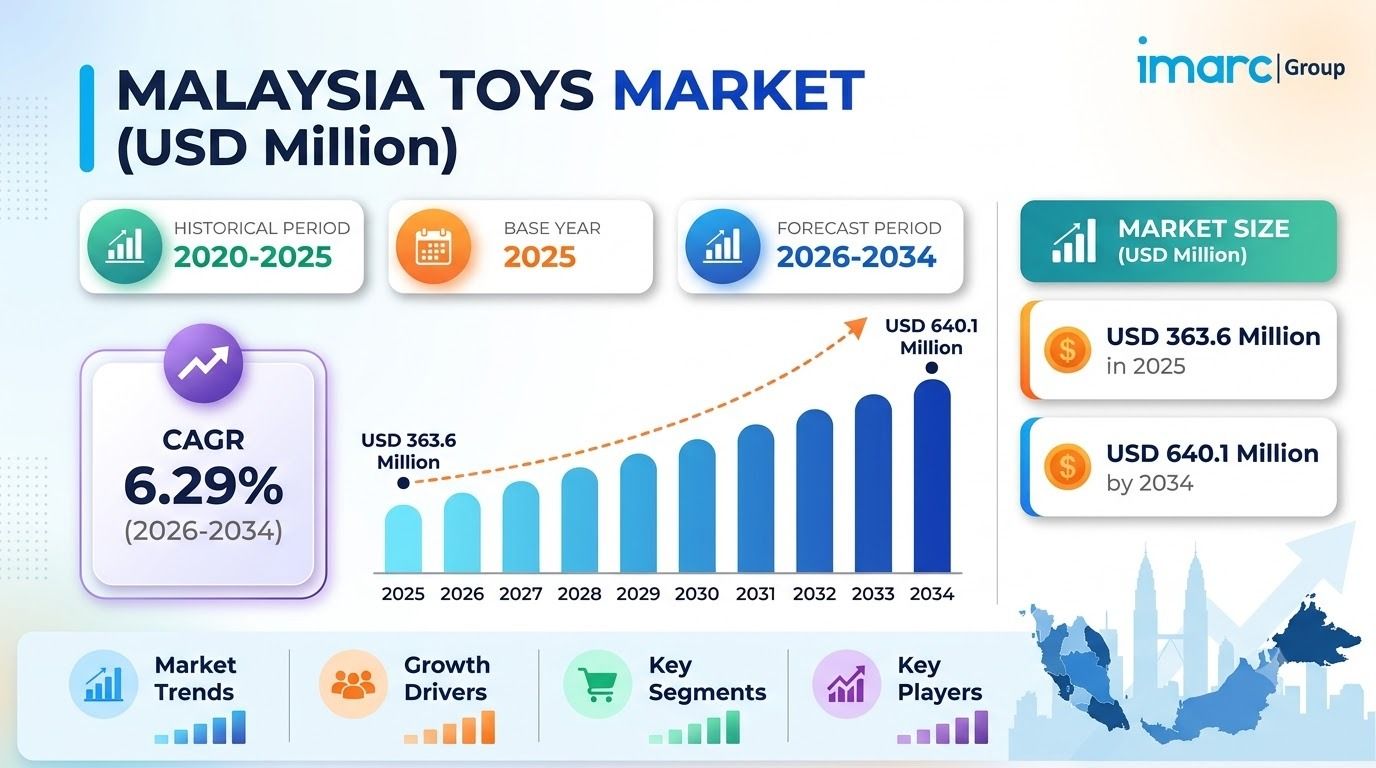
This IMARC Group study sizes the Malaysia toys market at USD 363.6 Million in 2025. The Malaysia toys market outlook provides a forecast of market size, share, and emerging trends for 2026–2034, covering segmentation by product type, age group, sales channel, and state across Selangor, W.P. Kuala Lumpur, Johor, Sarawak, and others.
What Is the Current Size of the Malaysia Toys Market?
The Malaysia toys market reached USD 363.6 Million in 2025 and is projected to reach USD 640.1 Million by 2034, registering a 6.29% CAGR over 2026–2034. Four forces underpin this trajectory: rising disposable income among young families, the collector culture expanding adult toy spending, e-commerce widening access beyond major cities, and government support for educational play.
What Are the Emerging Trends in the Malaysia Toys Market?
Collector Culture Turns Adults Into Core Buyers
Pop Mart’s rise in Malaysia has reshaped the traditional toy landscape, with its value share growing rapidly between 2021 and 2025 as Labubu-themed stores and exclusive drops drew adult collectors, according to Euromonitor International . This matters because adult collectors spend more per purchase and return frequently for new releases. Toy retailers that once focused solely on children now allocate shelf space and marketing budgets to blind boxes, limited editions, and anime-inspired figures. The shift widens the addressable market beyond parents buying for kids.
Experiential Retail Pulls Shoppers Back to Stores
Traditional toy stores maintain leadership in Malaysia’s retail channels even as e-commerce grows, because shoppers want to touch products and discover new releases in person, per Euromonitor International . Miniso’s first Miniso Land at Sunway Pyramid Mall exemplifies this trend, combining interactive displays with character-led merchandise. This matters because toy purchases are often impulse-driven and sensory. Physical retail creates discovery moments that a product grid online cannot replicate, supporting premium pricing for exclusive in-store items.
Anime and Local IP Drive Licensed Product Demand
Anime-inspired toys and local intellectual property such as BoBoiBoy and Ejen Ali are fueling demand for action figures and licensed merchandise, according to Euromonitor International . Pop Mart and Mattel captured share by reinforcing engagement through character collaborations and exclusive launches . This matters because licensed products carry built-in audiences and reduce marketing costs. Local IP also resonates with Malaysian parents seeking culturally relevant toys for their children, creating a niche that global brands cannot easily fill.
Safety Standards Tighten for Toy Imports
Malaysia revised its toy safety standard MS ISO 8124-1 in 2024, aligning mechanical and physical safety requirements with international norms, according to the Department of Standards Malaysia . The Consumer Protection regulations require a Certificate of Conformance and conformity mark for toys sold in the country . This matters because compliance costs rise for importers and small retailers. Brands that already meet international standards gain a competitive advantage, while informal sellers of uncertified toys face tighter enforcement.
Download Sample Report with Datasheet: https://www.imarcgroup.com/malaysia-toys-market/requestsample
What Factors Are Driving the Growth of the Malaysia Toys Market?
Disposable Income Supports Discretionary Toy Spending
Malaysia’s economy grew 5% in real terms in 2025 while inflation stayed moderate at 1%, leaving households with more room for discretionary purchases including toys, according to Euromonitor International . Traditional toys and games delivered 7% value growth in 2025, outpacing both GDP growth and regional expansion . This matters because toy purchases are among the first categories families cut when budgets tighten. Sustained income growth gives retailers confidence to expand inventory and open new outlets.
E-Commerce Extends Reach Beyond Urban Centres
Online channels are growing as shoppers in smaller towns gain access to toys that were previously available only in major city stores, according to 6Wresearch . Shopee and Lazada remain key platforms, though physical stores are regaining share as shoppers return to in-person browsing . This matters because e-commerce lowers the cost of reaching customers outside the Klang Valley. Brands that combine online discovery with physical pickup or showroom visits capture both convenience and tactile appeal.
Educational and Interactive Toys Gain Parental Preference
Demand is rising for toys that blend play with learning, including STEM kits, interactive games, and products that develop cognitive skills, according to 6Wresearch . Parents increasingly view toys as developmental tools rather than pure entertainment. This matters because educational toys command higher price points and face less price-based competition than commodity plush or plastic figures. Retailers that curate educational ranges build loyalty with parents who return for age-appropriate upgrades.
Government Supports Safe and Quality Products
Malaysian authorities have stepped up enforcement of toy safety regulations and promoted educational toys through public spending on learning initiatives, according to 6Wresearch . The revised MS ISO 8124-1 standard, published in 2024, gives regulators a clearer basis for market surveillance . This matters because formal standards raise consumer confidence in toys bought from licensed retailers. It also creates a barrier against low-quality imports that undercut legitimate brands on price.
What Are the Opportunities in the Malaysia Toys Market?
Adult Collectibles for Anime and Pop Culture Fans
The collector segment remains underdeveloped outside a few brands, despite Pop Mart’s success proving demand exists . Anime-inspired figures and local IP merchandise have dedicated fan bases willing to pay premium prices for limited editions. Retailers that build community through events, pre-orders, and loyalty programs can capture repeat spending from this segment. The opportunity lies in curation and authenticity, not volume.
Tier-2 City Toy Retail Expansion
Most toy specialty stores cluster in Kuala Lumpur and Selangor, leaving cities like Johor Bahru, Kuching, and Kota Kinabalu with fewer options. E-commerce reaches these markets, but parents still want to see products before buying. Small-format stores or pop-up concepts in shopping malls outside the Klang Valley can serve this demand. Franchise or partnership models lower the risk of expansion into unfamiliar markets.
Educational Toy Bundles for Schools and Learning Centres
Malaysia’s focus on educational reform creates demand from schools, tuition centres, and enrichment programmes for toys that support learning outcomes. Suppliers that bundle products with curriculum-aligned activity guides can sell to institutions rather than individual parents. This B2B channel offers bulk orders and recurring revenue. The key is demonstrating measurable developmental benefits, not just entertainment value.
What Are the Challenges in the Malaysia Toys Market?
Import Dependence Exposes Retailers to Currency and Freight Shocks
Most toys sold in Malaysia are imported, leaving retailers exposed to ringgit fluctuations and shipping cost volatility. Mattel has adjusted production locations amid tariff pressures, illustrating how global supply decisions affect local availability, according to Euromonitor International . This matters because retailers cannot easily pass sudden cost increases to price-sensitive parents. Those with long-term supplier relationships or local sourcing options weather volatility better than those buying spot.
Safety Compliance Costs Burden Small Retailers
The revised MS ISO 8124-1 standard and Certificate of Conformance requirements add testing and documentation costs for every product line . Large brands absorb these costs across high volumes; small retailers and independent importers struggle. This matters because non-compliance risks penalties and reputational damage, but compliance eats into thin margins. Enforcement gaps also mean uncertified toys continue to circulate, disadvantaging compliant sellers on price.
Video Games Compete for Children’s Attention and Spending
Malaysia’s toys and games market is increasingly dominated by video games, which generated a large majority of total value in 2025, according to Euromonitor International . Mobile titles like Mobile Legends and Free Fire command children’s time and parents’ budgets. This matters because traditional toy makers are not just competing with each other; they compete with free-to-play digital entertainment. Physical toys must offer experiences that screens cannot replicate, such as building, collecting, and social play.
What Are the Key Market Segments in the Malaysia Toys Market?
The Malaysia toys market outlook segments the market by product type, age group, sales channel, and state.
Which Product Types Lead the Malaysia Toys Market?
- Action Figures
- Building Sets
- Dolls
- Games and Puzzles
- Sports and Outdoor Toys
- Plush
- Others
Dolls hold the largest share because collector appeal and character licensing drive repeat purchases among both children and adults, with Pop Mart and similar brands expanding the category beyond traditional play . Building sets follow as the next-biggest segment, supported by parents who value toys that develop spatial reasoning and problem-solving skills.
Which Age Groups Drive the Malaysia Toys Market?
- Up to 5 Years
- 5 to 10 Years
- Above 10 Years
The 5 to 10 years age group accounts for the largest share because children in this range actively request specific characters and brands while still engaging in physical play. The above 10 years segment grows fastest as collector culture and anime fandom draw teenagers and adults into toy purchases that were once considered children’s products.
Which Sales Channels Serve Malaysia Toy Buyers?
- Supermarkets and Hypermarkets
- Specialty Stores
- Department Stores
- Online Stores
- Others
Specialty stores lead because they offer curated selection and discovery experiences that general retailers cannot match, maintaining leadership even as e-commerce grows . Online stores grow fastest from a smaller base, supported by platform promotions and the convenience of home delivery for repeat purchases and collectible drops.
Which States Lead the Malaysia Toys Market?
- Selangor
- W.P. Kuala Lumpur
- Johor
- Sarawak
- Others
Selangor leads because it contains the Klang Valley’s densest concentration of young families, shopping malls, and retail infrastructure, making it the primary market for toy brands entering Malaysia. W.P. Kuala Lumpur is a significant secondary market, anchored by high foot traffic, tourist spending, and flagship store locations that showcase new products.
Who Are the Key Players in the Malaysia Toys Market?
Competitive Landscape & Key Player Positioning:
Covering an in-depth analysis of the competitive landscape, market structure, key player positioning, competitive dashboards, top winning strategies, and detailed profiles of all major industry participants you will gain access to all these exclusive insights within the full research report.
What Are the Latest Recent Developments in the Malaysia Toys Market?
In October 2026, Malaysia’s Domestic Trade and Cost of Living Ministry seized 5,801 squishy toys worth RM70,428 nationwide during inspections of 1,845 premises, according to Bernama. The toys lacked the mandatory Safety Compliance Mark. The enforcement action signals tighter scrutiny of uncertified toys and reinforces the compliance pressure already shaping retailer and importer behaviour.
Customization Note: If you require any specific information not covered within this report's scope, we will provide it as part of the customization.
Request Report Customization: https://www.imarcgroup.com/request?type=report&id=37381&flag=E
Media Contact:
Company Name: IMARC Group
Email: [email protected]
Contact: +1-201971-6302
Address: 134 N 4th St., Brooklyn, NY 11249, USA