
Market Outlook
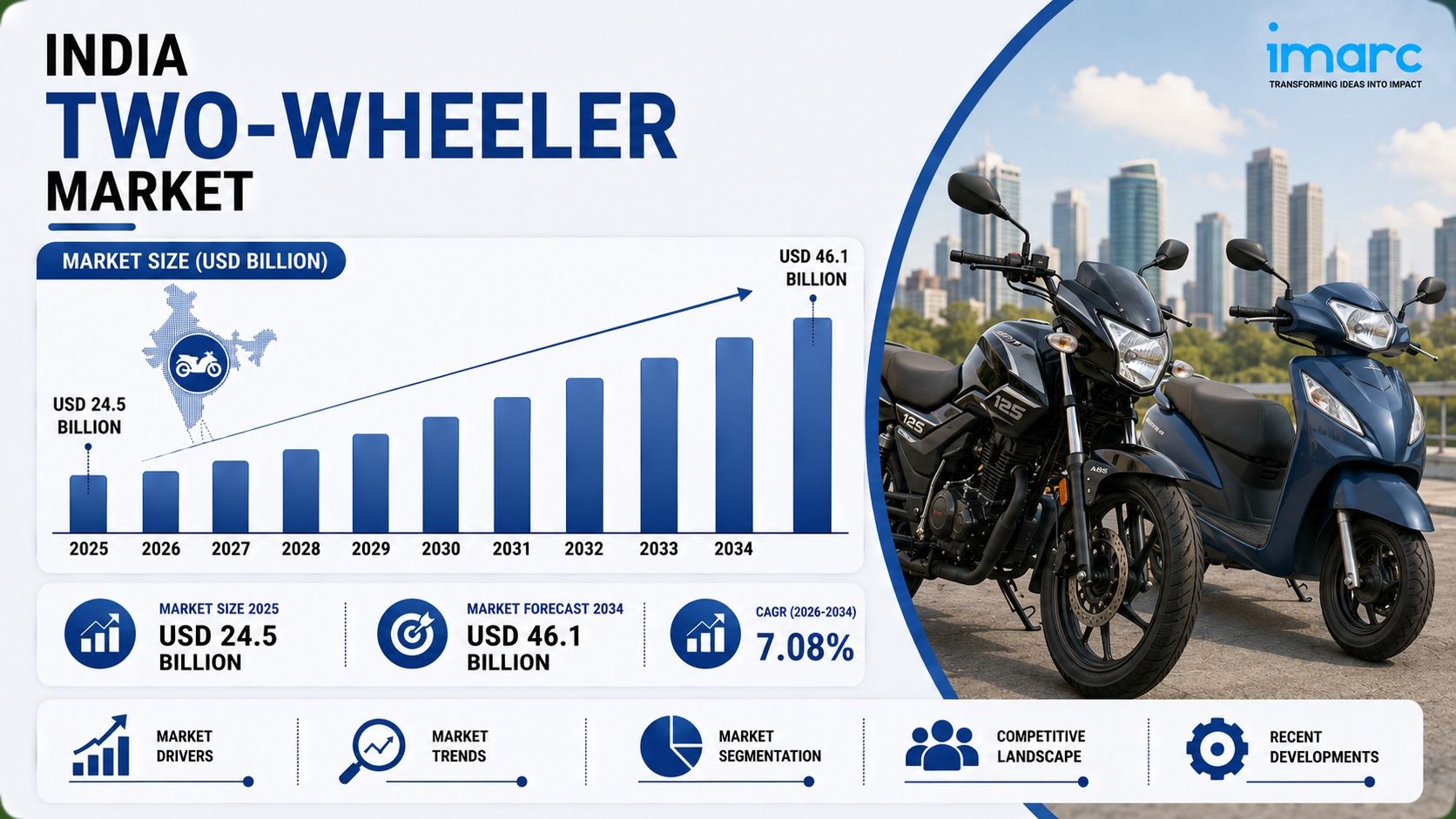
The India two-wheeler industry size reached USD 24.5 Billion in 2025 and is projected to reach USD 46.1 Billion by 2034, exhibiting a robust compound annual growth rate (CAGR) of 7.08% during the forecast period from 2026-2034. The market operates as the undisputed backbone of personal mobility in the country, structurally transitioning from a basic commuting necessity into an aspirational, technology-driven ecosystem. As rural incomes consistently rise and urban traffic congestion intensifies, two-wheelers provide unparalleled convenience and cost-effectiveness compared to four-wheelers and public transit.
Furthermore, the sector is experiencing a massive technological and demographic shift fueled by rapid premiumization and aggressive electrification. The domestic consumer base is increasingly pivoting away from entry-level commuter motorcycles toward higher-displacement, performance-oriented bikes and feature-rich automatic scooters. Supported by expansive digital financing options, localized mass manufacturing, and strong government subsidies accelerating the adoption of Electric Vehicles (EVs), the two-wheeler sector is actively cementing its position as one of the most dynamic and high-volume automotive segments globally.
Market Snapshot:
- Market Size (Current Year): USD 24.5 Billion (2025)
- Forecast Market Size (Forecast Year): USD 46.1 Billion (2034)
- CAGR: 7.08% (2026-2034)
- Leading Segment by Type: Motorcycle (56.0% share)
- Leading Segment by Technology: ICE (90.0% share)
- Leading Region: West and Central India (34.0% share)
What are the Growth Factors of India Two-wheeler Market?
- Aspirational Shift Toward the "Executive" and "Premium" Segments: The traditional dominance of the hyper-budget 100cc commuter motorcycle is steadily diluting as upwardly mobile urban and semi-urban consumers heavily upgrade to the 125cc-160cc executive class and 200cc+ premium lifestyle segments. This shift is driven by a younger demographic prioritizing aesthetics, engine performance, riding comfort, and brand prestige over absolute fuel economy, significantly expanding the average ticket size per vehicle sale.
- Rapid Expansion of Last-Mile Delivery and Gig Economy: The explosive national scaling of quick-commerce, food delivery, and e-commerce logistics relies entirely on a massive, decentralized fleet of two-wheelers. Gig economy workers fundamentally require highly durable, fuel-efficient, and easy-to-maintain motorcycles and scooters for commercial use. This structural B2B-like dependency guarantees a massive, recurring volume of utilitarian vehicle purchases and accelerated replacement cycles across all metropolitan and Tier-2 corridors.
- Deepening Rural Road Connectivity and Agricultural Incomes: For the vast majority of rural households, a two-wheeler acts as the first—and often only—motorized vehicle. Continuous government investments in rural road infrastructure, combined with rising minimum support prices (MSPs) and better agricultural yields, have significantly elevated rural purchasing power. Crossing the baseline annual household income threshold directly triggers the purchase of a commuter motorcycle, sustaining immense baseline market volumes.
- Hyper-Financing and Fintech Accessibility: The barrier to acquiring a new two-wheeler has been drastically lowered by aggressive fintech lending platforms and captive non-banking financial companies (NBFCs). Through instant e-KYC, localized credit scoring, and highly flexible EMI structures with minimal down payments, financiers are successfully capturing the massive unbanked and first-time-buyer demographics, rapidly accelerating immediate retail conversions right at the dealership floor.
➤ Request Sample Report (TOC & Charts): https://www.imarcgroup.com/india-two-wheeler-market/requestsample
What Are the Key Trends Shaping the Market?
- Aggressive Integration of Smartphone Connectivity and Telematics: Modern two-wheelers are rapidly evolving into intelligent mobility platforms. Manufacturers are aggressively standardizing fully digital instrument clusters featuring turn-by-turn GPS navigation, incoming call alerts, ride analytics, and geo-fencing capabilities through dedicated smartphone applications. This seamless digital integration is highly demanded by tech-savvy millennial and Gen-Z riders.
- Rise of Neo-Retro and Lifestyle Cruisers: There is a massive cultural trend heavily favoring neo-retro aesthetics and classic cruiser motorcycles. Brands are successfully blending vintage design languages with highly reliable, modern engineering and liquid-cooled engines. This segment thrives on building a deep sense of community, weekend touring culture, and extensive aftermarket customization, actively drawing buyers away from standard commuter designs.
- Mainstreaming of Battery-as-a-Service (BaaS) for Electric Scooters: To completely eliminate the high upfront acquisition cost of electric two-wheelers, manufacturers and charging operators are aggressively piloting Battery-as-a-Service (BaaS) and battery-swapping architectures. By decoupling the expensive lithium-ion battery from the vehicle’s sticker price and treating it as a pay-per-use operational expense, EV parity with traditional internal combustion engine (ICE) scooters is achieved instantly.
- Standardization of Advanced Active Safety Features: Reacting to stringent road safety mandates and increasing consumer awareness, essential safety technologies once reserved for premium sports bikes are trickling down to mass-market models. Features such as dual-channel Anti-Lock Braking Systems (ABS), slipper clutches for smoother downshifts, side-stand engine cut-offs, and traction control systems are rapidly becoming standard factory fitments across the 150cc+ categories.
What Are the Major Market Challenges?
- Extreme Volatility in Raw Material and Commodity Pricing: Two-wheeler manufacturing is heavily exposed to the highly volatile global pricing of critical commodities such as steel, aluminum, and precious metals for catalytic converters. Furthermore, the massive reliance on imported lithium-ion cells for the booming EV segment continuously subjects OEMs to global supply chain shocks. These input cost spikes heavily compress profit margins, forcing frequent, demand-dampening price hikes on the end consumer.
- Inadequate Urban Charging Infrastructure for EVs: While electric two-wheeler sales are surging, over 40-50% of the Indian urban population resides in high-density apartment complexes lacking dedicated, private parking spaces. The severe deficit of accessible, building-level charging sockets and reliable public fast-charging infrastructure acts as a major psychological and practical barrier, heavily deterring a massive segment of willing urban buyers from transitioning to EVs.
- Stagnation at the Extreme Entry-Level Commuter Segment: The core 100cc-110cc commuter segment, historically the bedrock of total industry volume, is experiencing prolonged stagnation. Rapidly escalating vehicle prices—driven by mandatory safety regulations (ABS/CBS), stringent BS-VI emission norms, and high fuel costs—have severely strained the purchasing capacity of price-sensitive, low-income demographics, causing them to delay purchases or pivot heavily toward the used-vehicle market.
➤ Explore the Full Report with Charts, Table of Contents, and List of Figures: https://www.imarcgroup.com/india-two-wheeler-market
How Is the Market Segmented?
By Type:
The market is segmented into Motorcycles, Scooters, Mopeds, and Electric Two-Wheelers. Motorcycles absolutely dominate the market with a 56.0% share in 2025, serving as the primary mode of transport across both urban centers and vast rural landscapes due to their superior fuel economy and robust suspension for uneven terrains.
By Technology:
Segmented into Internal Combustion Engine (ICE) and Electric. ICE retains a massive 90.0% share in 2025, deeply entrenched by decades of consumer trust, immense refueling infrastructure, and universal mechanic availability. However, the Electric segment is expanding at an explosive CAGR of approximately 22.5%, driven by massive subsidies and changing consumer preferences.
By Engine Capacity:
The 100-125cc category commands the largest market share at 42.0% in 2025. This specific engine class represents the perfect operational sweet spot, providing an optimal balance between high fuel efficiency for daily commutes and sufficient power for carrying pillion riders and cargo.
By Distribution Channel:
Offline channels heavily dominate with an 89.0% share in 2025. Despite the rapid growth of digital platforms, the physical dealership remains utterly irreplaceable for consumers seeking physical test rides, instant loan processing, tactile vehicle inspection, and the fundamental assurance of localized after-sales service.
By Region:
The market is distributed across North India, West and Central India, East India, and South India. West and Central India lead the market with a 34.0% share in 2025, firmly anchored by the immense industrial and agricultural wealth in Maharashtra and Gujarat, coupled with high baseline personal mobility demands across semi-urban clusters.
Competitive Landscape:
The India two-wheeler market exhibits an incredibly fierce and highly consolidated competitive environment, dominated by deeply established domestic titans and global automotive giants. Market leaders are continuously executing aggressive strategies centered around scaling massive rural distribution networks, heavily investing in dedicated EV sub-brands, and rapidly refreshing their product portfolios to capture the lucrative premium motorcycle segment.
Hero MotoCorp Limited:
Operates as the absolute, undisputed volume leader in the market, heavily leveraging the iconic "Splendor" platform. The company commands unparalleled rural distribution networks and is actively transitioning into the premium space through strategic global partnerships (e.g., Harley-Davidson) and its dedicated 'Vida' electric mobility brand.
Honda Motor Co., Ltd. (HMSI):
Maintains a massive market stronghold, predominantly driven by the "Activa," which stands as India's highest-selling two-wheeler model. The brand is deeply trusted for its industry-leading engine refinement, extreme reliability, and highly successful premium CB-series motorcycle portfolio.
TVS Holdings Limited:
Fiercely penetrates the market by aggressively blending its deep racing heritage with cutting-edge technology. The company commands massive loyalty in the premium commuter segment through its 'Apache' series and has rapidly captured immense market share in the EV space with its highly successful 'iQube' platform.
Bajaj Auto Ltd.:
Acts as a major powerhouse globally and domestically, dominating the executive and sports commuter categories through its massive 'Pulsar' brand. The company leverages extreme engineering efficiency, robust export volumes, and a rapidly expanding footprint in the electric segment with its revitalized 'Chetak' line.
Recent News or Developments
Massive Surge in Electric Two-Wheeler Sales:
In May 2026, India's electric two-wheeler market exhibited incredibly strong momentum, registering total retail sales of 1,70,733 units—a robust 62.76% year-on-year growth compared to May 2025. TVS Motor retained its absolute leadership position, selling 42,459 electric scooters, closely followed by Bajaj Auto with 39,202 units. Notably, Ather Energy completely doubled its sales volume to 28,240 units, capturing a massive 16.54% market share.
Honda Launches Retail Swappable Battery Network:
In February 2025, Honda Power Pack Energy India (HEID) officially launched its e:Swap network to explicitly support the new Activa e: scooter in Bengaluru, followed rapidly by rollouts in Delhi and Mumbai. The company is aggressively targeting the operationalization of approximately 500 dedicated swapping stations across these major metropolitan hubs by the end of 2026 to eliminate charging downtime for retail consumers.
Hero MotoCorp Regains Strong Sales Momentum:
By late 2025, Hero MotoCorp firmly reasserted its dominance in the domestic market, recording highly robust sales figures. In November 2025 alone, the company dispatched over 6,04,490 units, reflecting a massive 31% year-on-year increase. This immense volume was heavily driven by sustained post-festive demand in rural corridors and the highly successful market reception of its updated XTEC commuter platforms.
Customization Note: If you require any specific information not covered within this report's scope, we will provide it as part of the customization.
➤ Request Report Customization:https://www.imarcgroup.com/request?type=report&id=3991&flag=E
Conclusion
The India two-wheeler market is structurally engineered for incredibly robust and sustained expansion through 2034, fundamentally propelled by a rapidly expanding middle class, the aggressive modernization of the gig-economy logistics network, and heavily rising rural purchasing power. As domestic consumers increasingly prioritize advanced digital connectivity, superior riding ergonomics, and lifestyle branding, the historical reliance on basic entry-level commuters is completely transitioning toward highly lucrative executive and premium motorcycles.
Furthermore, the stringent focus by major OEMs on massively scaling their dedicated EV sub-brands perfectly addresses the critical national mandate for sustainable urban mobility. Supported by flexible Battery-as-a-Service financial architectures, deep penetrative retail financing, and the rapid rollout of public charging infrastructure, the two-wheeler sector unequivocally stands as the most vital, dynamic, and highest-volume pillar of India's contemporary automotive economy.