
India Trade Finance Market Outlook
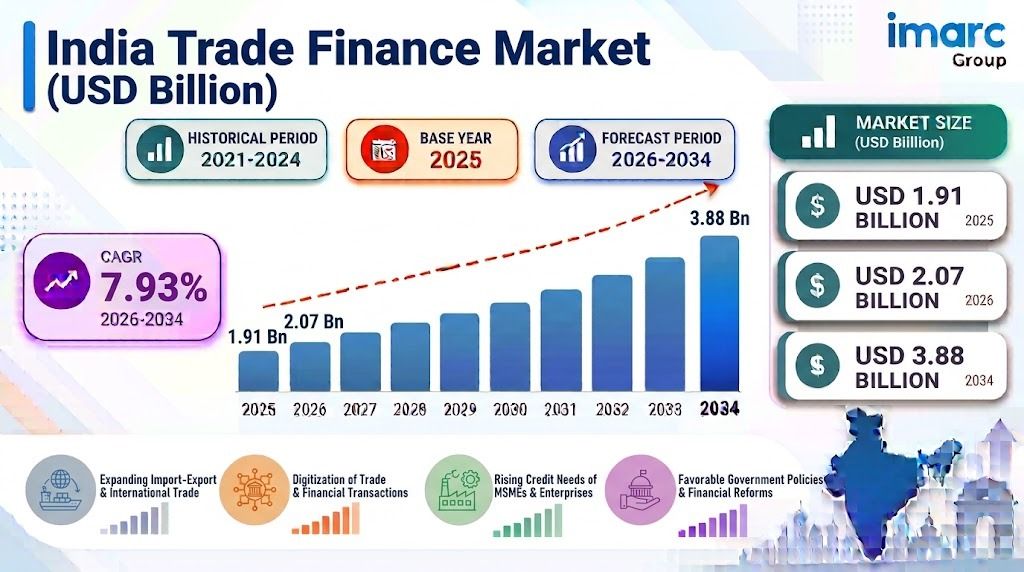
This research report by IMARC Group on the India Trade Finance Market provides a forecast of market size, share, and emerging trends for 2026–2034. The report covers segmentation by finance type, offering, service provider, end user, and region, with regional coverage across West and Central India, North India, South India, and East and Northeast India.
Market Snapshot
- Market Name: India Trade Finance Market
- Region: India
- Base Year and Market Size: 2025, USD 1.91 Billion
- Forecast Year and Market Value: 2034, USD 3.88 Billion
- CAGR: 7.93% (2026–2034)
- Forecast Period: 2026–2034
- Segmentation Covered: Finance Type, Offering, Service Provider, End User, Region
Current Market Size of the India Trade Finance Industry
In 2025, the India trade finance market size reached USD 1.91 Billion and is projected to touch USD 3.88 Billion by 2034, registering a CAGR of 7.93% from 2026 to 2034. Export growth, TReDS policy mandates, MSME working capital demand, and supply chain finance adoption underpin this growth.
Emerging Trends in the India Trade Finance Market
TReDS Becomes the Default MSME Settlement Rails
The government has made it mandatory for all Central Public Sector Enterprises to route MSME invoice settlements through TReDS platforms, with the Ministry of MSME notifying revised guidelines on 30 June 2026. Invoice discounting through TReDS grew from about ₹40,000 crore in FY2022 to ₹3.47 trillion in FY2026, according to the ministry. This policy shift moves MSME receivables financing from bilateral negotiation to a competitive bidding platform, compressing payment cycles.
Credit Guarantee Cover Arrives on TReDS Platforms
The Credit Guarantee Fund Trust for Micro and Small Enterprises integrated its guarantee portal with M1xchange, RXIL, and DTX in September 2026, offering 75% guarantee cover on defaulted invoices with maximum exposure of ₹2 crore for MSE sellers. This reduces credit risk for financiers bidding on MSME invoices, addressing the primary reason banks previously avoided small-ticket receivables. Financiers can now check eligibility and generate guarantee cover in real time on the platform.
RBI Issues Consolidated TReDS Directions
The Reserve Bank of India issued the Trade Receivables Discounting System Directions, 2026 in June, replacing guidelines issued between 2014 and 2023. The framework simplifies MSME onboarding, permits credit guarantee cover for exposures, and expands permitted participants to include insurance companies and government-notified guarantee funds. A unified regulatory structure reduces compliance ambiguity for platforms and financiers, supporting volume growth.
Geopolitical Relief Measures Extend Export Credit Tenor
The RBI issued Trade Relief Measures Directions in March 2026, permitting banks to extend pre-shipment and post-shipment export credit periods up to 450 days for disbursements made until 30 June 2026. The directions were issued to mitigate debt servicing burdens arising from geopolitical tensions caused by the West Asian crisis. Extended tenor gives exporters breathing room when shipping delays or payment disruptions occur, reducing default risk for trade financiers.
Request Sample Report with Datasheet: https://www.imarcgroup.com/india-trade-finance-market/requestsample
Growth Drivers of the India Trade Finance Market
Export Growth Creates Underlying Financing Demand
India’s merchandise exports grew 21.96% year-on-year to USD 309.06 Billion during April–October 2026-27, according to the Ministry of Commerce and Industry. Electronic goods exports rose 62.70% in October 2026, and engineering goods rose 36.01%. Every export shipment requires working capital financing between order placement and payment realisation, directly expanding the addressable market for trade finance products including letters of credit and packing credit.
CPSE Mandate Redirects MSME Invoice Volumes to TReDS
The June 2026 notification requiring all operating CPSEs to settle MSME procurement invoices through TReDS creates a captive volume pipeline for financiers. CPSEs must disclose invoice details and obtain statutory auditor certification confirming TReDS registration and compliance. This mandate converts a previously voluntary channel into a mandatory settlement route, guaranteeing a baseline of financeable invoices that did not exist at this scale before.
Export Promotion Mission Allocates ₹25,060 Crore
The Export Promotion Mission, approved in November 2025 with an outlay of ₹25,060 crore for FY2025-26 to FY2030-31, combines financial and non-financial support across trade finance, compliance, market access, and logistics. It targets MSMEs, first-time exporters, and labour-intensive sectors. Mission components including the RELIEF scheme, with ₹497 crore for freight and insurance cover during maritime disruptions, reduce risk factors that otherwise discourage lenders from extending trade credit to smaller exporters.
RBI Directions Lower Operational Friction for Financiers
The TReDS Directions, 2026 simplify onboarding, permit credit guarantee mechanisms, and allow re-discounting of factoring units among financiers. These operational changes reduce the per-transaction cost of financing small invoices, making it economically viable for banks and NBFCs to serve smaller ticket sizes. Lower friction translates into more competitive bidding on TReDS, which improves pricing for MSME sellers and expands the pool of financeable receivables.
Key Market Segments in the India Trade Finance Market
The India trade finance market is segmented by finance type, offering, service provider, end user, and region.
Finance Type Segmentation
- Traditional Trade Finance
- Supply Chain Finance
- Structured Trade Finance
Traditional trade finance leads with a 48.6% share in 2025, driven by continued preference for letters of credit and bank guarantees that provide international legal enforceability. Supply chain finance at 31.7% is the fastest-growing type at approximately 9.2% CAGR, supported by TReDS adoption and MSME financing demand, while structured trade finance at 19.7% serves commodity and large project-linked flows.
Offering Segmentation
- Export and Import Bills
- Letter of Credit
- Performance Bonds
- Shipping Guarantees
- Others
Letters of credit remain the anchor offering for cross-border transactions requiring payment assurance, while export and import bill financing addresses working capital gaps between shipment and payment realisation. Performance bonds and shipping guarantees serve specific contractual and logistical requirements in project exports and commodity trade, where financiers assess underlying transaction risk rather than standalone borrower creditworthiness.
Service Provider Segmentation
- Banks
- Trade Finance Houses
Banks dominate with a 78.6% share in 2025, leveraging branch networks, correspondent banking relationships, and established letter-of-credit infrastructure. Public sector banks maintain strong positions through pan-India networks and EXIM financing relationships. Trade finance houses at 21.4% grow faster through specialised products, digital-first models, and niche SME financing focused on supply chain finance and export factoring.
End User Segmentation
- Large Enterprises
- Small and Medium-sized Enterprises
Large enterprises remain the primary end user for traditional trade finance products, reflecting their larger shipment values and established banking relationships. SME demand is growing faster as TReDS mandates and CGTMSE guarantee cover reduce the friction that previously excluded smaller suppliers from formal receivables financing, particularly in export clusters across Maharashtra, Gujarat, and Tamil Nadu.
Regional Segmentation
- West and Central India
- North India
- South India
- East and Northeast India
West and Central India leads with a 35.7% share in 2025, supported by Mumbai’s concentration of bank headquarters, JNPT port activity, and Maharashtra–Gujarat export corridors across chemicals, pharmaceuticals, and textiles. North India at 27.4% follows as a significant secondary region, supported by Delhi-NCR’s manufacturing exports and Punjab’s agricultural commodity trade.
Who Are the Key Players in the India Trade Finance Market?
State Bank of India, HDFC Bank Ltd., ICICI Bank, Axis Bank, Standard Chartered, HSBC Group, and Kotak Mahindra Bank Limited compete on correspondent banking depth, digital platform capability, pricing architecture, and MSME segment reach. Public sector banks leverage pan-India networks and EXIM relationships, while private banks and foreign banks differentiate through faster turnaround and specialised supply chain finance products. Trade finance houses challenge incumbents in niche SME segments.
Latest Recent Developments in the India Trade Finance Market
CGTMSE Guarantee Cover Goes Live on TReDS Platforms
The Ministry of MSME rolled out CGTMSE credit guarantee cover on invoice discounting through M1xchange, RXIL, and DTX on 25 September 2026. The guarantee covers 75% of default amounts, with maximum exposure of ₹10 crore for MSE buyers and ₹2 crore for MSE sellers on a revolving basis. Financiers can check eligibility and apply for cover in real time.
Government Mandates TReDS for CPSE MSME Settlements
The Ministry of MSME notified revised guidelines on 30 June 2026 requiring all operating CPSEs to route MSME procurement invoice settlements through RBI-regulated TReDS platforms. CPSEs must obtain statutory auditor certification confirming registration and compliance. Invoice discounting through TReDS reached ₹3.47 trillion in FY2026, up from ₹40,000 crore in FY2022.
RBI Issues Consolidated TReDS Directions
The Reserve Bank of India issued the Trade Receivables Discounting System Directions, 2026 in June, replacing prior guidelines. The framework streamlines capital requirements, simplifies MSME onboarding, expands permitted participants to include insurance companies, and permits credit guarantee cover for TReDS exposures. Existing authorised entities have until 31 March 2028 to meet revised net-worth requirements.
Customization Note
If you require any specific information not covered within this report's scope, we will provide it as part of the customization.
Request Report Customization: https://www.imarcgroup.com/request?type=report&id=21598&flag=E
Frequently Asked Questions (FAQs)
Q1. How large is the India trade finance market and what is its forecast value?
The India trade finance market reached USD 1.91 Billion in 2025 and is projected to reach USD 3.88 Billion by 2034, growing at a CAGR of 7.93% from 2026 to 2034.
Q2. Why is demand rising for trade finance in India?
Demand is rising due to merchandise export growth of 21.96% during April–October 2026-27, the government mandate requiring CPSEs to settle MSME invoices through TReDS, and CGTMSE guarantee cover that reduces lender risk on small-ticket receivables.
Q3. Which finance type leads the India trade finance market?
Traditional trade finance leads with a 48.6% share in 2025, driven by letters of credit and bank guarantees. Supply chain finance at 31.7% is the fastest-growing type at approximately 9.2% CAGR, supported by TReDS adoption and MSME financing demand.
Q4. Which region leads the India trade finance market and why?
West and Central India leads with a 35.7% share in 2025, supported by Mumbai’s concentration of bank headquarters, JNPT port activity, and Maharashtra–Gujarat export corridors across chemicals, pharmaceuticals, and textiles.
Q5. How is the India trade finance market changing?
TReDS has become the mandatory settlement route for CPSE-MSME transactions, CGTMSE guarantee cover is now live on three platforms, and the RBI has consolidated TReDS regulations into a single framework. Invoice discounting through TReDS reached ₹3.47 trillion in FY2026.