
India Steel Pipes Market: Outlook
The report titled "India Steel Pipes Market Size, Share, Trends and Forecast by Material Type, Application, and Region, 2026–2034" comprises the overall market analysis of India, size, growth trends, key drivers, and regional insights of the steel pipes market in India and other important aspects related to the report.
How Big is the India Steel Pipes Market?
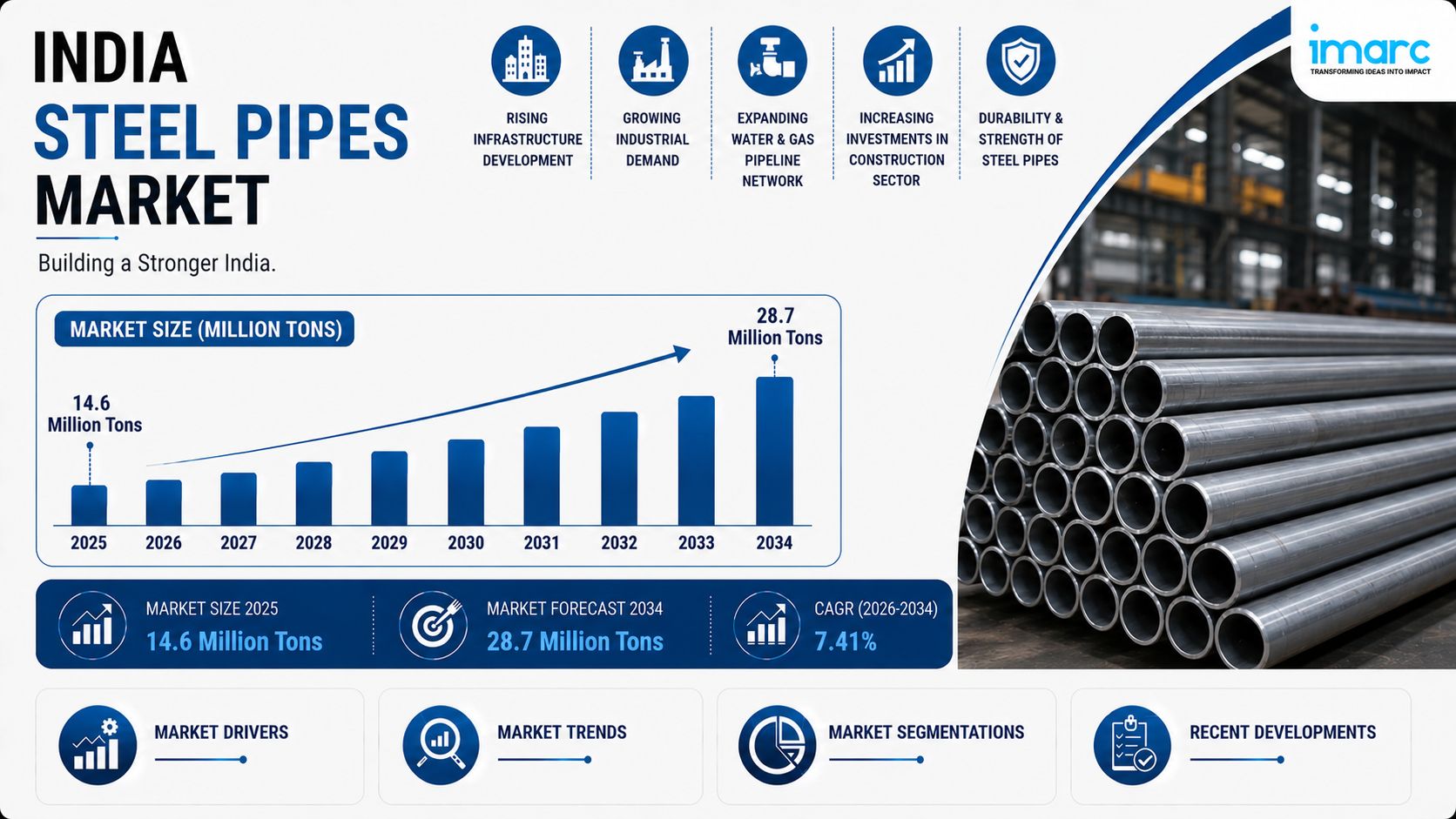
The India steel pipes market size reached 14.6 Million Tons in 2025. Looking forward, IMARC Group expects the market to reach 28.7 Million Tons by 2034, exhibiting a growth rate (CAGR) of 7.41% during 2026–2034. The market is growing steadily, driven by infrastructure development, expanding oil & gas projects, rising exports, expanding government initiatives, increasing demand for seamless and welded pipes, and ongoing advancements in manufacturing and sustainability.
What are the Key Developments and Emerging Trends in India Steel Pipes Market?
- Rising Demand for Seamless Steel Pipes: The India steel pipes market is experiencing a massive surge in demand for seamless steel pipes, primarily driven by their widespread use in oil and gas and critical infrastructure applications. There is a growing preference for these pipes because they provide outstanding strength, extreme durability, and superior high-pressure resistance.
- Expansion of Sustainable and High-Performance Pipes: The Indian steel pipe industry is actively placing environmental sustainability at the forefront of its market strategy. To meet stringent government regulations, major manufacturers are heavily prioritizing eco-friendly production methods, investing in renewable energy, and adopting low-carbon steel processes alongside maintaining absolute product performance and structural excellence.
- Innovations for Green Energy Transport: Leading market players are successfully pioneering the development of highly specialized Electric Resistance Welded (ERW) pipes designed explicitly for transporting 100% pure gaseous hydrogen under high pressure. This strategic innovation perfectly aligns with national green energy targets, establishing a foundation for India's sustainable and clean energy infrastructure.
- Massive Production Capacity Enhancements: The steel manufacturing industry in India is continuously increasing its production capacity to fulfill the rising domestic demand across core sectors. Companies are aggressively injecting millions of dollars into state-of-the-art technologies and drastically expanding their ERW and seamless pipe facilities to enhance their overall market presence.
- Urban Infrastructure Modernization: The exceptionally quick pace of urban and industrial development across the country creates a remarkably strong market demand for superior, heavy-duty pipes. These advanced steel conduits are utilized extensively in modern construction works, sophisticated municipal water delivery systems, and expanding commercial real estate projects nationwide.
➤ Request Sample Report (TOC & Charts): https://www.imarcgroup.com/india-steel-pipes-market/requestsample
How will the India Steel Pipes Market Evolve in the Coming Years?
The India steel pipes market is poised for robust and sustained expansion through the forecast period, driven by massive infrastructure modernization, a structural transition toward sustainable manufacturing, and aggressive capacity expansions by domestic players. The convergence of green hydrogen transportation initiatives, rising oil extraction activities, and government-backed water grid expansions will significantly enhance the value proposition across all industrial tiers.
The market reached a volume of 14.6 Million Tons in 2025 and is projected to reach 28.7 Million Tons by 2034, growing at a compound annual growth rate (CAGR) of 7.41% from 2026–2034. Seamless steel pipes will definitively maintain immense demand due to their critical role in highly volatile, high-pressure industrial environments, while the industry's shift toward low-carbon, environmentally responsible infrastructure will continuously outpace traditional manufacturing protocols.
What Factors are Driving Growth in the India Steel Pipes Market?
- Rapid Infrastructure Development and Urbanization: The nationwide push for modernizing infrastructure acts as a primary market driver. Mega construction projects, smart city developments, and the rapid expansion of commercial real estate generate an unavoidable, high-volume demand for reliable steel piping networks, propelling consistent volumetric growth across the domestic steel manufacturing sector.
- Increased Investment in Oil and Gas Projects: As domestic energy giants aggressively boost extraction capacities and establish new transportation networks, the captive requirement for robust seamless steel pipes continues to skyrocket. Evaluating the oil and gas pipeline construction steel demand today, these expansion plans strictly mandate highly durable conduits for safe transport in extreme high-pressure environments.
- Government Initiatives for Water Transportation: Heavy government backing for massive national infrastructure projects, such as the Pradhan Mantri Urja Ganga project and extensive rural water irrigation schemes, guarantees a lucrative, multi-year order pipeline. This continuous federal funding sustains high demand floors for specialized steel pipes used in civic water delivery systems.
- Supportive Industrial and Energy Policies: Aggressive governmental regulatory measures aimed at boosting industrial development and incentivizing low-carbon steel production significantly propel market growth. By requesting substantial budget allocations for emission reduction and raw material efficiency, the government is modernizing the steel pipes market to meet globally recognized environmentally responsible manufacturing standards.
- Rising Demand Across Manufacturing Sectors: Continuous, aggressive growth in the automotive, heavy engineering, and general manufacturing sectors strongly supports the domestic steel market. The expansion of these massive heavy-duty industries constantly drives the need for precisely engineered structural steel tubes, galvanized pipes, and customized piping solutions capable of withstanding extreme mechanical stress.
Industry Value Chain Analysis
- Raw Material Procurement: This foundational stage involves the extensive sourcing of high-grade iron ore, scrap steel, and metallurgical coal. Robust supply networks are established to guarantee continuous access to raw materials for large-scale steel melting and casting operations.
- Pipe Manufacturing and Processing: During this highly technical, capital-intensive phase, steel billets and coils are transformed into seamless or ERW pipes. Manufacturers utilize state-of-the-art metallurgical technologies to ensure strict compliance with international pressure, thickness, and safety standards.
- Distribution and EPC Integration: The final stage relies on complex logistical networks bridging massive manufacturing plants with regional distributors and Engineering, Procurement, and Construction (EPC) firms. These specialized pipes are subsequently integrated directly into national pipelines, urban water grids, and industrial factory infrastructure.
Investment & Growth Opportunities
- Hydrogen-Ready Pipeline Infrastructure: Institutional investors should focus heavily on the transition toward green energy. Funding the research, development, and mass production of specialized ERW pipes certified for transporting 100% pure gaseous hydrogen presents a massive, highly lucrative growth frontier.
- Capacity Expansions for Seamless Pipes: There is a highly lucrative opportunity in backing established steel manufacturers aggressively expanding their seamless pipe production lines. The surging requirements of the domestic oil and gas exploration sector guarantee highly sticky, recurring revenue streams.
- Eco-Friendly and Low-Carbon Steel Initiatives: Capitalizing on the government's push for sustainable industrial development offers significant returns. Deploying capital into steel plants that prioritize emission reductions and renewable energy financing ensures long-term regulatory compliance and premium brand positioning.
➤ Explore the Full Report with Charts, Table of Contents, and List of Figures: https://www.imarcgroup.com/india-steel-pipes-market
Deep-Dive Segment Insights:
By Material Type: The India steel pipes market by material type is segmented into Seamless and Welded (ERW/SAW) formats. The demand for seamless steel pipes remains exceptionally high. The segment's leadership is driven by the following factors:
- High-Pressure Resistance: Seamless pipes are completely devoid of welded joints, making them inherently stronger and absolutely crucial for transporting highly pressurized fluids and gases.
- Oil & Gas Dominance: The aggressive expansion of domestic oil extraction operations heavily mandates the deployment of these exceptionally durable pipes.
- Infrastructure Reliability: These pipes offer outstanding structural integrity and longevity, which are strictly required for critical, large-scale construction frameworks.
By Application: The India steel pipes market by application is broadly categorized into Oil & Gas, Construction, Water Supply, and Others. The oil & gas and construction sectors command a highly dominant share. The segment's leadership is driven by the following factors:
- Extraction Capacity Boosts: Massive investments by energy corporations to radically increase daily oil production directly multiply the requirement for vast transportation pipelines.
- Urban Expansion: The unprecedented pace of industrial and residential development mandates millions of tons of steel pipes for essential foundational structures and civic utilities.
- National Pipeline Grids: Aggressive federal initiatives aimed at expanding energy distribution networks ensure a massive, continuous captive market for specialized steel conduits.
By Region: The India steel pipes market is segmented into North India, South India, East India, and West India. The regional dynamics are driven by the following factors:
- Manufacturing Proximity: Eastern India continues to serve as a massive metallurgical hub, providing unparalleled proximity to raw materials and legacy steel manufacturing plants.
- Infrastructure Hotspots: Western and Northern India boast highly aggressive urbanization rates and massive real estate developments, acting as continuous, high-volume demand centers for construction-grade pipes.
- Port and Export Infrastructure: Advanced port facilities across the coastal states heavily facilitate the seamless export of surplus Indian steel pipes to international markets.
Competitive Landscape & Key Company Insights
The India steel pipes market exhibits a highly competitive, capital-intensive landscape characterized by massive domestic steel conglomerates and specialized pipe manufacturing enterprises. Market participants are competing aggressively through massive localized capacity expansions and the strategic development of high-performance, sustainable products. Companies are heavily investing in localized R&D to introduce specialized ERW pipes for hydrogen transport and advanced seamless variants for extreme-pressure oil extraction. Furthermore, aggressive lobbying for government budget incentives regarding low-carbon production and strategic joint ventures remain the definitive strategies utilized by top players to optimize supply chains, secure massive national tenders, and achieve absolute scale across India’s rapidly modernizing industrial sector.
Recent Developments
- India Steel Pipes Market Experiences Infrastructure Surge Elevating Prices (April 2026): The Indian steel pipe market witnessed a bullish trend in Q2 2026, with prices for MS ERW and Ductile Iron pipes firming up significantly. This price surge was heavily driven by aggressive Jal Jeevan Mission execution targets and a substantial 52% spike in upstream feedstock costs.
- India Steel Pipes Market Witnesses Massive Order Books for DI Pipes (April 2026): The Ductile Iron (DI) pipe segment experienced an order book explosion, with major market players like Welspun Corp holding consolidated global orders reaching nearly ₹24,700 crore, reflecting immense demand from regional water grids and wastewater segments.
- India Steel Pipes Market Seeks Budget to Incentivize Low-Carbon Steel (January 2025): India's steel ministry officially sought ₹150 billion ($1.74 billion) from the 2025–2026 budget to heavily incentivize low-carbon steel production, aggressively focusing on emission reduction, R&D enhancement, raw material efficiency, and renewable energy financing.
- India Steel Pipes Market Celebrates Hydrogen Pipe Development (August 2024): Tata Steel and Welspun Corp formally announced the successful development of Electric Resistance Welded (ERW) pipes designed explicitly for transporting 100% pure gaseous hydrogen under high pressure, aligning perfectly with government green energy initiatives.
Customization Note: If you require any specific information not covered within this report's scope, we will provide it as part of the customization.
➤ Request Report Customization: https://www.imarcgroup.com/request?type=report&id=30660&flag=E
Frequently Asked Questions:
Q1. How big is the steel pipes market in India?
The steel pipes market in India reached a volume of 14.6 Million Tons in 2025.
Q2. What is the future outlook of the steel pipes market in India?
The India steel pipes market is projected to exhibit a CAGR of 7.41% during 2026–2034, reaching a total volume of 28.7 Million Tons by 2034.
Q3. What are the key factors driving the India steel pipes market?
The market is primarily driven by rapid infrastructure development, widespread urbanization, and massive increased investments in oil, gas, and national water transportation projects.
Q4. Why is the demand for seamless steel pipes growing rapidly?
The demand for seamless pipes is heavily fueled by their widespread necessity in oil and gas extraction and transportation, primarily because they provide outstanding strength, durability, and high-pressure resistance.
Q5. How is the industry addressing the transition toward green energy?
Key manufacturers are aggressively developing specialized ERW pipes capable of transporting 100% pure gaseous hydrogen under high pressure, directly supporting the government's sustainable energy and low-carbon infrastructure initiatives.
Strategic Insight & Verdict:
Through comprehensive data analysis, we at IMARC Group have observed that the strategic transition toward manufacturing sustainable, low-carbon steel pipes and specialized conduits for emerging green energy sectors represents the most lucrative frontier for stakeholders. Institutional investors and massive steel manufacturers must prioritize capital deployment into seamless pipe capacity expansions, advanced ERW hydrogen-transport technology, and eco-friendly metallurgical facilities. Leveraging aggressive government infrastructure spending and deeply integrating within the booming domestic oil and gas exploration supply chains will remain the definitive path for securing absolute market dominance through 2034.