
Market Outlook
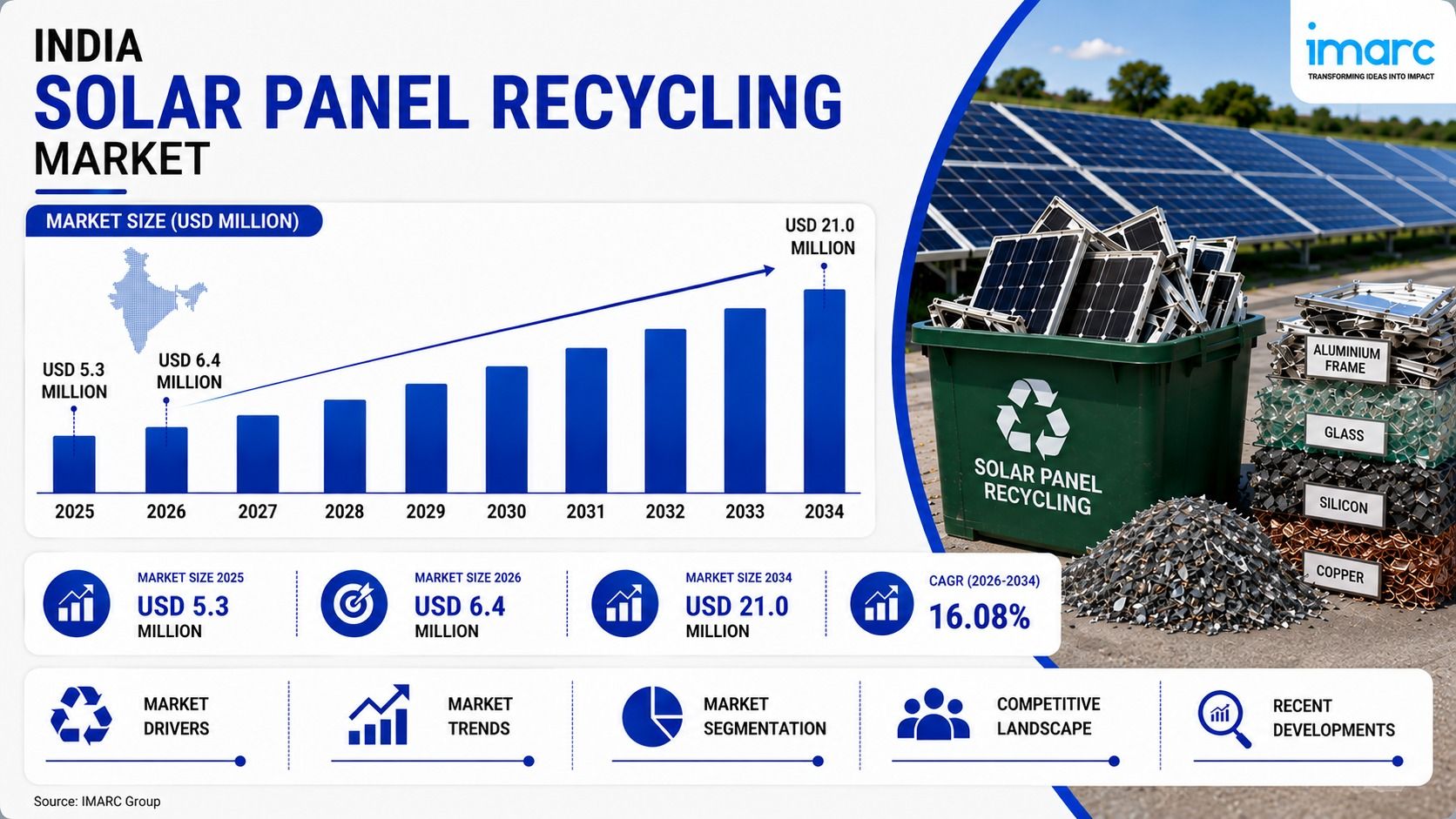
The India solar panel recycling market size increased from USD 5.3 Million in 2025 to USD 6.4 Million in 2026. Looking forward, the market is expected to reach USD 21.0 Million by 2034, exhibiting a growth rate (CAGR) of 16.08% during 2026-2034. The market expansion is underpinned by a mandatory Extended Producer Responsibility framework covering solar photovoltaic waste, rapidly rising projected solar waste volumes as early installations approach end-of-life, and sustained government-funded research into recycling technology and critical mineral recovery. Growing regulatory traceability through approved manufacturer listings, expanding EPR certificate trading infrastructure, and rising strategic priority on recovering silicon and silver necessitate sustained investment across collection, processing and material-recovery infrastructure.
Deepening policy support for a circular economy in the solar sector and growing academia-industry collaboration on recycling technology are further strengthening India's domestic solar waste management ecosystem, collectively expanding the overall India solar panel recycling market share. The industry demonstrates resilience amid a shortage of authorised recyclers and enforcement complexity created by an import-heavy manufacturing base, benefiting from sustained regulatory tightening, rising government R&D funding, and growing strategic recognition of solar waste as a source of critical minerals.
Market Snapshot:
- Market Size (2025): USD 5.3 Million
- Market Size (2026): USD 6.4 Million
- Forecast Market Size (2034): USD 21.0 Million
- CAGR: 16.08% (2026-2034)
- Processes Covered: Thermal, Mechanical, Laser, Others
- Types Covered: Crystalline Silicon, Thin Film, Others
- Materials Covered: Metal, Glass, Aluminum, Silicon, Others
- Regions Covered: North India, South India, East India, West India
What are the Growth Factors of the Solar Panel Recycling Market in India?
Mandatory EPR Framework Under the E-Waste Management Rules, 2022
The Ministry of Environment, Forest and Climate Change notified the E-Waste (Management) Rules, 2022 on 2 November 2022, explicitly bringing solar photovoltaic modules, panels and cells within India's Extended Producer Responsibility regime. Manufacturers and producers are required to store solar PV waste generated as per Central Pollution Control Board guidelines until 2034-35, while the CPCB has operationalised an online EPR portal to facilitate collection, storage and disposal, creating a structured compliance framework that is directly driving demand for organised recycling capacity.
Rapidly Rising Projected Solar Waste Volumes
The Ministry of New and Renewable Energy, together with the Council on Energy, Environment and Water, estimates that cumulative waste from India's existing and projected solar capacity could reach approximately 600 kilo-tonnes by 2030. India already generates a substantial volume of solar photovoltaic waste today, with independent analysis placing current annual volumes in excess of 187,000 tonnes, underscoring the scale of end-of-life panel volumes that will require organised recycling capacity as the country's earliest solar installations approach retirement.
Government-Funded Innovation and R&D Support
MNRE has introduced an Innovation Challenge for Circularity in Renewable Energy Technologies, funding research into recycling technologies, second-life applications and sustainable design for solar modules, while the Department of Science and Technology has invited proposals for economically feasible recycling methods through academic-industrial partnerships. The Ministry of Mines has separately established a recycling incentive programme under the National Critical Mineral Mission, further channelling public research funding toward solar waste recovery technologies.
ALMM Regulatory Framework Enabling Traceability and Enforcement
MNRE's Approved List of Models and Manufacturers order requires that government-linked solar projects source panels only from listed manufacturers, with roughly 95% of projects commissioned after March 2020 sourcing from ALMM-enlisted producers. This regulatory traceability framework gives authorities a practical mechanism to enforce contractual, statutory and environmental obligations, including recycling and EPR compliance, across a large share of India's installed solar base.
Grab a sample copy of this report: https://www.imarcgroup.com/india-solar-panel-recycling-market/requestsample
What Are the Key Trends Shaping the Market?
Shift Toward a Circular Economy Framework for the Solar Sector
The Indian government has constituted dedicated committees to develop action plans enabling 11 selected sectors, including solar panels, to transition from linear to circular economic systems. This structured, sector-specific approach to circularity planning reflects a broader policy shift toward treating solar waste as a resource-recovery opportunity rather than purely an environmental liability.
EPR Certificate Trading Mechanism Building Market Infrastructure
The E-Waste (Management) Rules, 2022 introduced a formal provision for the generation and transaction of EPR certificates, with recycled quantities computed based on end products to prevent false compliance claims. This certificate-trading mechanism is gradually building the market infrastructure needed to create genuine commercial incentives for organised solar panel recycling, extending a model already used for other categories of electronic waste.
Academia-Industry R&D Partnerships for Recycling Technology
Government research bodies are actively funding partnerships between academic institutions and industrial organisations to develop economically viable solar panel recycling methods. This collaborative R&D approach is expected to help close the technology and cost-efficiency gap that currently limits the commercial viability of large-scale solar panel recycling operations in India.
Critical Mineral Recovery Gaining Strategic Priority
The Ministry of Mines' decision to fold solar panel recycling incentives into the National Critical Mineral Mission reflects growing strategic recognition that recovered silicon and silver from end-of-life panels contribute to India's broader mineral security goals. This alignment between renewable energy waste management and critical mineral strategy is expected to attract additional policy attention and funding to the sector over the coming years.
What Are the Major Market Challenges?
Shortage of Authorised Recycling Infrastructure
Despite India already generating well over 187,000 tonnes of solar photovoltaic waste annually, the country faces a stiff challenge in managing this volume due to an insufficient number of authorised recyclers, according to independent environmental policy analysis. This infrastructure gap means a meaningful share of current solar waste risks being handled outside formal, environmentally sound recycling channels.
Import-Based Industry Structure Complicating EPR Enforcement
India's solar industry remains substantially import-based, with many panel manufacturers operating outside the direct regulatory reach of Indian authorities. This structure complicates the enforcement of Extended Producer Responsibility obligations, as regulators must rely on mechanisms such as the ALMM framework to indirectly extend compliance requirements to manufacturers not directly headquartered or regulated within India.
Weak Institutional Capacity and Absent Collection Networks
Academic research on EPR adoption for solar photovoltaic waste in developing economies has identified the absence of pre-established collection networks and weak institutional capacity as significant barriers to effective implementation. Building the logistics and institutional infrastructure needed to systematically collect end-of-life panels from geographically dispersed installations, particularly rooftop and off-grid systems, remains a substantial operational challenge for India's nascent recycling industry.
Explore the Full Report with Charts, Table of Contents, and List of Figures: https://www.imarcgroup.com/india-solar-panel-recycling-market
How Is the Market Segmented? (From the given Link)
- By Process: The market is segmented into Thermal, Mechanical, Laser and Others, reflecting the range of technologies used to separate and recover valuable materials from decommissioned solar panels.
- By Type: The market is segmented into Crystalline Silicon, Thin Film and Others, corresponding to the two dominant solar panel technologies installed across India's utility-scale and rooftop solar capacity.
- By Material: The market is segmented into Metal, Glass, Aluminum, Silicon and Others, spanning the key recoverable materials that determine the economic viability of solar panel recycling operations.
- By Shelf Life: The market is segmented into Normal Loss and Early Loss, distinguishing between panels reaching end-of-life through natural degradation and those decommissioned prematurely due to damage or defects.
- Regional Insights: The market is segmented into North India, South India, East India and West India, reflecting differences in installed solar capacity, panel vintage and recycling infrastructure development across these regions.
Competitive Landscape:
India's solar panel recycling market remains at an early, developing stage, featuring a mix of specialised e-waste recycling companies extending into solar photovoltaic waste processing and dedicated start-ups focused specifically on solar module recycling technology. Competition centres on developing cost-effective, scalable processing methods capable of efficiently recovering silicon, silver, glass and aluminium from decommissioned panels, as well as securing the regulatory registrations required to participate in India's formal EPR ecosystem. Given the sector's nascent commercial scale, market participation continues to expand as both established electronic-waste recyclers and new entrants build out processing capacity to serve rising volumes of end-of-life solar panels.
Recent News or Developments
- Government outlines steps to strengthen domestic solar recycling capacity (2026): The Ministry of New and Renewable Energy detailed a coordinated set of measures to promote domestic recycling capacity and circular economy practices in the solar sector, including the CPCB's operational EPR portal, sector-specific circularity committees, MNRE's Innovation Challenge for Circularity, and a Ministry of Mines recycling incentive programme under the National Critical Mineral Mission.
- E-Waste Management Rules EPR recycling targets step up (2025-26 onward): Annual e-waste recycling targets under the E-Waste (Management) Rules, 2022, which cover solar photovoltaic modules, panels and cells, rose from 60% for 2023-24 and 2024-25 to 70% for 2025-26 and 2026-27, progressively tightening compliance requirements for producers.
- CEEW publishes Solar Module Waste and Recycling Roadmap by 2047: The Council on Energy, Environment and Water released its Solar Module Waste and Recycling Roadmap by 2047, recommending dedicated EPR targets for the solar sector, revision of the E-Waste Management Rules, 2022 to expand bulk-consumer responsibility, and a dedicated circular solar taskforce to coordinate government and private-sector action.
Customization Note: If you require any specific information not covered within this report's scope, we will provide it as part of the customization.
Request Report Customization: https://www.imarcgroup.com/request?type=report&id=29664&flag=E
Frequently Asked Questions (FAQs)
Q1. What is the current size of the India solar panel recycling market?
The India solar panel recycling market size is estimated at USD 6.4 Million in 2026.
Q2. What is the expected growth rate of the India solar panel recycling market during 2026-2034?
The market is projected to grow at a CAGR of 16.08% during 2026-2034, reaching USD 21.0 Million by 2034.
Q3. What factors are driving the growth of the India solar panel recycling market?
Key growth drivers include the mandatory EPR framework under the E-Waste Management Rules, 2022, rapidly rising projected solar waste volumes, government-funded innovation and R&D support, and the ALMM regulatory framework enabling traceability and enforcement.
Q4. Which segments are covered in the India solar panel recycling market report?
The report covers segmentation by process, type, material, shelf life, and region.
Q5. What are the major challenges facing the India solar panel recycling market?
Major challenges include a shortage of authorised recycling infrastructure, an import-based industry structure complicating EPR enforcement, and weak institutional capacity alongside absent collection networks.