
India Solar Energy Market: Industry Report 2026–2034
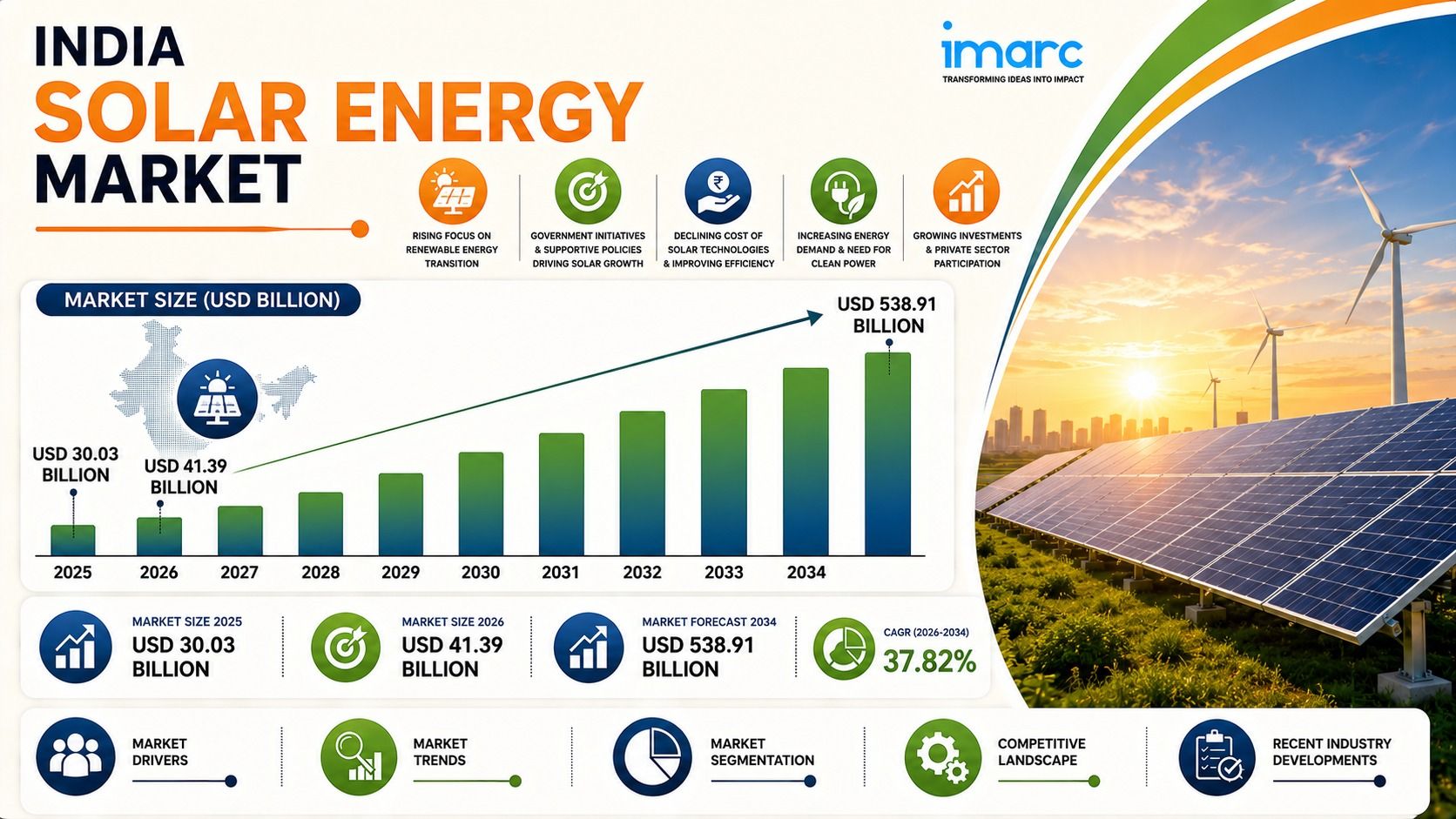
The India solar energy market grew from USD 30.03 Billion in 2025 to USD 41.39 Billion in 2026 and is projected to reach USD 538.91 Billion by 2034, exhibiting an unprecedented CAGR of 37.82% during 2026–2034. This monumental expansion represents a historic transition in the national power grid, shifting the country away from a heavy reliance on fossil fuels towards a decentralized, clean-energy economy. Driven by massive government subsidies, rapid capacity additions, and skyrocketing corporate demand for sustainable electricity, solar power has effectively become the absolute centerpiece of India’s long-term energy strategy.
What Is the Size and Growth Forecast of the India Solar Energy Market?
The India solar energy sector has demonstrated extraordinary, exponential growth anchored by aggressive central capacity auctions, mature rooftop financing models, and rapidly falling global photovoltaic module costs.
- Market Size in 2025: USD 30.03 Billion.
- Market Size in 2026: USD 41.39 Billion.
- Market Forecast in 2034: USD 538.91 Billion.
- Compound Annual Growth Rate (CAGR): 37.82% during the 2026–2034 forecast period.
- Underpinning Momentum: India’s steadfast commitment to expanding non-fossil fuel capacity and the commercial maturation of highly efficient solar-plus-storage projects are ensuring massive, continuous capital injections into the utility and residential grids.
What Are the Latest Emerging Trends in the India Solar Energy Market?
- Agrivoltaics and Dual-Land Utilization: Farmers are rapidly integrating solar panels directly above active agricultural fields to maximize dual-land productivity. This innovative agrivoltaic approach generates substantial supplementary rural income through localized electricity sales while simultaneously shielding delicate cash crops from increasingly severe, heat-induced dehydration during scorching and arid summer months.
- Integration of AI in Solar Asset Management: Utility-scale solar park operators are deploying advanced artificial intelligence frameworks for predictive asset maintenance. These sophisticated algorithms continuously analyze vast microclimatic data and real-time inverter performance, immediately identifying severe panel degradation or localized dust accumulation to drastically optimize overall grid efficiency and prevent massive and costly hardware failures.
- Massive Adoption of Floating Solar Farms: To completely bypass severe land acquisition bottlenecks, energy developers are heavily investing in expansive floating solar installations across massive municipal reservoirs. These advanced aquatic photovoltaic farms intelligently minimize expensive water evaporation while utilizing natural underlying thermal cooling to significantly enhance overall electrical generation efficiency and total output.
- Transition Towards High-Efficiency Bifacial Modules: Large-scale commercial developers are aggressively shifting away from traditional monofacial panels toward advanced bifacial solar modules. By simultaneously capturing direct overhead sunlight and ground-reflected albedo radiation, these highly efficient components massively increase total energy yields, significantly optimizing the levelized cost of electricity across vast national utility projects.
- Rise of Peer-to-Peer Energy Trading Networks: Decentralized blockchain networks are empowering residential rooftop solar owners to seamlessly trade excess generated electricity directly with neighboring households. This peer-to-peer digital energy framework completely bypasses traditional utility intermediaries, fostering a highly localized, democratic energy economy while deeply incentivizing rapid urban solar adoption and community grid resilience.
➤ Request Sample Report (TOC & Charts): https://www.imarcgroup.com/india-solar-energy-market/requestsample
What Growth Factors Are Driving the India Solar Energy Market?
- Aggressive National Decarbonization Commitments: The central government's unwavering commitment to achieving five hundred gigawatts of non-fossil fuel capacity by 2030 acts as a massive, fundamental primary growth catalyst. This aggressive decarbonization mandate forces sweeping policy reforms and creates immense, highly lucrative long-term investment opportunities for domestic and international renewable energy conglomerates.
- Favorable Production-Linked Incentive Schemes: Strategic federal subsidies targeting domestic solar module manufacturing drastically reduce India's historical dependence on imported photovoltaic components. These massive financial incentives empower local manufacturers to rapidly scale their production capacities, ensuring a highly resilient, cost-effective domestic supply chain capable of meeting the country's surging internal energy requirements.
- Escalating Commercial Open-Access Demand: Corporate entities face immense pressure to achieve stringent global environmental sustainability targets and significantly lower their operational electricity expenses. Consequently, massive commercial and industrial conglomerates are aggressively adopting open-access solar power purchase agreements, creating a massive, uninterrupted revenue stream for utility-scale independent renewable power producers operating nationwide.
- Implementation of the PM Surya Ghar Initiative: The PM Surya Ghar scheme drastically accelerates decentralized rooftop solar adoption by providing substantial direct financial subsidies to millions of urban households. By fundamentally lowering the initial capital expenditure barrier, the revolutionary initiative empowers ordinary citizens to actively generate clean electricity, fundamentally transforming domestic residential energy landscapes.
- Declining Costs of Photovoltaic Infrastructure: Technological advancements and massive global manufacturing economies of scale have severely slashed the overall capital costs associated with solar panels and inverters. This continuous price deflation makes solar energy substantially cheaper than conventional thermal power, powerfully incentivizing rapid, widespread installation across both utility and distributed residential segments.
Who Are the Key Players Shaping the India Solar Energy Sector?
The competitive landscape of the India solar energy market features a robust mix of massive, highly capitalized independent power producers (IPPs), integrated utility conglomerates, and aggressive domestic module manufacturers scaling under PLI schemes. Leading entities actively identified as dominating the sector include:
- Adani Group
- Tata Power
- Waaree Energies Ltd.
- ReNew
- JSW
➤ Explore the Full Report with Charts, Table of Contents, and List of Figures: https://www.imarcgroup.com/india-solar-energy-market
Deep-Dive Segment Insights
The market is meticulously segmented to address operational requirements across varying deployment scales, specific consumption applications, and diverse geographical consumption hubs.
By Deployment
- Ground-mounted: Leads the deployment segment with a dominant 58.05% market share in 2025, primarily supported by massive utility-scale solar parks and central agency procurement tenders.
- Rooftop: Accounts for a robust 41.95% share in 2025 and represents an aggressively expanding segment fueled by net-metering reforms and decentralized residential schemes.
By Application
- Commercial and Industrial (C&I): Dominates the segment with a 36.1% share in 2025, driven by escalating corporate adoption of open-access frameworks to secure reliable, cost-effective clean power.
- Utility-scale: Captures a close second at 34.2% in 2025, anchored by massive governmental project deployments.
- Residential: Witnessing the highest structural growth due to heavy state subsidies.
By Region
- West India: Commands the leading position with a 33.8% regional share in 2025, spearheaded by massive commercial power demand and high solar irradiance across Gujarat and Maharashtra.
- South India: Holds a substantial 27.6% share in 2025, driven by a mature rooftop installer ecosystem and a rapidly growing IT manufacturing footprint.
- East India: Identified as the fastest-growing region, rapidly capturing a 14.1% share in 2025 due to rural electrification and emerging industrial corridors.
- North India: Maintains strong momentum with a 24.5% share, heavily supported by agricultural solarization and large utility parks.
Recent Developments
- August 2026: According to data released by the Press Information Bureau (PIB), FY 2025–26 marked a historic milestone for India’s renewable sector. The country successfully added a staggering 44.61 GW of solar capacity, nearly doubling the 23.83 GW added in the previous fiscal year. Simultaneously, domestic solar module manufacturing capacity surged to approximately 172 GW by March 2026.
- August 2026: An industry analysis by The Economic Times reported that India’s power system crossed a massive historic tipping point. Between the start of 2025 and mid-2026, India installed an immense 75.5 GW of pure solar capacity, completely eclipsing the mere 3.8 GW of newly added coal capacity, definitively proving the economic viability and dominance of clean energy.
- July 2025: Operational grid records demonstrated the sheer scale of the sector's expansion, with renewable energy sources successfully meeting an unprecedented 51.5% of India’s total national electricity demand on a single day, marking the highest monthly share ever recorded in the nation's history.
Customization Note: If you require any specific information not covered within this report's scope, we will provide it as part of the customization.
➤ Request Report Customization: https://www.imarcgroup.com/request?type=report&id=43852&flag=E
Frequently Asked Questions (FAQs):
Q1. How big is the India solar energy market? The India solar energy market size was valued at USD 30.03 Billion in 2025 and reached USD 41.39 Billion in 2026.
Q2. What is the projected growth rate of the India solar energy market? The market is projected to reach an immense USD 538.91 Billion by 2034, exhibiting a phenomenal CAGR of 37.82% during the 2026–2034 forecast period.
Q3. Which deployment method commands the largest market share? Ground-mounted solar installations lead the market with a 58.05% share in 2025, primarily driven by massive government-backed utility-scale solar parks.
Q4. Which application and region dominate the market? The Commercial and Industrial (C&I) segment leads applications with a 36.1% share, while West India commands the regional landscape with a 33.8% market share in 2025.
Q5. What factors are driving the growth of the market? Major growth drivers include aggressive national decarbonization mandates (targeting 500 GW of non-fossil capacity), domestic manufacturing subsidies under the PLI scheme, the PM Surya Ghar rooftop initiative, and the steep decline in global photovoltaic module costs.
Conclusion
The India solar energy market is undergoing an explosive and historic transformation, catapulting from USD 41.39 Billion in 2026 to an astonishing projected value of USD 538.91 Billion by 2034 at a massive CAGR of 37.82%. This phenomenal expansion cements solar power as the absolute backbone of India's rapidly modernizing, sustainable energy grid. Driven by unrelenting government policy mandates, skyrocketing corporate commercial open-access demand, and an aggressively expanding domestic module manufacturing base, solar energy has decisively transitioned from a supplementary alternative into the highly lucrative, dominant force powering the nation's long-term economic growth.