
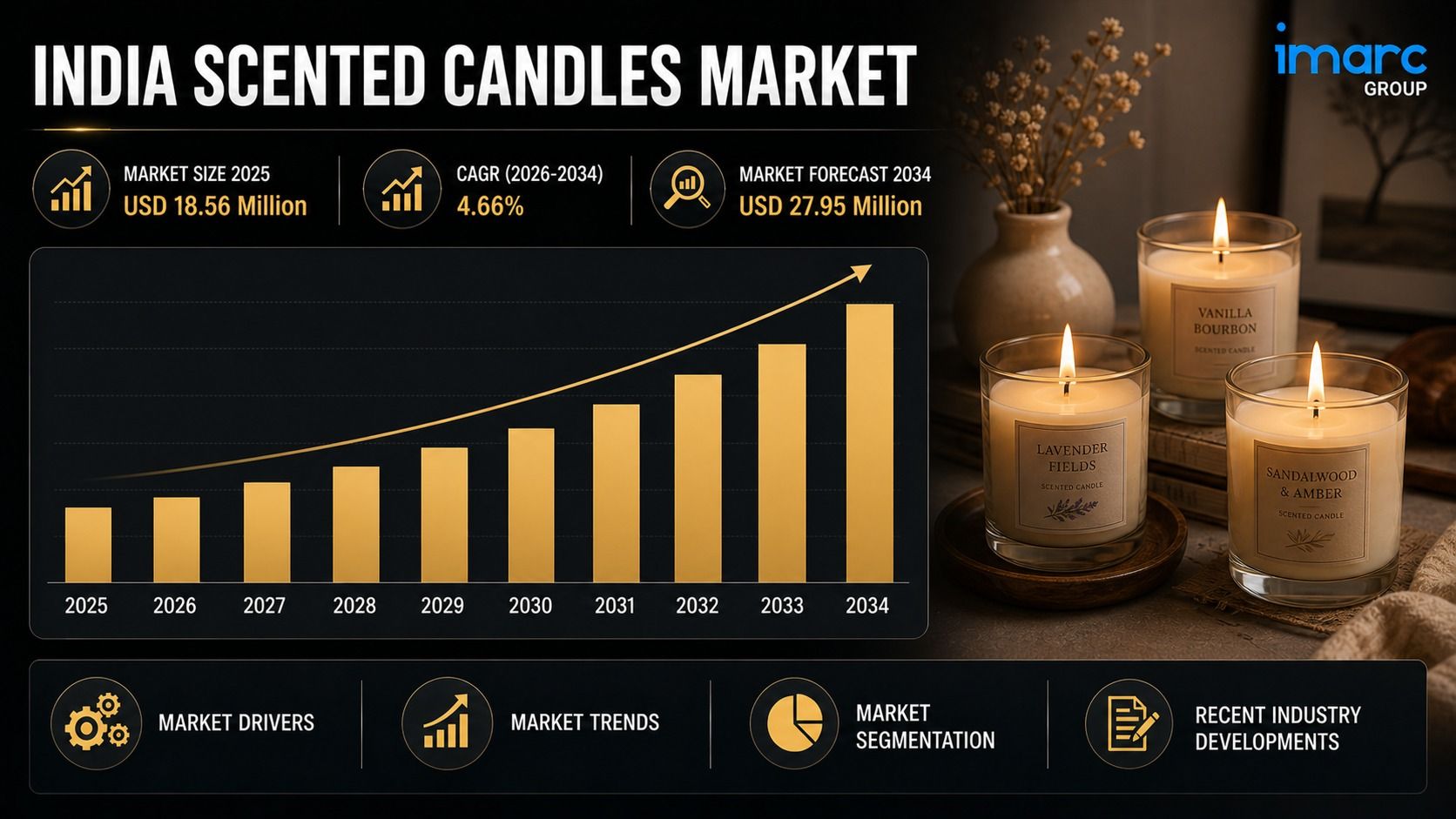
India Scented Candles Market Outlook
This research report by IMARC Group on the India Scented Candles Market provides a forecast of market size, share, and emerging trends for 2026–2034. The report covers segmentation by product, category, raw material, and distribution channel, with regional coverage across North India, West and Central India, South India, and East India.
Market Snapshot
- Market Name: India Scented Candles Market
- Region: India
- Base Year and Market Size: 2025, USD 18.56 Million
- Forecast Year and Market Value: 2034, USD 27.95 Million
- CAGR: 4.66%
- Forecast Period: 2026–2034
- Segmentation Covered: Product, Category, Raw Material, Distribution Channel, Region
Current Market Size of the India Scented Candles Industry
In 2025, the India scented candles market size reached USD 18.56 Million and is projected to touch USD 27.95 Million by 2034, expanding at a CAGR of 4.66% during 2026–2034. Four forces explain this trajectory: the shift of candles from festival items to everyday home decor, direct-to-consumer brands that reach buyers through Instagram and marketplaces, gifting demand that spikes during Diwali and weddings, and growing interest in soy and beeswax alternatives to paraffin.
Emerging Trends in the India Scented Candles Market
D2C Brands Reshape How Candles Are Sold
Direct-to-consumer brands are the primary growth engine for India’s branded scented candle segment, using Instagram and e-commerce platforms to reach buyers without depending on traditional retail distribution . This matters because D2C brands can test scents and packaging quickly, build loyal followings through storytelling, and price at premium levels that general trade cannot support. The model lowers entry barriers for small entrepreneurs but raises competition for shelf attention online.
Candles Become Mood Tools, Not Just Decor
Buyers are selecting candles by occasion and emotional intent rather than by fragrance family alone. Consumers now pick minimal scents for workspaces, calming notes for relaxation, and fragrances that complement interior design, according to brand founders quoted by the Times of India in August 2026 . This shifts product development toward mood-specific collections and occasions, and it rewards brands that can articulate a clear use case rather than selling generic lavender and vanilla variants.
Tier-2 Cities Drive Online Candle Purchases
Smaller cities are becoming a significant share of online candle demand. Tier-2 and smaller cities generate approximately 60% of online candle orders, reducing dependence on premium retail locations in major metros, according to Ken Research in August 2026 . The national broadband base surpassed 1 billion subscribers in November 2025, making online discovery mainstream. For D2C brands, this means logistics and packaging must suit smaller-city delivery patterns, and marketing must reach buyers who do not visit premium home decor stores.
Luxury Candle Growth Outpaces the Mass Segment
Premium candles are growing faster than the overall market. Luxury candle sales are projected to grow 12.9% annually through 2033, exceeding the broad market trajectory and shifting profit pools toward differentiated propositions, according to Ken Research . Brands that invest in fragrance consistency, burn performance, and vessel aesthetics can command higher prices, while mass-market paraffin candles compete on cost and face pressure from both premium brands and inexpensive imports.
➤ Request Sample Report with Datasheet: https://www.imarcgroup.com/india-scented-candles-market/requestsample
Growth Drivers of the India Scented Candles Market
Gifting Culture Sustains Seasonal Demand Spikes
Candles have become a standard component of curated gift hampers alongside flowers and gourmet treats. Avi Kumar of FNP noted that luxury candles complement other gifts while adding warmth and personality, according to the Times of India . Diwali, weddings, and corporate gifting create concentrated demand windows that brands plan inventory around. The gifting channel also introduces candles to buyers who may not purchase them for personal use, expanding the customer base beyond home decor enthusiasts.
Home Fragrance Category Expansion Lifts Candles
Scented candles sit within India’s broader home fragrance market, which is growing as consumers invest in atmosphere and wellness at home. Grand View Research projects India’s home fragrance market will more than double by 2033, as scented candles become expressive luxuries that elevate interiors, according to the Times of India . A rising tide in home fragrance benefits candles because buyers who try diffusers or room sprays often cross over to candles for their visual and experiential appeal.
Export Manufacturing Base Supports Domestic Quality
India’s candle manufacturing sector already serves international retailers, and that capability transfers to domestic brands. Export volume reached 32.77 million kg in 2024, and imports were only USD 4.52 million, indicating that domestic manufacturing capability substantially exceeds dependence on imported finished candles, according to Ken Research . Manufacturers with export experience understand fragrance consistency and burn performance, raising the quality baseline for domestic brands that source from them or compete with them.
GST Structure Favours Scented Candle Formalisation
Scented candles attract 12% GST, while plain and religious candles attract 5%, according to tax guidance for candle makers . The distinction creates an incentive for producers to formalise scented candle operations because the premium segment supports compliance costs. Registered manufacturers can also claim input credit on wax, fragrance, and packaging, which improves margins relative to unregistered producers selling through informal channels.
Opportunities in the India Scented Candles Market
Corporate Gifting Beyond Diwali
Most candle brands concentrate gifting efforts on Diwali, leaving other occasions underserved. Corporate gifting for employee recognition, client appreciation, and event giveaways continues through the year, and candles suit these use cases because they are easy to brand and ship. Brands that build B2B gifting capabilities with custom labeling and bulk pricing can smooth revenue between festive seasons, reducing dependence on a single quarter’s sales.
Soy and Beeswax Blends for Health-Conscious Buyers
Paraffin remains the dominant raw material, but health and environmental concerns are pushing interest toward plant-based waxes. Grand View Research identifies beeswax as the fastest-growing raw material segment in India’s scented candle market . Brands that offer soy or beeswax candles with clear clean-burn claims can reach buyers who avoid paraffin for indoor air quality reasons, though these materials cost more and require different pouring and curing processes.
Experiential Retail and Scent Discovery
Specialty stores that allow customers to smell candles before purchase are important for premium categories. These stores provide product trial and storytelling that online channels cannot replicate, and they contribute to consumer education and price premium justification, according to Research and Markets . Brands that partner with home decor retailers or open small experiential counters in metro cities can convert buyers who are hesitant to purchase fragrance products without sampling them first.
➤ Request Detailed Methodology: https://www.imarcgroup.com/india-scented-candles-market/methodology
Challenges in the India Scented Candles Market
Paraffin Price and Supply Exposure
Most Indian scented candles still use paraffin wax, which is derived from petroleum and exposed to crude oil price swings. Grand View Research places paraffin’s share of India’s scented candle raw material mix at 36.85% in 2025 . When crude prices rise, paraffin costs increase, squeezing margins for mass-market candle makers who compete on price. Brands that have not developed soy or blended wax alternatives absorb the full impact of feedstock volatility.
Fragrance Consistency and Burn Quality
Candle quality problems, including weak scent throw, tunnelling, and soot, damage brand reputation quickly in a category where repeat purchase depends on sensory experience. Soy candles require 48 to 72 hours of curing before the scent fully develops, and burning or selling before that time gives a weak scent throw and disappointed customers, according to candle manufacturing guidance . Small brands that skip testing and curing steps risk negative reviews that are difficult to recover from on marketplaces.
Fragmented Competition from Unbranded Producers
India’s candle market includes a large unorganised segment that sells plain and religious candles at low price points. The branded scented candle segment, valued at USD 18.56 Million in 2025, captures only a small share of the broader candle industry . Unbranded producers can undercut branded candles on price because they avoid packaging, fragrance, and compliance costs. Branded scented candles must justify their premium through visible quality differences that buyers can perceive before purchase.
Key Market Segments in the India Scented Candles Market
The India scented candles market is segmented by product, category, raw material, distribution channel, and region.
Product Segmentation
- Container-Based
- Pillar
- Others
Container-based candles hold the leading position because glass jars protect the candle, extend burn time, and serve as reusable decor after the wax is consumed. Pillar candles appeal to buyers who want freestanding decorative pieces for dining tables and shelves. The others category includes tea lights, votives, and specialty shapes that serve occasion-specific and gifting use cases.
Category Segmentation
- Mass
- Premium
The mass category accounts for the larger share of scented candle volume, serving price-sensitive buyers through general retail and online marketplaces. The premium category is growing faster, with luxury candle sales projected to grow 12.9% annually through 2033, driven by branded D2C players, gifting demand, and buyers who treat candles as home decor investments .
Raw Material Segmentation
- Paraffin Wax
- Soy Wax
- Beeswax
- Others
Paraffin wax remains the largest raw material segment, holding 36.85% of India’s scented candle market in 2025, because it is inexpensive, holds fragrance well, and is familiar to manufacturers . Soy wax is gaining share as a plant-based alternative with cleaner burn characteristics, while beeswax is the fastest-growing segment, driven by buyers seeking natural materials and premium positioning.
Distribution Channel Segmentation
- Hypermarkets and Supermarkets
- Convenience Stores
- Online Stores
- Others
Hypermarkets and supermarkets remain a major channel for mass and mid-range scented candles because buyers can smell products before purchase and compare options in person. Online stores are the fastest-growing channel, with D2C brands using Instagram, marketplaces, and brand websites to reach buyers in Tier-2 and smaller cities, which generate approximately 60% of online candle orders .
Regional Breakdown
- North India
- West and Central India
- South India
- East India
North India leads scented candle demand, supported by festival and wedding gifting traditions, a large urban consumer base in Delhi NCR, and a concentration of home decor retail. West and Central India is the significant secondary region, driven by higher incomes in Mumbai, Pune, and Ahmedabad, modern retail formats, and a growing interest in premium home fragrance brands, according to Research and Markets .
Who Are the Key Players in the India Scented Candles Market?
Competitive Landscape & Key Player Positioning:
Covering an in-depth analysis of the competitive landscape, market structure, key player positioning, competitive dashboards, top winning strategies, and detailed profiles of all major industry participants you will gain access to all these exclusive insights within the full research report.
Latest Recent Developments in the India Scented Candles Market
D2C Wellness Boom Positions Candles as Everyday Ritual
In July 2026, industry analysis highlighted that India’s scented and aromatherapy candle segment is growing primarily through direct-to-consumer brands rather than traditional retail, with the branded scented-candle segment valued at USD 18.56 million in 2025 and projected to reach USD 27.95 million by 2034 . The D2C model lets brands sell mood-specific scents directly to consumers, bypassing the shelf-space constraints of general trade.
Premium Home Fragrance Growth Outpaces Mass Segment
In August 2026, Ken Research reported that luxury candle sales are projected to grow 12.9% annually through 2033, exceeding the broad market trajectory and shifting profit pools toward differentiated propositions . Suppliers are responding by improving fragrance consistency, burn performance, and vessel aesthetics to capture premium buyers who treat candles as design objects rather than utility purchases.
Candle Exporters Seek GST Scheme Correction
In April 2026, the Export Promotion Council for EOUs and SEZs requested correction of an HSN mapping error that excluded candle exporters from a 2.75% interest subvention on packing credit, citing the correct classification as HSN 34060010 . The issue affects exporters including Marvellite Aromatics, which supplies international retailers across the USA, Europe, and Australia. Resolution would reduce financing costs for export-oriented candle manufacturers that also supply domestic brands.
If you require any specific information not covered within this report’s scope, we will provide it as part of the customization.
➤ Request Report Customization: https://www.imarcgroup.com/request?type=report&id=43737&flag=E
Frequently Asked Questions (FAQs)
Q1. How large is the India scented candles market and what is its forecast?
The market stood at USD 18.56 Million in 2025 and is projected to reach USD 27.95 Million by 2034, growing at a CAGR of 4.66% during 2026–2034.
Q2. Why is demand rising for scented candles in India?
Candles are shifting from festival items to everyday home decor, D2C brands are reaching buyers online, gifting demand remains strong, and premiumization is lifting average prices.
Q3. Which product and raw material lead India’s scented candle market?
Container-based candles lead product demand because glass jars extend burn time and serve as reusable decor, while paraffin wax remains the largest raw material at 36.85% share in 2025.
Q4. Where is scented candle demand strongest in India?
North India leads, supported by festival and wedding gifting traditions and Delhi NCR’s urban consumer base, with West and Central India as the significant secondary region driven by premium home fragrance adoption.
Q5. How is India’s scented candle market changing in 2026?
D2C brands are reshaping distribution, buyers are choosing candles by mood and occasion rather than fragrance alone, and Tier-2 cities are generating the majority of online orders.