
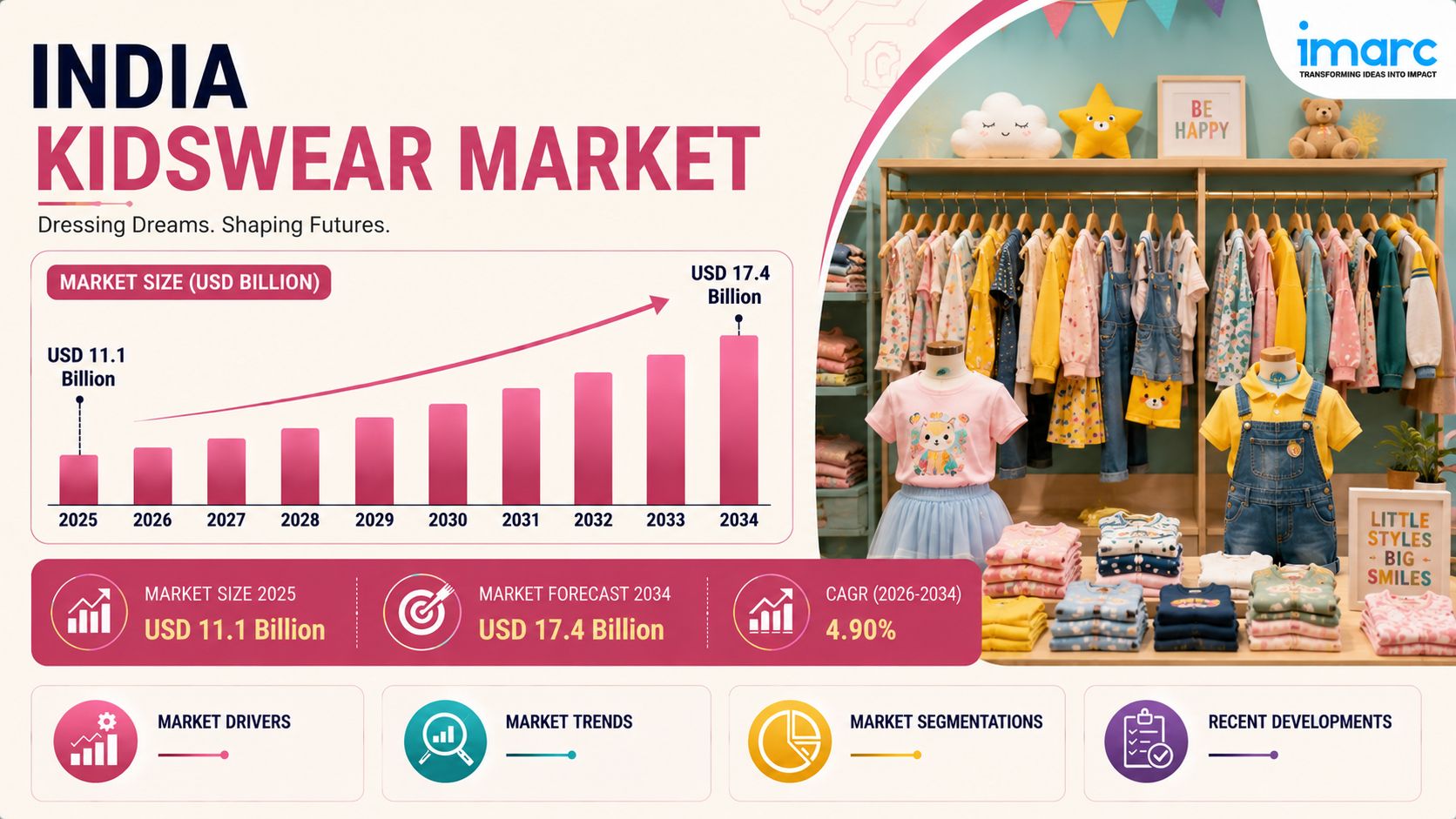
According to IMARC Group's report titled "India Kidswear Market Size, Share, Trends and Forecast by on Gender, Category, Season, Sector, Sales Channel, and Region, 2026-2034", the report offers a comprehensive analysis of the industry, including market growth, share, trends, and regional insights.
India's kidswear market reached USD 11.1 Billion in 2025 and is projected to reach USD 17.4 Billion by 2034, growing at a CAGR of 4.90%. Rising disposable incomes, brand-conscious parenting, growing demand for premium and sustainable clothing, and increasing urbanization are fueling growth across both organized and unorganized sectors of this culturally significant apparel category.
- Market scale: USD 11.1 Billion in 2025 → USD 17.4 Billion by 2034 at 4.90% CAGR.
- Luxury market entry: In March 2025, Jacadi Paris French luxury children's wear brand launched its first India store in Mumbai with Bengaluru planned, citing India's growing luxury market appetite.
- Sustainable brand scaling: Kidbea targets Rs 100 crore revenue by FY26, expanding to 100 multi-brand outlets and 20 exclusive stores backed by ten Indian TV actor brand ambassador partnerships announced in January 2025.
- Organic kidswear debut: In September 2024, PILOLO launched at Junior's Fashion Week Mumbai a GOTS-aligned organic kidswear brand targeting children aged 4-9 using non-toxic dyes and skin-friendly fabrics.
- Premium retail deepening: Kate and Oscar opened its sixth store in Gurgaon in February 2024, targeting 30 stores across major metro cities within three years signaling organized premium segment geographic expansion.
The Strategic Market Challenge: Navigating the Kidswear Market in India
India's kidswear market faces the structural tension between a premium and sustainable segment where organic fabrics, GOTS certification, and luxury brand positioning command higher margins and a vast price-sensitive mass market still largely served by the unorganized sector. Counterfeit and low-quality products from unorganized manufacturers limit brand value protection for organized players. Rapid fashion cycle changes driven by social media and celebrity influence create inventory management complexity, while seasonal demand concentration adds working capital pressure for smaller brands expanding multi-city retail footprints.
India's Strategic Vision for the Kidswear Market
- Sustainable textile and chemical safety regulations: Government bans on hazardous chemicals in children's apparel and initiatives promoting sustainable textiles are creating compliance-driven demand for certified organic kidswear directly supporting brands with GOTS certification and chemical-free manufacturing.
- FDI in single-brand retail: Policy enabling 100% foreign investment in single-brand retail is facilitating international luxury kidswear brands like Jacadi Paris to establish direct India operations creating aspirational market benchmarks that accelerate premium segment development.
- E-commerce and digital retail infrastructure: Expanding digital payment systems and logistics networks into Tier-2 and Tier-3 cities are enabling online-first kidswear brands to build national consumer reach without proportional physical retail investment.
- Organized retail expansion: Government policies supporting organized retail development are enabling premium kidswear brands to expand exclusive store networks and multi-brand outlet presence with Kate and Oscar's 30-metro-store target and Kidbea's 100 outlet plan reflecting this trajectory.
➤ Access Industry-Focused Insights and Future Forecasts - Request Sample Report
Why Invest in the India Kidswear Market: Key Growth Drivers & ROI
- Brand-conscious parenting creating premium demand: Rising disposable incomes and social media influence are driving parents to prioritize high-quality, stylish, and safe clothing with celebrity endorsements, aspirational lifestyle content, and exclusive festive collections accelerating premium adoption among urban middle-class and affluent households simultaneously.
- Organic and sustainable clothing as a structural growth segment: Consumer preference for organic cotton, bamboo fiber, and plant-dyed fabrics driven by skin sensitivity concerns and eco-conscious parenting is creating a fast-growing certified product segment. PILOLO's September 2024 Junior's Fashion Week launch and Kidbea's eco-brand scaling both confirm that the sustainable kidswear opportunity is commercially proven and attracting organized investment.
- E-commerce democratizing premium brand access: Online platforms offering personalization, exclusive launches, and competitive pricing are making premium and international kidswear accessible to aspirational Tier-2 city consumers lacking access to luxury retail stores expanding the addressable premium market well beyond current metropolitan concentration.
- Multi-brand and exclusive store network expansion creating distribution moats: Kidbea's 100 multi-brand outlet and 20 exclusive store plan, Kate and Oscar's 30-metro target, and Jacadi Paris's Mumbai-Bengaluru rollout confirm that organized retail network depth is becoming the defining competitive differentiator rewarding early geographic expansion investment with durable distribution advantages.
India Kidswear Market Trends & Future Outlook:
- GOTS-certified organic kidswear is transitioning from a niche premium category to a mainstream organized retail segment as parental health awareness and eco-conscious parenting become purchasing baseline expectations.
- Luxury international brand localization exemplified by Jacadi Paris adapting to local tastes while maintaining French design is establishing a new premium ceiling in India's kidswear market that domestic brands must compete against.
- Celebrity and influencer-driven brand building is becoming a standard market entry strategy with Kidbea's ten Indian TV actor brand ambassador partnerships demonstrating that earned media through celebrity association is an accessible and effective growth tool.
- Ethnic wear and festive collections are high-growth sub-categories as families invest in culturally significant occasion wear creating a recurring seasonal premium demand cycle that rewards brands with strong traditional and fusion design capabilities.
- Multi-brand outlet and exclusive store hybrid models are emerging as the preferred distribution architecture balancing broad market reach through multi-brand partnerships with brand-controlled premium experience through exclusive storefronts.
Regulatory Landscape & Policy Catalysts in India:
- Chemical safety regulations for children's apparel including bans on hazardous dyes and synthetic chemicals create compliance requirements that structurally favor organized GOTS-certified manufacturers over informal sector producers unable to meet testing and certification standards.
- FDI policy in single-brand retail enabling 100% foreign investment is facilitating international luxury kidswear brands like Jacadi Paris to establish direct India operations creating aspirational market benchmarks that accelerate premium segment development.
- Sustainable textile government initiatives promoting eco-friendly fabric adoption are creating institutional support for organic cotton and bamboo fiber supply chains improving raw material access for sustainable kidswear brands.
- E-commerce and digital retail policy expanding digital payment infrastructure and logistics networks into smaller cities is enabling online-first kidswear brands to build national consumer reach without proportional physical retail investment.
- BIS and quality standards enforcement for children's clothing safety covering chemical content and mechanical safety are progressively raising minimum quality standards that limit unorganized sector competition in the organized market space.
- Organized retail expansion policy supporting supermarket, hypermarket, and exclusive store network growth in Tier-2 cities directly improves branded kidswear shelf availability with Kidbea's 100-outlet and Kate & Oscar's 30-store expansion plans reflecting the commercial opportunity this infrastructure creates.
Market Segmentation Breakdown:
Analysis by Gender:
- Female (Dominant segment due to higher variety and fashion trends)
- Male
Analysis by Category:
- Uniforms (Consistent demand)
- T-Shirts/Shirts
- Bottom Wear
- Ethnic Wear (High value during festive seasons)
- Dresses
- Denims
- Others
Analysis by Season:
- Summer Wear (Largest volume due to tropical climate)
- Winter Wear
- All Season Wear
Analysis by Sector:
- Organized Sector (Fastest growing)
- Unorganized Sector (Still holds significant volume share in rural areas)
Regional Insights:
- North India (Highest value share due to distinct winter season driving winter wear sales)
- South India
- East India
- West India
Competitive Landscape & Key Player Positioning:
Covering an in-depth analysis of the competitive landscape, market structure, key player positioning, competitive dashboards, top winning strategies, and detailed profiles of all major industry participants you will gain access to all these exclusive insights within the full research report.
Note: If you need specific information that is not currently within the scope of the report, we can provide it to you as a part of the customization.
➤ Tailor the Research to Your Exact Business Needs - Request Customization
Frequently Asked Questions (FAQs):
Q1: What is the current value and projected growth of the India Kidswear Market?
According to IMARC Group, the India kidswear market reached USD 11.1 Billion in 2025 and is projected to reach USD 17.4 Billion by 2034, growing at a CAGR of 4.90%, driven by rising disposable incomes, brand-conscious parenting, premium and sustainable clothing demand, and increasing urbanization.
Q2: What segments and sales channels does the India kidswear market cover?
The market covers gender (female, male), categories (uniforms, t-shirts, bottom wear, ethnic wear, dresses, denims), seasons (summer, winter, all-season), and sectors (organized, unorganized). Sales channels include supermarkets/hypermarkets, exclusive stores, multi-branded stores, online, and others with online and exclusive stores growing fastest.
Q3: How is sustainable and organic clothing reshaping the market?
Parents are prioritizing organic cotton, bamboo fiber, and plant-dyed fabrics to avoid skin irritation and chemical exposure. GOTS certification is becoming a consumer trust signal, with PILOLO's September 2024 Junior's Fashion Week Mumbai launch reflecting growing demand. Government bans on hazardous chemicals in children's apparel are creating compliance-driven tailwinds for certified organic brands.
Q4: Which recent market entries signal India's premium kidswear growth direction?
Jacadi Paris launched its first Mumbai store in March 2025 targeting India's luxury market. Kate and Oscar opened its sixth Gurgaon store in February 2024 targeting 30 metro locations in three years. Kidbea is expanding to 100 multi-brand outlets and 20 exclusive stores targeting Rs 100 crore revenue by FY26 all confirming accelerating organized premium segment momentum.
Q5: What are the primary growth opportunities and challenges through 2034?
Opportunities include GOTS-certified organic segment expansion, luxury international brand localization, e-commerce reach into Tier-2 cities, and ethnic festive wear recurring demand cycles. Challenges are unorganized sector competition limiting organized brand pricing power, rapid social media fashion cycles creating inventory complexity, and high real estate costs for multi-city exclusive store rollouts.
Strategic Insight & Verdict
India's kidswear market offers a balanced investment thesis stable 4.90% CAGR volume growth combined with premium and sustainable segment value creation that outpaces overall market expansion. Based on our analysis, we at IMARC Group have observed that brands combining GOTS-certified organic credentials, multi-city retail expansion, and e-commerce-led Tier-2 city penetration are best positioned to capture disproportionate value as the market scales toward USD 17.4 Billion by 2034.
Verified Data Source: India Kidswear Market Report by IMARC Group