
India HVAC Market Outlook
The report titled "India HVAC Market Size, Share, Trends and Forecast by Product Type, End User, and Region, 2026–2034" comprises a comprehensive analysis of the Indian market, covering its size, growth trends, key drivers, regional insights, and other critical metrics defining the country's heating, ventilation, and air conditioning ecosystem.
How Big is the HVAC Market in India?
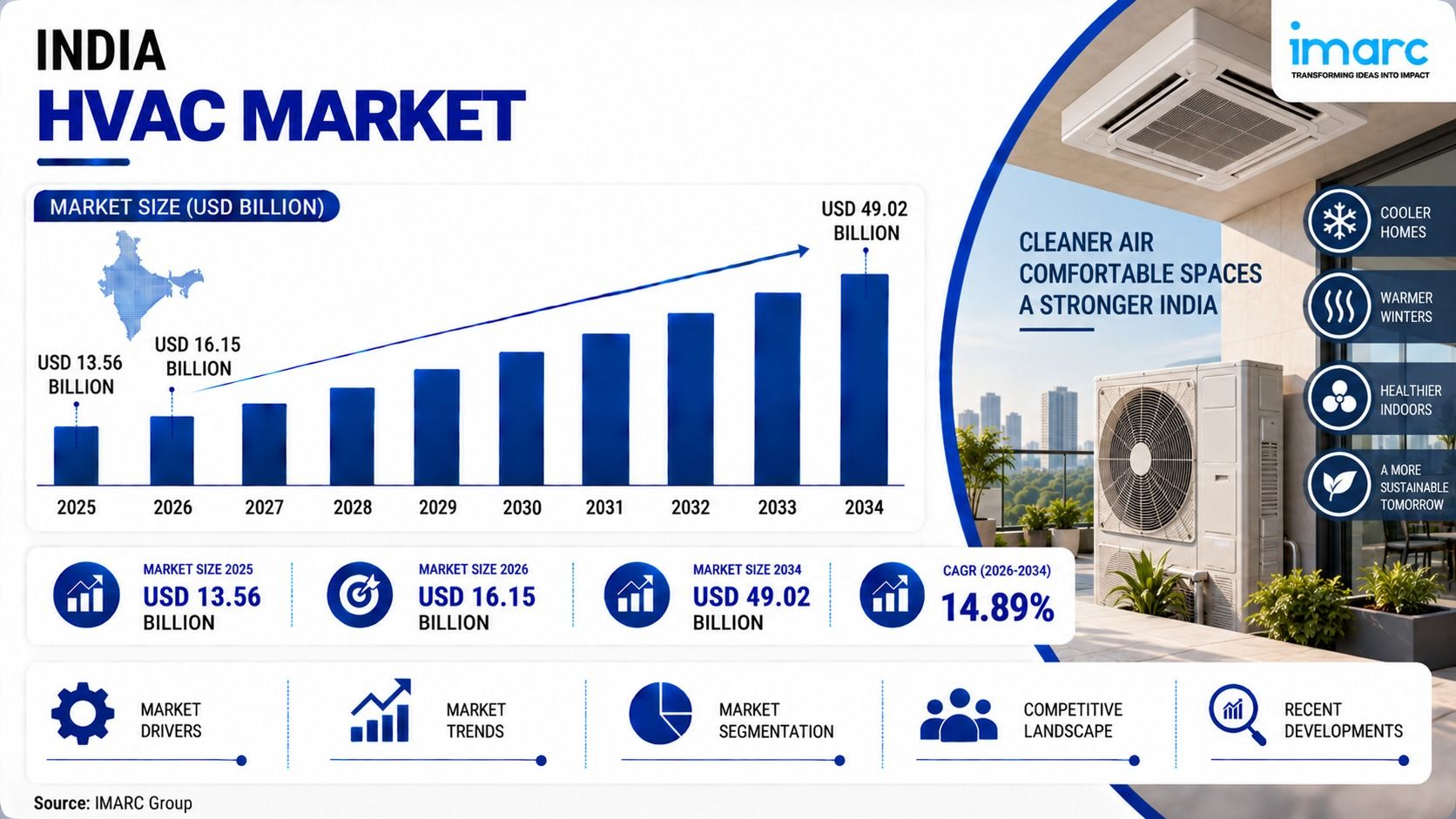
The India HVAC market outlook indicates that the market size increased from USD 13.56 Billion in 2025 to USD 16.15 Billion in 2026 and is projected to reach USD 49.02 Billion by 2034, growing at a CAGR of 14.89% during 2026–2034. Rising heatwave intensity, with India recording around 536 heatwave days during summer 2024 according to the India Meteorological Department (IMD), rapid urbanization, growing disposable incomes, expanding commercial real estate, and supportive government efficiency programs are the primary drivers shaping the market growth.
Emerging Trends in the India HVAC Market:
- Shift Toward Inverter and Energy-Efficient Air Conditioners:
Inverter air conditioners have become the default purchase across urban India, replacing fixed-speed units owing to lower running costs, smoother temperature control, and better star ratings. Most leading brands now offer inverter-only line-ups in the 1 Ton and 1.5 Ton categories, reflecting how completely the technology has displaced older alternatives in the mass market. In Q1 2025, Samsung India doubled its room air conditioner sales by aggressively expanding its AI-enabled, inverter-driven AC portfolio, capturing 10% market share. Energy efficiency has shifted from a premium feature to a baseline consumer expectation.
- Rise of Smart, IoT, and AI-Enabled HVAC:
Connected air conditioners with Wi-Fi control, voice-assistant integration, and AI-based climate sensing are gaining ground in metro cities. Brands are integrating smart home platforms, predictive maintenance alerts, and remote diagnostics to differentiate premium models and improve service economics. These capabilities are particularly attractive to urban tech-savvy households and modern commercial buildings seeking centralized control. As the installed base of connected devices grows, manufacturers are also building new service-revenue models around remote monitoring, energy-tracking dashboards, and proactive maintenance, moving beyond one-time product sales toward recurring customer relationships.
- Eco-Friendly Refrigerant Adoption:
Manufacturers are accelerating the move from legacy refrigerants to lower-GWP alternatives in line with India's HFC phase-down obligations. Lower global warming potential, improved cooling efficiency, and emerging compliance norms are pushing OEMs to redesign compressors and heat exchangers for new refrigerants. This transition adds certification complexity and sourcing challenges but also opens opportunities for manufacturers that can localize compliant component production. As regulatory timelines tighten, refrigerant transition is becoming a decisive factor in product planning, export competitiveness, and long-term market positioning across both residential and commercial segments.
Growth Factors Driving the India HVAC Market:
- Rising Heatwave Frequency and Climate Stress:
Increasing summer temperatures and longer heat seasons across India are turning HVAC ownership into a near-essential purchase, with cooling demand peaking from March to June each year. In 2025, India recorded its eighth hottest year ever, with the national average temperature being 0.28 degrees Celsius higher than the 1991-2020 Long Period Average, as per the Annual Climate Statement 2025 from IMD. In March 2026, Delhi recorded its warmest day of the year, with the temperature hitting 40.1 degrees Celsius in the Ridge area. This sustained climate stress is structurally embedding cooling demand across Indian households and businesses.
- Rapid Urbanization and Housing Density:
City migration and tier-2 and tier-3 housing growth are driving steady demand for split air conditioners, packaged units, and centralized HVAC across new residential and mixed-use developments. As urban housing becomes denser and apartment living expands, the addressable base for room air conditioners grows in parallel with construction activity. Rising disposable incomes and the spread of zero-cost EMI schemes are bringing first-time air conditioner ownership within reach for middle-income households across smaller cities, widening the market beyond traditional metropolitan strongholds and accelerating volume growth.
- Government Energy Efficiency and PLI Schemes:
BEE star labelling and the Production Linked Incentive (PLI) scheme for AC components are encouraging local manufacturing, supporting energy-efficient products, and reducing import dependency. The PLI scheme is driving investment in compressors, motors, controllers, and copper tube facilities, strengthening domestic supply chains and improving cost competitiveness for manufacturers. Together, these policy interventions are helping the industry shift toward higher-efficiency products while building resilience against currency volatility, logistics disruptions, and tariff changes that have historically exposed manufacturers to imported component risks.
Industry Value Chain Analysis:
- Raw Material Supply: Suppliers of steel, copper, aluminum, refrigerants, and electronic components used in coils, cabinets, and circuit assemblies form the upstream base of the value chain.
- Component Manufacturing: Compressor, motor, fan, heat-exchanger, and electronic control unit producers supply both domestic OEMs and import-substituting PLI scheme participants.
- OEM Assembly and Production: Brand-owning manufacturers assemble split, window, packaged, VRF, and chiller units across plants in Tamil Nadu, Maharashtra, Andhra Pradesh, and Haryana.
- Compliance and Certification: BEE star ratings, Bureau of Indian Standards (ISI) marks, and refrigerant safety standards ensure products meet regulatory and efficiency benchmarks.
- Distribution and Installation: Multi-brand retailers, exclusive brand outlets, e-commerce platforms, electrical contractors, EPC firms, and MEP consultants serve commercial and industrial projects.
- End Users and Lifecycle: Households, offices, malls, hotels, hospitals, transportation hubs, and industrial users rely on service partners for installation, AMC, refrigerant top-up, and end-of-life recycling.
Deep-Dive Segment Insights
- By Product Type: Direct expansion systems lead with 62.4% share in 2025, driven by mass-market split, window, and packaged air conditioners across residential and small commercial premises. Central air conditioning systems hold 37.6% share in 2025, serving commercial real estate, hospitals, hotels, malls, and industrial facilities requiring uniform cooling across large floorplates.
- By End User: Residential dominates with a 55.8% share in 2025, reflecting rising household incomes, denser urban housing, and the perception of air conditioning as a comfort necessity. Commercial accounts for 44.2% in 2025, supported by expanding office space, retail malls, hospitality investments, and healthcare infrastructure.
- By Region: North India leads with 32.6% share in 2025, driven by extreme summer heat, dense urban housing, and large institutional cooling load. South India at 28.4% is the fastest-growing region through 2034, followed by West India at 23.5% and East India at 15.5%.
Competitive Landscape & Key Player Positioning:
Covering an in-depth analysis of the competitive landscape, market structure, key player positioning, competitive dashboards, top winning strategies, and detailed profiles of all major industry participants you will gain access to all these exclusive insights within the full research report.
Latest Recent Developments in the India HVAC Market:
- Delhi Records Warmest Day of the Year at 40.1°C (March 2026): Delhi recorded its warmest day of the year, with the temperature hitting 40.1 degrees Celsius in the Ridge area, reinforcing the intensifying cooling demand pattern that is driving HVAC adoption across North India's residential and commercial segments.
- India Records Eighth Hottest Year Ever in 2025: According to the Annual Climate Statement 2025 from the India Meteorological Department, India recorded its eighth hottest year ever, with the national average temperature being 0.28 degrees Celsius higher than the 1991-2020 Long Period Average. This sustained warming trend continues to structurally embed cooling demand across Indian households and businesses.
- Blue Star Launches 125 New Room Air Conditioner Models for Summer 2026 (2026): Blue Star Limited launched a comprehensive range of 125 new room air conditioner models, including the premium Iconia series, with manufacturing capacity scaled to 1.8 million units across facilities in Andhra Pradesh and Himachal Pradesh and distribution through over 10,000 outlets nationwide.
- Voltas Reintroduces All-Weather Winter Campaign Across North India (December 2024): Voltas reintroduced its All-Weather winter campaign across North India, mainly through digital platforms and radio, aiming to generate interest in its All-Weather Hot & Cold AC offering while highlighting its effectiveness in various weather conditions.
Customization Note: If you require any specific information not covered within this report's scope, we will provide it as part of the customization.
Frequently Asked Questions (FAQs)
Q1. What is the current size of India's HVAC market?
India's HVAC market size increased from USD 13.56 Billion in 2025 to USD 16.15 Billion in 2026.
Q2. What is the CAGR for India's HVAC market (2026-2034)?
India's HVAC market grows at a 14.89% CAGR during 2026-2034, reaching USD 49.02 Billion by 2034.
Q3. Which product type leads India's HVAC market?
Direct expansion systems lead at 62.4% in 2025, driven by mass-market split and window air conditioner adoption. Central air conditioning systems hold the remaining 37.6% share.
Q4. Which end user leads India's HVAC market?
Residential dominates at 55.8% in 2025, supported by rising household incomes and longer summers. Commercial accounts for 44.2%, driven by offices, malls, hospitals, and hospitality.
Q5. Which region leads India's HVAC market?
North India commands 32.6% in 2025, driven by high urban density, extreme seasonal temperature variations, and strong demand from residential and commercial segments. South India at 28.4% is the fastest-growing region through 2034.