
India Household Insecticides Market Outlook
According to latest research report by IMARC Group, the report titled "India Household Insecticides Market Size, Share, Trends and Forecast by Product Type, Composition, Packaging, Application, Distribution Channel, and Region, 2026–2034" comprises a comprehensive analysis of the Indian market, covering its size, growth trends, key drivers, regional insights, and other critical metrics defining the country's household pest control and vector-borne disease prevention ecosystem.
How Big is the Household Insecticides Market in India?
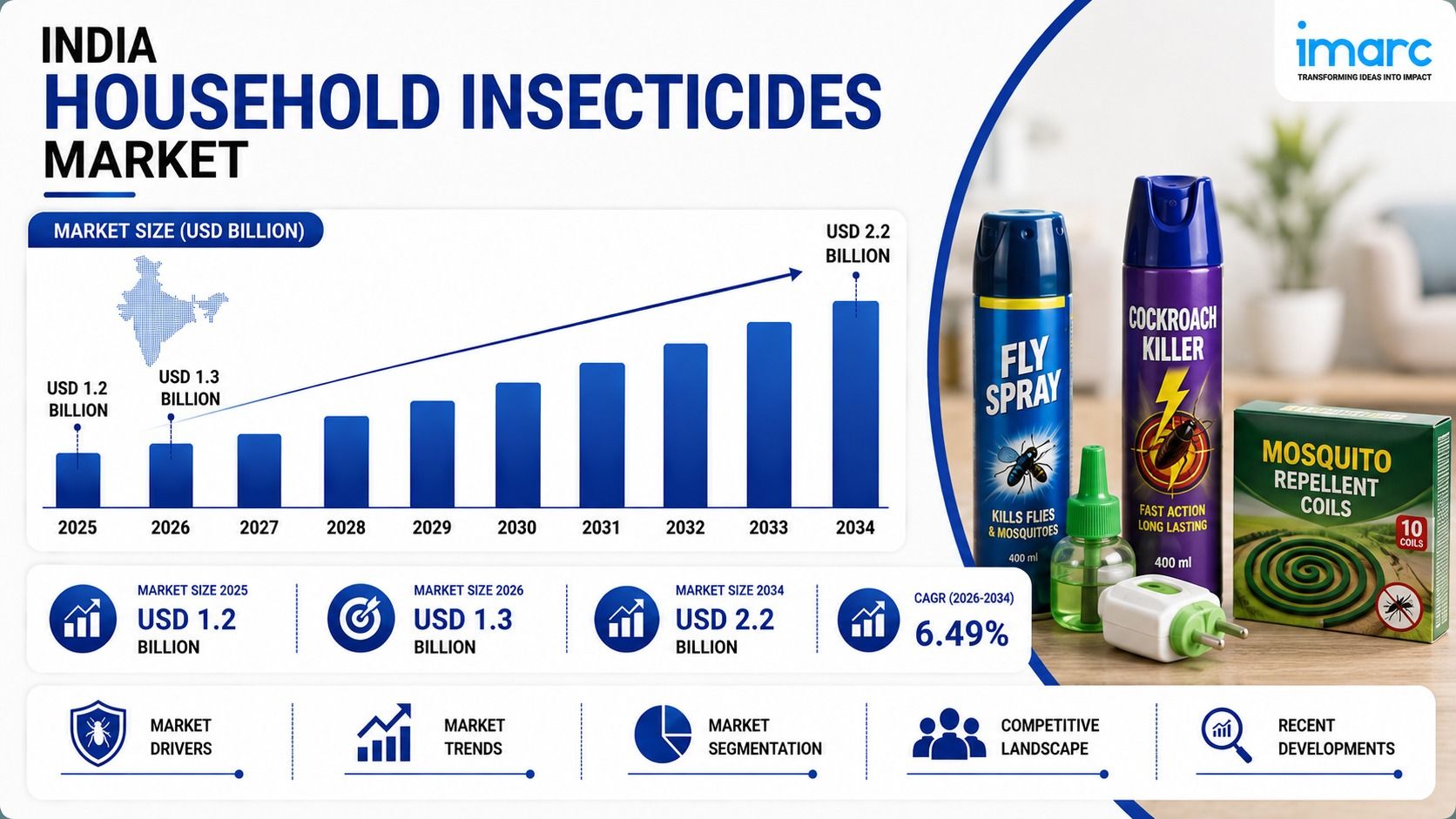
The India household insecticides market outlook indicates that the market grew from USD 1.2 Billion in 2025 to USD 1.3 Billion in 2026 and is projected to reach USD 2.2 Billion by 2034, exhibiting a CAGR of 6.49% during 2026–2034. The market is driven by rising consciousness among individuals towards the adverse effects of prolonged exposure to harmful chemicals, increasing prevalence of vector-borne diseases such as malaria and dengue, growing public health awareness, rapid urbanization, and changing lifestyles that create conducive environments for pest infestations.
Emerging Trends in the India Household Insecticides Market:
- Growing Preference for Natural and Herbal Formulations:
Indian consumers are increasingly gravitating toward natural and plant-based insecticide formulations as awareness of the adverse effects of prolonged chemical exposure grows. Products containing citronella oil, geraniol, and other botanical extracts are gaining traction among health-conscious households, particularly those with children and elderly family members. This shift is being reinforced by the broader clean-label movement in Indian consumer goods, where transparency around ingredients and safety profiles influences purchasing decisions. Manufacturers are responding by expanding their natural product portfolios, reformulating existing offerings to reduce synthetic content, and emphasizing safety credentials in their marketing communications across both traditional retail and digital channels.
- Electric Vaporizers and Smart Pest Control Devices Gaining Share:
Electric vaporizers have emerged as a preferred format for urban households seeking continuous, low-effort mosquito protection without the smoke and residue associated with traditional coils. Liquid vaporizer refills, plug-in devices, and advanced heating mechanisms now dominate bedroom and living room usage patterns across metropolitan and tier-two cities. Manufacturers are investing in product differentiation through longer-lasting refills, adjustable intensity settings, and aesthetically designed devices that complement modern home interiors. The convenience factor, combined with growing consumer willingness to pay for premium formats, is driving this segment's expansion and encouraging innovation in smart, timer-based, and app-connected pest control solutions.
- E-Commerce and Organized Retail Expanding Market Access:
The distribution landscape for household insecticides is undergoing significant transformation, with online platforms and organized retail chains expanding access beyond traditional general stores. Quick commerce platforms and e-commerce marketplaces now offer convenient purchase options for sprays, vaporizers, and refills, often with subscription models that ensure regular replenishment. Modern trade formats including supermarkets and hypermarkets provide enhanced product visibility, in-store demonstrations, and competitive pricing that drive trial and adoption. This omnichannel expansion is particularly impactful in tier-two and tier-three cities, where improved access is converting first-time users and expanding the overall addressable market for household insect control products.
➤ Request Sample Report with Datasheet – TOC, Charts & Key Insights: https://www.imarcgroup.com/india-household-insecticides-market/requestsample
Growth Factors Driving the India Household Insecticides Market:
- Prevalence of Vector-Borne Diseases Driving Demand:
The prevalence of vector-borne diseases such as malaria, dengue, and chikungunya remains a primary driver of household insecticide adoption across India. Seasonal outbreaks, particularly during monsoon months, create urgent demand for mosquito control solutions, while year-round concerns about cockroaches, rats, and other household pests sustain baseline consumption. As public health awareness grows and government campaigns emphasize preventive measures, households are increasingly adopting insect control measures as a routine component of home hygiene rather than a reactive purchase. This health-motivated demand base functions largely independently of broader discretionary spending cycles, providing relative stability to the market.
- Urbanization and Changing Lifestyles:
Rapid urbanization across India is creating concentrated living environments where crowded spaces, shared walls, and inadequate drainage create conducive conditions for pest infestations. Urban households increasingly prioritize convenience and ease of application when selecting insect control products, favouring sprays, vaporizers, and baits over traditional manual methods. Changing family structures, dual-income households, and busier lifestyles reduce tolerance for pests and increase willingness to spend on effective solutions. Growing awareness about hygiene and sanitation standards, amplified by media coverage and social discourse, further reinforces the perception of household insecticides as essential rather than optional purchases.
- Development of Eco-Friendly and Innovative Formulations:
Ongoing research and development within the industry is producing innovative formulations that address consumer concerns about safety, efficacy, and environmental impact. Manufacturers are developing eco-friendly products with reduced toxicity to humans and pets, biodegradable ingredients, and improved delivery mechanisms that minimize waste. Slow-release vaporizing systems, targeted baits, and precision spray technologies are enhancing effectiveness while reducing the quantity of active ingredients required. These innovations are expanding the range of acceptable products for safety-conscious consumers and opening new usage occasions, from child-safe bedroom protection to pet-friendly formulations for homes with animals.
Industry Value Chain Analysis:
- Active Ingredient and Raw Material Supply: Suppliers provide natural extracts including citronella oil and geraniol alongside synthetic compounds such as DEET and Picaridine, with growing emphasis on sourcing ingredients that meet safety and regulatory standards.
- Formulation and Manufacturing: Manufacturers blend active ingredients with carriers, solvents, and propellants to produce sprays, vaporizer liquids, coils, and baits, with increasing investment in eco-friendly formulations and precision delivery systems.
- Packaging and Branding: Products are packaged in small, medium, and large formats suited to different consumption patterns and price points, with branding emphasizing safety, efficacy, and convenience to build consumer trust.
- Distribution and Channel Management: Products reach consumers through supermarkets and hypermarkets, convenience stores, general stores, and online platforms, with omnichannel strategies improving access across urban and semi-urban markets.
- Consumer Education and After-Sales: Manufacturers invest in awareness campaigns about pest-related health risks, correct usage methods, and product safety, with customer feedback informing continuous product improvement and portfolio expansion.
Deep-Dive Segment Insights
- By Product Type: The India household insecticides market share is categorized into sprays, electric vaporizers, mosquito coils, baits, and others, with electric vaporizers gaining significant share in urban households seeking continuous, low-effort protection.
- By Composition: The market is segmented into natural (citronella oil, geraniol, and others) and synthetic (N, N-Diethyl-Meta-Toluamide (DEET), Hydroxyethyl Isobutyl Piperidine Carboxylate (Picaridine), and others), reflecting diverse consumer preferences around safety and efficacy.
- By Packaging: The market covers small, medium, and large packaging formats, serving different household sizes, usage frequencies, and price sensitivities.
- By Application: The market covers cockroaches, ants, flies and moths, mosquitoes, rats and rodents, bedbugs and beetles, and others, with mosquitoes representing a significant application segment due to vector-borne disease concerns.
- By Distribution Channel: The market covers supermarkets and hypermarkets, convenience stores, general stores, online stores, and others, with online channels expanding rapidly.
- By Region: The report covers North India, West and Central India, South India, and East and Northeast India.
Competitive Landscape & Key Player Positioning:
Covering an in-depth analysis of the competitive landscape, market structure, key player positioning, competitive dashboards, top winning strategies, and detailed profiles of all major industry participants you will gain access to all these exclusive insights within the full research report.
Latest Recent Developments in the India Household Insecticides Market:
- Growing Consumer Preference for Natural Insecticides Reshaping Product Portfolios (2025-2026): Rising consciousness among individuals towards the adverse effects of prolonged exposure to harmful chemicals is driving demand for natural formulations, prompting manufacturers to expand portfolios featuring citronella oil, geraniol, and other botanical extracts.
- Electric Vaporizers Emerging as Preferred Format in Urban Households (2025-2026): Electric vaporizers are gaining share as urban consumers seek continuous, low-effort mosquito protection without the smoke and residue associated with traditional coils, driving product innovation in longer-lasting refills and adjustable intensity settings.
Customization Note: If you require any specific information not covered within this report's scope, we will provide it as part of the customization.
Frequently Asked Questions (FAQs)
Q1. What is the current size of India's household insecticides market?
India's household insecticides market size increased from USD 1.2 Billion in 2025 to USD 1.3 Billion in 2026.
Q2. What is the CAGR for India's household insecticides market (2026-2034)?
India's household insecticides market grows at a 6.49% CAGR during 2026-2034, reaching USD 2.2 Billion by 2034.
Q3. What are the key product types in India's household insecticides market?
The market is categorized into sprays, electric vaporizers, mosquito coils, baits, and others.
Q4. What are the major regions covered in India's household insecticides market?
The report covers North India, West and Central India, South India, and East and Northeast India.
Q5. What are the key factors driving the India household insecticides market?
India's household insecticides industry is fueled by increased fear of vector-borne diseases and a greater focus on hygiene and sanitation. Urbanization and changing lifestyles have fueled the demand for easy-to-use insect control products like sprays, coils, and vaporizers. The market is also influenced by the development of eco-friendly formulations and intelligent pest-control options. Increased distribution through organized retail and e-commerce improves consumer access across the country.