
Market Overview & Summary
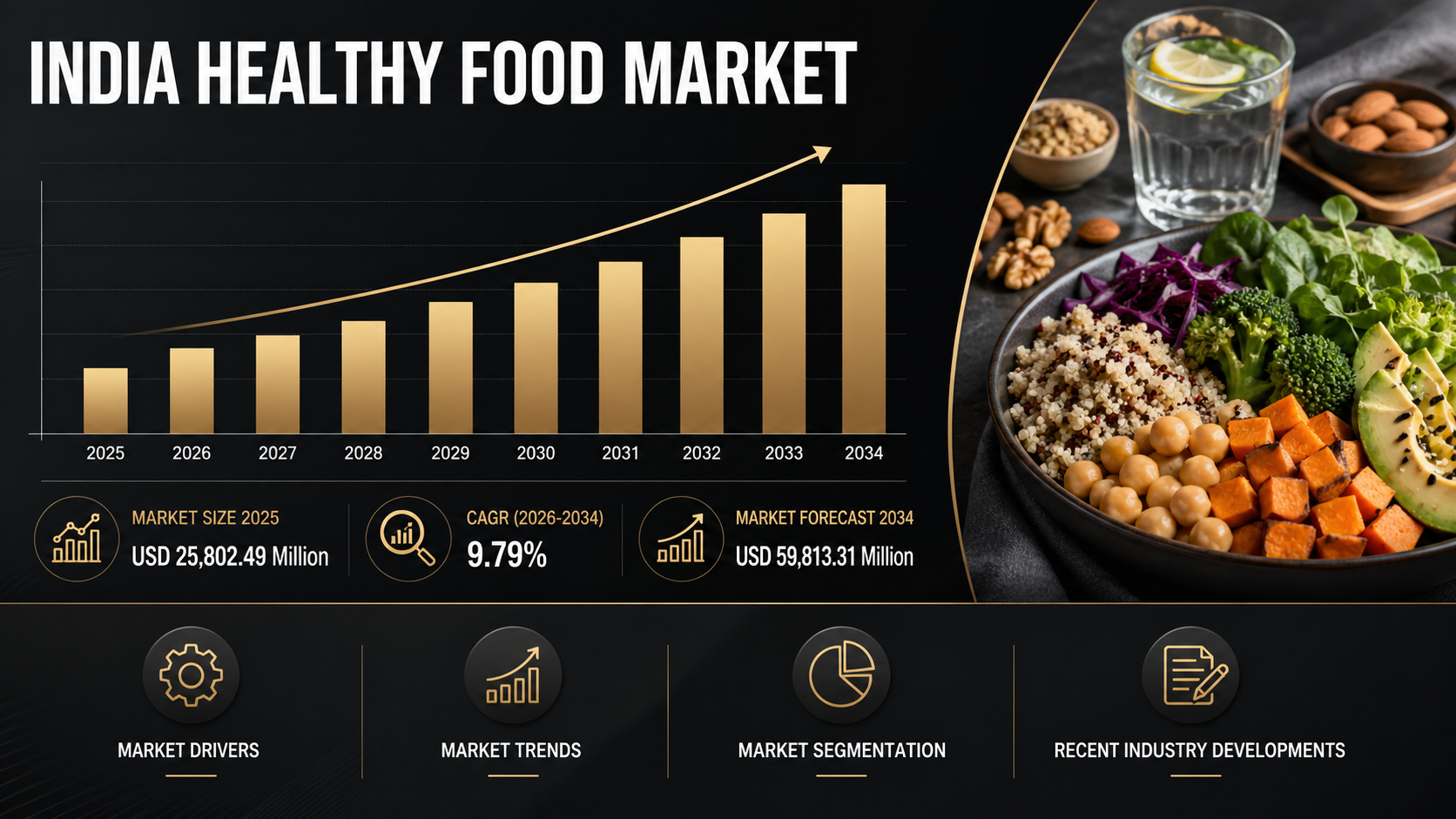
The India healthy food market size reached USD 25.80 Billion in 2025. Looking forward, the market is projected to reach USD 59.81 Billion by 2034, exhibiting a highly robust compound annual growth rate (CAGR) of 9.79% during 2026-2034. The industry is experiencing a profound, scientifically-backed structural transformation. Moving away from generic wellness claims, the market is now tightly governed by stringent new regulatory frameworks from the Food Safety and Standards Authority of India (FSSAI) and updated nutritional benchmarks set by the Indian Council of Medical Research (ICMR-NIN). As the government heavily incentivizes domestic production of indigenous, climate-resilient grains through massive Production Linked Incentive (PLI) schemes, the healthy food sector has formalized into a highly compliant, evidence-based FMCG powerhouse.
Market Size & Forecast:
- Market Size (2025): USD 25.80 Billion
- Projected Market Size (2034): USD 59.81 Billion
- CAGR (2026 - 2034): 9.79%
- Leading Regional Market: North India (33.8% Share)
Key Market Trends:
- Regulatory Shift to BOLD Nutritional Disclosures: Following the FSSAI's significant 2024-2026 regulatory amendments, food brands are now legally required to display sugar, salt, and saturated fat contents in bold and larger font sizes on packaging. Furthermore, facing pressure from the Supreme Court, the FSSAI is transitioning the market toward clear tabular declarations of Recommended Daily Allowances (RDA) for High Fat, Sugar, and Salt (HFSS) foods, eliminating deceptive label designs.
- Formulations Engineered for PLI Compliance: Rather than just marketing millets generically, manufacturers are specifically engineering their Ready-to-Cook (RTC) and Ready-to-Eat (RTE) products to contain strictly over 15% millet content. Hitting this precise formulation threshold ensures companies qualify for the Ministry of Food Processing Industries (MoFPI) PLI scheme, which provides a highly lucrative 9% financial incentive on incremental sales for FY 2025–26.
- ICMR-Backed Protein Complementarity in FMCG: Moving past the generic "plant-based" trend, brands are formulating vegetarian foods based strictly on the ICMR-NIN's amino acid guidelines. Because cereals are lower in lysine and pulses lack methionine, manufacturers are launching scientifically blended cereal-pulse combinations (like specific dal-rice or soy-chana mixes) that offer a complete, complementary protein profile capable of meeting the ICMR's 0.83 g/kg daily requirement without relying on meat.
- Mandatory Allergen and Descending Ingredient Transparency: As part of the strict 2026 FSSAI labeling enforcement, brands are entirely restructuring their ingredient panels. Ingredients must now legally appear in exact descending order of weight or volume. Simultaneously, the mandatory and highly visible declaration of common allergens (milk, nuts, soy, gluten) is driving a massive trend of specialized, allergen-free healthy snack lines.
- Phasing Out of "Health-Washing" via Supreme Court Deadlines: The Indian Supreme Court has issued strict deadlines to formalize Front-of-Pack Labeling (FoPL) rules to combat rising lifestyle diseases. This judicial intervention is forcing FMCG companies to abandon vague, unsubstantiated claims like "100% natural" or "healthy" and replace them with standardized, scientifically verifiable nutrition facts, permanently altering food marketing strategies.
➤ Request Sample Report (TOC & Charts): https://www.imarcgroup.com/india-healthy-food-market/requestsample
Strategic Market Dynamics:
Growth Drivers:
- Strategic Capital Infusion via MoFPI’s PLISFPI: The Production Linked Incentive Scheme for Food Processing Industry (PLISFPI), backed by an ₹800 crore outlay, serves as a massive supply-side catalyst. By directly subsidizing the manufacturing of millet-based products and rewarding a minimum 10% CAGR in sales, this government capital injection is aggressively scaling domestic production capabilities for MSMEs and large food corporations alike.
- Combatting the Dual Burden of Malnutrition: As highlighted in the newly expanded 2024-2025 ICMR-NIN Dietary Guidelines, India faces a severe "dual burden" widespread undernutrition existing simultaneously with a massive spike in urban obesity and diet-related non-communicable diseases. This critical public health crisis acts as an absolute driver, forcing both consumers and institutional buyers to procure nutrient-dense, low-glycemic healthy foods.
- Institutional Alignment with ICMR-NIN Frameworks: The updated Dietary Guidelines for Indians serve as a foundational resource for public health policymakers. Because government and institutional canteens (schools, hospitals, defense sectors) are aligning their bulk procurement policies with these verified guidelines which emphasize diverse, nutrient-rich foods over refined carbohydrates there is a guaranteed, high-volume baseline demand for compliant healthy food manufacturers.
- Strict Enforcement of the 14-Digit FSSAI Validation: The rigorous 2026 enforcement requiring the 14-digit FSSAI license number to be prominently displayed and verifiable via a central login portal is rapidly formalizing the healthy food sector. By weeding out unorganized, unregulated, and counterfeit "diet" food fabricators, this mandate funnels the entirety of consumer spending directly toward organized, compliant healthy food brands, boosting their overall market share.
- Climate-Resilient Agriculture (ESG) Integration: The ICMR-NIN guidelines emphasize the critical connection between sustainable food choices and human health. Consequently, FMCG giants are investing heavily in drought-resistant, low-water-footprint crops (like sorghum and pearl millet) to insulate their supply chains against increasingly erratic monsoons. This alignment with global ESG (Environmental, Social, and Governance) targets stabilizes long-term raw material costs and ensures consistent production.
Market Restraints:
- Cost Constraints of Compliance and Reformulation: Navigating the complex regulatory landscape such as conducting continuous third-party FSSAI label audits, reformulating recipes to avoid mandatory HFSS (High Fat, Sugar, and Salt) warnings, and upgrading packaging to display bolded nutritional fonts imposes severe operational and R&D costs. This regulatory burden heavily strains the profit margins of mid-sized healthy food startups.
- The High Cost of an ICMR-Compliant Diet: Despite aggressive government promotion, achieving a scientifically optimal, diverse diet remains economically challenging. The inherent premium placed on organically certified ingredients, high-quality vegetarian protein isolates, and specialized fortified grains restricts the consistent, daily consumption of premium healthy foods to affluent urban demographics, limiting deep rural penetration.
➤ Explore the Full Report with Charts, Table of Contents, and List of Figures: https://www.imarcgroup.com/india-healthy-food-market
Competitive Landscape & Key Company Insights:
The India healthy food market features a highly dynamic and fiercely competitive landscape. It is characterized by a convergence of legacy FMCG conglomerates (who are aggressively acquiring healthy brands or reformulating existing portfolios) and highly agile, digital-first health-tech startups. Competition is primarily fought on the basis of strict FSSAI compliance, the ability to engineer ICMR-aligned protein profiles, and securing MoFPI production incentives.
Deep-Dive Segment Insights:
Product Insights:
- Functional Foods
- Organic Foods
- BFY (Better-For-You) Foods
- Others
Key Insight: Organic foods dominate the market as the largest segment in 2025. However, Functional Foods and BFY categories are undergoing the most rigorous transformations as they align their ingredient lists and protein profiles with the latest ICMR-NIN scientific benchmarks to secure clinical credibility.
Distribution Channel Insights:
- Supermarkets & Hypermarkets
- Convenience Stores
- Specialty Stores
- Online Retailers
Key Insight: Supermarkets and hypermarkets strictly lead the market with a 36.7% share in 2025, offering consumers the ability to physically inspect the newly mandated bold FSSAI nutritional panels. However, Online Retailers represent the fastest-growing channel, fueled by direct-to-consumer traceability.
Region Insights:
- North India
- South India
- East India
- West India
Key Insight: North India commands the largest regional market share at 33.8% in 2025. This strong position is underpinned by highly concentrated urban populations in the Delhi-NCR region and robust retail infrastructure capable of maintaining strict regulatory compliance across the supply chain.
Recent News and Developments:
- Supreme Court Deadlines for Front-of-Pack Labeling (2025-2026): In a landmark push for clearer nutrition transparency, the Supreme Court of India set firm deadlines for the Union Government to finalize Front-of-Pack Labeling (FoPL) rules. In response to the ongoing legal pressure, FSSAI has filed affidavits proposing tabular declarations of daily added sugar and salt allowances to curb the consumption of HFSS foods.
- FSSAI Mandates Bold Fonts for Sugar and Salt (July 2026): Following the major 2024 amendments approved in the 44th Food Authority meeting, FSSAI has aggressively tightened label audits throughout 2026. Food brands face massive penalties or product recalls if they fail to display total sugar, sodium, and saturated fat in bold, enlarged typography on their nutritional panels.
- ICMR-NIN Releases Updated Dietary Guidelines (2024-2025): The ICMR-National Institute of Nutrition (NIN) published comprehensive new dietary guidelines addressing India's dual burden of undernutrition and obesity. The guidelines provide strict scientific benchmarks for balancing vegetarian protein intake through specific cereal-pulse combinations, offering a blueprint for FMCG product reformulations.
- MoFPI Opens PLI Incentive Claim Filing (2025-2026): The Ministry of Food Processing Industries officially opened the incentive claim filing window for the PLISFPI scheme for the financial year 2025-26. Companies manufacturing Ready-to-Cook (RTC) and Ready-to-Eat (RTE) foods containing over 15% millet are actively claiming up to 9% financial incentives on their incremental sales, driving a massive surge in domestic healthy food manufacturing.
Customization Note: If you require any specific information not covered within this report's scope, we will provide it as part of the customization.
➤ Request Report Customization: https://www.imarcgroup.com/request?type=report&id=45101&flag=E
Q1. How big is the India healthy food market?
Ans. The India healthy food market was valued at USD 25.80 Billion in 2025.
Q2. What is the projected growth rate of the India healthy food market?
Ans. The market is projected to reach USD 59.81 Billion by 2034, exhibiting a robust CAGR of 9.79% during the 2026-2034 forecast period.
Q3. What are the key factors driving the market?
Ans. The market is aggressively driven by the MoFPI's ₹800 crore PLI scheme for millet-based foods, the adoption of ICMR-NIN dietary guidelines to combat the dual burden of malnutrition, and the formalization of the industry via strict FSSAI licensing mandates.
Q4. Which product segment leads the India healthy food market?
Ans. Organic foods strictly dominate the market, though functional and Better-For-You (BFY) foods are rapidly scaling by aligning with ICMR protein complementarity recommendations.
Q5. How are new Supreme Court and FSSAI regulations impacting the industry?
Ans. Under Supreme Court pressure to finalize Front-of-Pack Labeling (FoPL), FSSAI is enforcing strict rules that require sugar, salt, and saturated fat to be printed in bold fonts. This effectively ends deceptive "health-washing" and forces brands to reformulate their recipes to meet clean nutritional standards.
Strategic Insight & Verdict:
The India healthy food market is undergoing a highly lucrative, scientifically governed maturation cycle. Expanding to a projected USD 59.81 Billion by 2034 at a 9.79% CAGR, the sector has fundamentally evolved from a landscape of vague wellness marketing into a strictly regulated FMCG powerhouse. Anchored by the ICMR-NIN's definitive dietary guidelines targeting the dual burden of malnutrition, the industry is witnessing a massive pivot toward scientifically engineered cereal-pulse protein combinations. Furthermore, monumental regulatory shifts driven by Supreme Court mandates on Front-of-Pack Labeling and FSSAI's strict rules on bold nutritional disclosures have permanently eradicated deceptive marketing practices. Manufacturers that strategically reformulate their portfolios to qualify for the MoFPI's lucrative 15% millet PLI incentives, ensure absolute transparency in descending ingredient lists, and align with ICMR macronutrient benchmarks are exceptionally well-positioned to capture enduring market dominance over the forecast period.