
India Hair Oil Market Outlook
The latest research report by IMARC Group on the India Hair Oil Market provides a comprehensive forecast of the industry's size, share, and emerging trends from 2026 to 2034. It offers an in-depth analysis across various types, product types, categories, applications, distribution channels, and regions, covering all critical metrics of the country's hair care and personal grooming ecosystem.
How Big is the Hair Oil Market in India?
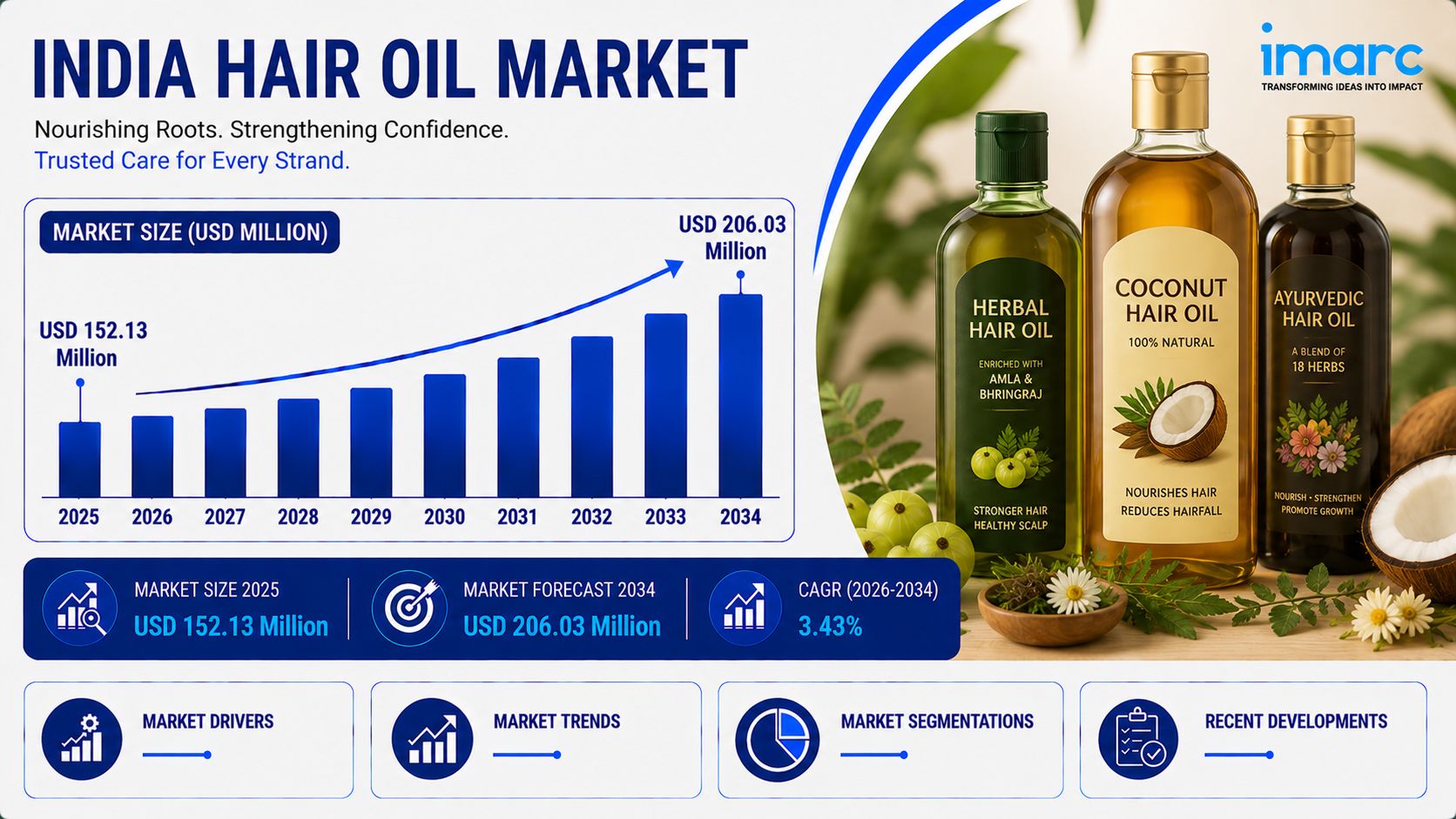
The India hair oil market outlook indicates that the market size reached USD 152.13 Million in 2025 and is projected to reach USD 206.03 Million by 2034, exhibiting a growth rate of 3.43% during 2026–2034. The India hair oil market growth is driven by the regulatory formalization of Ayurvedic products through FSSAI frameworks that enhance consumer confidence and manufacturer clarity, the rapid digital transformation expanding e-commerce accessibility across urban and rural markets, and the escalating consumer preference for natural and Ayurvedic formulations over synthetic alternatives.
Emerging Trends in the India Hair Oil Market:
- Regulatory Framework for Ayurvedic Products:
The India hair oil market growth is being significantly propelled by comprehensive regulatory developments that formalize Ayurvedic product manufacturing and distribution. In July 2025, the Food Safety and Standards Authority of India (FSSAI), working in close collaboration with the Ministry of Ayush, released an exhaustive list of Ayurvedic food preparations classified under "Ayurveda Aahara" as part of the Food Safety and Standards (Ayurveda Aahara) Regulations, 2022. This landmark regulatory initiative represents a crucial step in integrating India's ancient dietary and wellness wisdom into modern food safety frameworks, thereby providing unprecedented clarity for both manufacturers and consumers. The regulations mandate that food businesses operating across India must apply for specific licenses to produce and market traditional Ayurvedic foods starting from September 2025, with applications processed through the Food Safety Compliance System (FoSCoS) portal. This regulatory clarity not only protects consumers by ensuring product safety and authenticity but also empowers manufacturers to innovate with confidence, knowing their products meet national standards.
- Digital Transformation and E-Commerce Expansion Revolutionizing Distribution Channels:
The Indian hair oil market is undergoing a profound transformation propelled by the rapid expansion of digital commerce and omnichannel retail strategies that are democratizing access to diverse product portfolios across geographical boundaries. Online retail channels are projected to register robust compound annual growth rates throughout the forecast period as consumers increasingly leverage e-commerce platforms to explore extensive product selections, compare competitive pricing, access authentic customer reviews, and obtain expert recommendations without the traditional constraints of physical retail environments. The proliferation of mobile commerce applications, coupled with aggressive promotional campaigns and discount offerings on leading e-commerce platforms such as Amazon India, Flipkart, Nykaa, and specialized beauty marketplaces, has fundamentally altered consumer purchasing behaviors by delivering unprecedented convenience and value propositions. The rise of influencer marketing and beauty content creators who demonstrate product applications and share authentic testimonials has significantly amplified product awareness and driven purchase intent among millennial and Generation Z demographics.
- Rising Consumer Demand for Natural and Ayurvedic Formulations:
Consumer preferences in the Indian hair oil market are experiencing a decisive shift toward natural, organic, and Ayurvedic formulations as health consciousness intensifies and awareness about harmful synthetic ingredients grows across urban and semi-urban demographics. This transition is particularly pronounced among educated consumers who actively scrutinize product labels while also seeking transparency about ingredient sourcing, manufacturing processes, and the absence of parabens, sulfates, silicones, and mineral oils that have been associated with long-term hair and scalp damage. Traditional Ayurvedic ingredients including amla (Indian gooseberry), bhringraj (false daisy), coconut oil, neem, hibiscus, and fenugreek are witnessing unprecedented demand as consumers rediscover time-honored formulations rooted in centuries of wellness practices. In August 2024, Marico Limited exemplified this market evolution by launching Hair & Care Oil in Serum, an innovative product that strategically combines the styling benefits of modern hair serums with the nourishing properties of almond oil enriched with Vitamin E.
➤ Request Sample Report with Datasheet – TOC, Charts & Key Insights: https://www.imarcgroup.com/india-hair-oil-market/requestsample
Growth Factors Driving the India Hair Oil Market:
- Regulatory Clarity Enhancing Consumer Confidence and Manufacturer Innovation:
The comprehensive regulatory developments formalizing Ayurvedic product manufacturing are providing unprecedented clarity for both manufacturers and consumers. The Ayurveda Aahara regulations establish clear, pre-approved references for manufacturing products under the Ayurveda Aahara category, ensuring both authenticity and regulatory compliance while supporting industry growth. By creating this structured pathway, the government has effectively addressed longstanding ambiguities in the classification and regulation of Ayurvedic personal care and wellness products, including hair oils that incorporate traditional formulations. This regulatory clarity not only protects consumers by ensuring product safety and authenticity but also empowers manufacturers to innovate with confidence, knowing their products meet national standards. The initiative reflects the Government of India's broader commitment to promoting traditional knowledge systems while maintaining rigorous safety protocols, ultimately strengthening consumer trust in Ayurvedic hair care products.
- Digital Transformation Democratizing Access Across Geographies:
The rapid expansion of digital commerce and omnichannel retail strategies is democratizing access to diverse product portfolios across geographical boundaries. E-commerce platforms enable consumers to explore extensive product selections, compare competitive pricing, access authentic customer reviews, and obtain expert recommendations without the traditional constraints of physical retail environments. The proliferation of mobile commerce applications, combined with aggressive promotional campaigns, has fundamentally altered consumer purchasing behaviors by delivering unprecedented convenience and value propositions. Quick delivery services, including same-day and next-day fulfillment options now extending into tier-2 and tier-3 cities, have eliminated traditional barriers to product accessibility while enhancing customer satisfaction. Social commerce innovations, where brands leverage Instagram, Facebook, and emerging platforms for direct-to-consumer sales, are creating additional touchpoints for consumer engagement and enabling even smaller regional brands to compete effectively with established national players.
- Escalating Consumer Preference for Natural and Ayurvedic Formulations:
Health consciousness and awareness about harmful synthetic ingredients are driving a decisive shift toward natural, organic, and Ayurvedic formulations across urban and semi-urban demographics. Traditional Ayurvedic ingredients including amla, bhringraj, coconut oil, neem, hibiscus, and fenugreek are witnessing unprecedented demand as consumers rediscover time-honored formulations rooted in centuries of wellness practices. The success of blended oils that combine multiple natural ingredients has been remarkable, with these formulations capturing substantial market share as consumers recognize the holistic benefits of synergistic ingredient combinations. The premiumization trend is evident as consumers demonstrate willingness to pay higher prices for certified organic, cruelty-free, and sustainably sourced products that align with their values. This consumer evolution is compelling even mass-market brands to reformulate existing products and launch new variants that emphasize natural credentials while maintaining affordability for price-sensitive segments.
Industry Value Chain Analysis:
- Raw Material Sourcing and Cultivation: Suppliers provide coconut, almond, argan, amla, bhringraj, and other botanical ingredients, with growing emphasis on organic and sustainably sourced inputs to meet clean-label consumer expectations.
- Processing and Formulation: Manufacturers extract, refine, and blend botanical oils with additives and preservatives to create finished products across light, heavy, and cooling hair oil categories, with increasing investment in research and development for innovative formulations.
- Quality Assurance and Compliance: Products undergo testing to verify purity, safety, and efficacy claims, with FSSAI and Ayurveda Aahara regulations establishing standards for manufacturing and labeling.
- Packaging and Brand Development: Brands invest in packaging innovation, design, and marketing campaigns to differentiate products, with growing emphasis on sustainable packaging and transparent ingredient labeling.
- Distribution and Retail: Products reach consumers through supermarkets and hypermarkets, pharmacies, online stores, and other channels, with omnichannel strategies improving access across urban and rural markets.
Market Segmentation Analysis
IMARC Group's latest research report on the India Hair Oil Market categorizes the market based on type, product type, category, application, distribution channel, and region.
By Type
The market is categorized into light hair oil, heavy hair oil, cooling hair oil, and others. Light hair oils are gaining popularity among urban consumers seeking non-greasy, everyday nourishment options, while heavy hair oils remain popular for deep conditioning treatments. Cooling hair oils address specific consumer needs around scalp health and comfort, particularly in warmer regions.
By Product Type
The market covers coconut oil, almond oil, argan oil, and others. Coconut oil represents a well-established segment with deep cultural roots and widespread household adoption across India, while almond oil and argan oil are gaining traction among premium consumers seeking specialized benefits. Blended formulations combining multiple natural ingredients are also expanding.
By Category
The market is segmented into non-medicated and medicated hair oils. Non-medicated products dominate household consumption, while medicated hair oils address specific scalp conditions and hair concerns, often positioned through pharmacies and dermatologist recommendations.
By Application
The market covers individual and commercial applications. Individual consumers represent the dominant application segment, while commercial applications include salons, spas, and professional hair care services that use bulk quantities of hair oil products.
By Distribution Channel
The market covers supermarkets and hypermarkets, pharmacies, online stores, and others. Supermarkets and hypermarkets remain significant channels due to product visibility and one-stop shopping convenience, while online stores are the fastest-growing channel, driven by convenience, product variety, and competitive pricing.
By Region
The report covers North India, South India, East India, and West India. South India leads due to the strong cultural tradition of hair oil usage, high coconut production, and warm climate that makes oil application a year-round practice. North India benefits from high urbanization and disposable incomes, while West and East India are emerging as significant markets driven by rising awareness and expanding retail infrastructure.
Competitive Landscape & Key Player Positioning:
Covering an in-depth analysis of the competitive landscape, market structure, key player positioning, competitive dashboards, top winning strategies, and detailed profiles of all major industry participants you will gain access to all these exclusive insights within the full research report.
Latest Recent Developments in the India Hair Oil Market:
- Marico Limited Launches Hair & Care Oil in Serum (August 2024): Marico Limited launched Hair & Care Oil in Serum, an innovative product that strategically combines the styling benefits of modern hair serums with the nourishing properties of almond oil enriched with Vitamin E. This product launch across West Bengal, Orissa, Punjab, and Northeast regions at an accessible price point of Rs 2 per use demonstrates how leading manufacturers are responding to consumer aspirations for premium yet affordable hair care solutions.
- FSSAI and Ministry of Ayush Release Ayurveda Aahara Regulations (July 2025): The Food Safety and Standards Authority of India (FSSAI), working in close collaboration with the Ministry of Ayush, released an exhaustive list of Ayurvedic food preparations classified under "Ayurveda Aahara" as part of the Food Safety and Standards (Ayurveda Aahara) Regulations, 2022, providing unprecedented clarity for manufacturers and consumers of Ayurvedic hair care products.
Customization Note: If you require any specific information not covered within this report's scope, we will provide it as part of the customization.
Frequently Asked Questions (FAQs)
Q1. What is the current size of India's hair oil market?
The India hair oil market reached a value of USD 152.13 Million in 2025.
Q2. What is the CAGR for India's hair oil market (2026-2034)?
The market is projected to grow at a CAGR of 3.43% during 2026-2034, reaching USD 206.03 Million by 2034.
Q3. What are the key types in India's hair oil market?
The market is categorized into light hair oil, heavy hair oil, cooling hair oil, and others.
Q4. What are the major regions covered in India's hair oil market?
The report covers North India, South India, East India, and West India.
Q5. What are the key factors driving the India hair oil market?
Key growth drivers include the regulatory formalization of Ayurvedic products through FSSAI frameworks enhancing consumer confidence and manufacturer clarity, rapid digital transformation expanding e-commerce accessibility across urban and rural markets, and supported by rising disposable incomes and heightened awareness about hair health. Key trends include rising demand for Ayurvedic and herbal blended oils combining traditional ingredients such as amla, rapid expansion of online retail and social commerce platforms, and increasing product innovation targeting lightweight, non-greasy formats suited to evolving urban lifestyle and grooming preferences.