
India Green Building Materials Market Overview
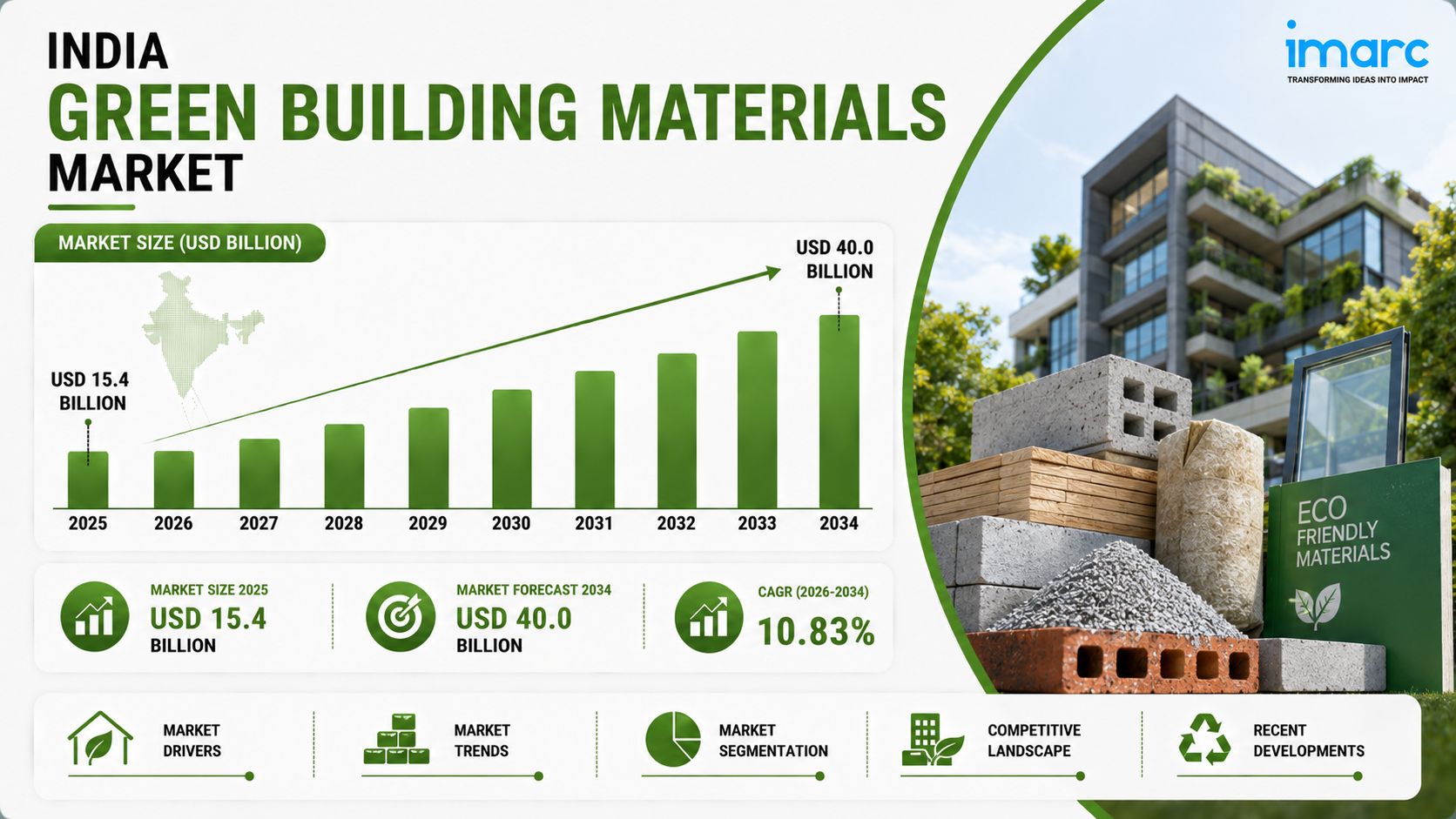
India's green building materials market stands as a transformative segment within the broader construction and real estate industry, encompassing diverse applications such as insulation, roofing, framing, interior finishing, exterior siding, and others. The market serves widespread infrastructural developments spanning North India, South India, East India, and West India. The India green building materials market size increased from USD 15.4 Billion in 2025 to USD 17.6 Billion in 2026. Looking forward, the market is projected to reach USD 40.0 Billion by 2034, exhibiting a compound annual growth rate (CAGR) of 10.83% during 2026-2034.
The market is expanding rapidly due to a structural shift towards sustainable urban development, stringent environmental compliance mandates, and the rising prominence of green building certifications such as LEED and GRIHA. As rapid urbanization intensifies, developers are aggressively integrating energy-efficient and low-emission materials to reduce the massive carbon footprint of the construction sector. Furthermore, the commercialization of innovative, bio-based alternatives and the utilization of industrial waste streams to produce affordable structural components are democratizing access to sustainable construction. With major infrastructure initiatives prioritizing sustainability and a growing consumer preference for eco-friendly housing, leading manufacturers are actively competing to capture a larger India green building materials market share, structurally transforming the country's construction landscape over the next decade.
Market Snapshot
- Current Market Size (2025): USD 15.4 Billion
- Market Size (2026): USD 17.6 Billion
- Projected Market Size (2034): USD 40.0 Billion
- CAGR: 10.83%
- Insulation and interior finishing represent highly dominant application segments, driven by the critical need to enhance thermal efficiency and safeguard indoor air quality in modern high-rise developments.
- North India and South India command significant regional market shares, anchored by rapid commercial real estate expansion, IT park developments, and the highest concentration of LEED-certified green buildings.
- The adoption of Autoclaved Aerated Concrete (AAC) blocks and green cement is aggressively replacing conventional red bricks and Portland cement, acting as a massive volume driver.
What Growth Factors Are Driving India Green Building Materials Market?
- Expanding Residential and Commercial Construction Sector:
The rapid urbanization and continuous expansion of the residential and commercial construction sectors in India serve as primary catalysts for market growth. As major metropolitan areas witness a surge in high-rise buildings and modern commercial complexes, developers are increasingly integrating sustainable building materials to meet strict environmental compliance and secure prestigious green certifications like LEED. This fundamental shift from conventional, energy-intensive materials towards eco-friendly alternatives is driving substantial volume demand across the country, encouraging manufacturers to drastically scale their production capacities and lower overall product costs.
- Surging Demand for Energy Efficiency and Insulation:
Escalating energy costs and a growing emphasis on maintaining optimal indoor environmental quality are significantly boosting the demand for advanced insulation materials across India. Green building materials, such as high-performance roofing and exterior siding, fundamentally enhance the thermal efficiency of structures, thereby reducing the reliance on artificial heating and cooling systems. By minimizing long-term operational expenditures and lowering overall carbon footprints, these energy-efficient solutions are becoming indispensable for both new infrastructural developments and large-scale retrofitting projects, permanently reshaping the modern Indian construction landscape.
- Heightened Environmental Awareness Among the Masses:
Rising environmental consciousness among the general public and corporate stakeholders is fundamentally transforming the Indian construction ecosystem. Consumers are actively demanding sustainable, low-emission residential projects that prioritize health and ecological preservation. This profound behavioral shift compels builders to utilize green building materials, including non-toxic interior finishing and low-volatile organic compound (VOC) paints, which safeguard indoor air quality. As sustainability becomes a core purchasing criterion rather than a niche preference, material suppliers are aggressively expanding their eco-friendly portfolios to capture a larger market share.
- Rising Cost-Competitiveness of Eco-Friendly Solutions:
Historically, the premium pricing of sustainable construction materials deterred widespread adoption across price-sensitive segments in India. However, significant technological advancements, localized manufacturing, and robust economies of scale have drastically reduced the production costs of green building materials. Innovative indigenous companies are utilizing abundant agricultural waste and recycled industrial byproducts to manufacture highly durable, affordable structural components. This growing cost-competitiveness effectively bridges the gap between conventional and sustainable materials, accelerating the rapid market penetration of eco-friendly alternatives across both premium and affordable housing segments nationwide.
- Widespread Integration of Recycled and Reclaimed Materials:
The systematic integration of recycled and reclaimed materials is serving as a massive structural driver for the domestic market. Addressing the country’s mounting solid waste management challenges, manufacturers are innovatively converting plastic waste, construction debris, and industrial fly ash into highly resilient paver blocks, tiles, and green cement. This circular economy approach not only significantly reduces the embodied carbon of building components but also creates a reliable, continuous supply chain of affordable raw materials, structurally fortifying the long-term growth of the domestic green construction sector.
Government Policy Support
- Energy Conservation Building Code (ECBC): Mandatory regulations that set minimum energy standards for commercial buildings, directly stimulating the large-scale procurement of advanced insulation, smart glazing, and efficient roofing materials.
- Smart Cities Mission: The massive capital infusion into modernizing urban centers with sustainable infrastructure heavily incentivizes the deployment of green building materials across municipal and commercial projects.
- PMAY-Urban 2.0 (Technology & Innovation Sub-Mission): Government housing initiatives actively shifting the market away from conventional methods by promoting alternative, eco-friendly construction technologies for affordable mass housing.
- Make in India Initiative: Strategic incentives supporting domestic manufacturing and the agritech sector, providing essential capital subsidies for startups developing bio-based composite panels and zero-emission structural materials.
Evaluate Market Opportunity with the Business Sample Report
What Are the Latest Emerging Trends in India Green Building Materials Market?
- Proliferation of Bio-Based Composite Panels:
A prominent emerging trend reshaping the Indian market is the rapid commercialization of bio-based composite panels derived from abundant agricultural residue. Startups are innovatively converting wheat, rice, and sugarcane stubble into high-strength, structural building components. This ingenious approach actively mitigates severe air pollution caused by crop burning while simultaneously providing architects with highly sustainable, carbon-negative alternatives to traditional wood and drywall. As awareness of these eco-friendly panels expands, they are rapidly gaining significant traction across both residential interior finishing and commercial modular construction projects nationwide.
- Adoption of Zero-Emission and Carbon-Negative Bricks:
The domestic market is witnessing a decisive shift toward the adoption of zero-emission and carbon-negative bricks. Emerging indigenous startups are leveraging advanced material science to engineer highly durable bricks that completely eliminate greenhouse gas emissions during both their manufacturing process and operational lifecycle. These innovative, pest-resistant, and fire-retardant structural elements offer immense environmental benefits over traditional energy-intensive clay bricks. By effectively capturing and sequestering carbon, these next-generation building materials are rapidly establishing a new baseline for sustainable masonry in modern Indian infrastructural development projects.
- Implementation of Smart and Adaptive Green Windows:
The integration of smart, adaptive green window technologies is emerging as a highly influential trend in modern Indian architecture. These advanced glazing systems intelligently adjust their tint and opacity in real-time to control solar heat gain and optimize natural daylight penetration. By significantly reducing the massive energy loads associated with severe summer cooling requirements, these high-performance windows are becoming a staple in premium commercial complexes and luxury residential towers. This technological evolution effectively bridges the gap between sustainable building materials and cutting-edge digital building automation.
- Expansion of Autoclaved Aerated Concrete (AAC) Blocks:
Autoclaved Aerated Concrete (AAC) blocks are rapidly emerging as the preferred lightweight structural alternative to conventional red bricks across the Indian construction landscape. Manufactured using fly ash, a byproduct of thermal power plants, AAC blocks offer superior thermal insulation, exceptional fire resistance, and significantly faster construction timelines. Their lightweight nature drastically reduces the dead load on building foundations, translating to substantial savings in structural steel and cement. This powerful combination of structural efficiency, cost-effectiveness, and environmental sustainability is propelling their ubiquitous adoption across all regions.
- Rise of Green Cements and Low-Carbon Concrete:
The aggressive transition toward green cements and low-carbon concrete formulations represents a monumental shift within the heavy construction sector. Leading domestic cement manufacturers are systematically replacing highly polluting clinker with sustainable supplementary cementitious materials, including industrial slag and calcined clay. These advanced formulations deliver exceptional structural durability while slashing massive carbon dioxide emissions associated with traditional concrete production. As public infrastructural mega-projects increasingly mandate stringent sustainability benchmarks, the rapid commercialization of green cement is permanently transforming the fundamental baseline of the Indian building materials industry.
How will India Green Building Materials Market Evolve in the Coming Years?
The India green building materials market possesses exceptionally robust growth prospects through 2034, driven by a permanent structural shift toward sustainable urbanization and stringent environmental compliance. The market is projected to expand dramatically from USD 17.6 Billion in 2026 to USD 40.0 Billion by 2034 at a compound annual growth rate (CAGR) of 10.83%. As corporate environmental, social, and governance (ESG) mandates become stricter, the baseline integration of low-emission, recycled, and energy-efficient materials will transition from a premium luxury to a standard industry requirement. Manufacturers that heavily invest in localized R&D, commercialize bio-based alternatives derived from agricultural waste, and forge strategic partnerships with massive real estate developers are optimally positioned to dominate the sector over the coming decade.
How Is India's Green Building Materials Market Segmented?
➤ By Application
- Insulation
- Roofing
- Framing
- Interior Finishing
- Exterior Siding
- Others
➤ By Region
- North India
- South India
- East India
- West India
Competitive Landscape — By IMARC GROUP
The competitive landscape of the India green building materials market is highly dynamic and moderately fragmented. It features a diverse mix of massive multinational conglomerates, established domestic cement and steel giants, and a surging wave of innovative indigenous startups specializing in bio-based and recycled material science. Competition is fiercely centered around product durability, lifecycle carbon footprints, thermal insulation properties, and the ability to seamlessly align with prestigious green building certification standards (such as LEED and IGBC). Market leaders are aggressively expanding their localized manufacturing capabilities and distribution networks to ensure consistent, cost-effective supply to large-scale infrastructural and residential developers.
Frequently Asked Questions
How big is the green building materials market in India?
➤ The India green building materials market reached USD 15.4 Billion in 2025 and expanded to USD 17.6 Billion in 2026, supported by rapid urbanization, expanding commercial real estate, and strict environmental compliance mandates.
What is the projected growth rate of the India green building materials market?
➤ The market is projected to reach USD 40.0 Billion by 2034, registering a highly robust compound annual growth rate (CAGR) of 10.83% between 2026 and 2034.
What are the key factors driving market growth?
➤ Key drivers include the massive surge in energy-efficient high-rise constructions, rising consumer awareness regarding indoor air quality, the aggressive commercialization of affordable AAC blocks, and strong government initiatives promoting sustainable smart cities.