
India Emobility Market Overview
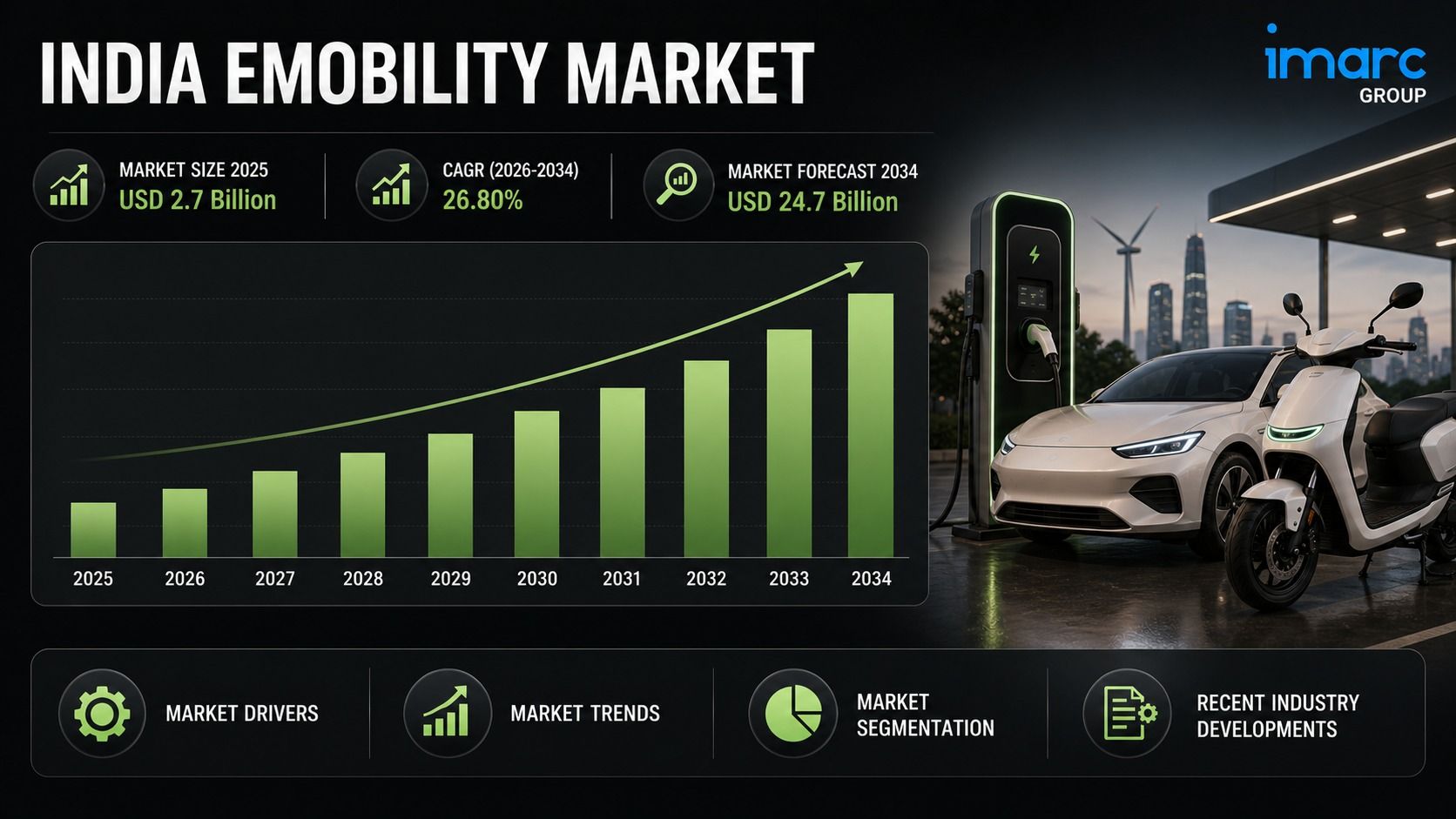
India's emobility market stands as a transformative technological pillar within the country's rapidly evolving transportation and energy sectors. The market encompasses a diverse range of products, including electric cars, electric motorcycles, electric scooters, electric bikes, and others. Operating across various voltage architectures such as less than 24V, 24V, 36V, 48V, and greater than 48V these vehicles heavily utilize energy storage systems including sealed lead acid, li-ion, and NiMH batteries. Serving an incredibly vast consumer base, the market spans extensive geographical zones across North India, South India, East India, and West India. The India emobility market size reached USD 2.7 Billion in 2025 and is projected to reach USD 24.7 Billion by 2034, exhibiting a robust compound annual growth rate (CAGR) of 26.80% during 2026-2034.
The market is expanding rapidly due to a powerful confluence of massive government subsidies, aggressive localization of manufacturing, and deeply shifting consumer preferences driven by escalating fossil fuel costs. The exponential growth of electric two-wheelers in congested urban centers, coupled with the rapid integration of advanced lithium-ion batteries and smart connectivity, has fundamentally transitioned electric vehicles from niche novelties into mainstream mobility solutions. With major logistical fleets electrifying their operations and deep-tech collaborations accelerating battery cell innovation, top automotive players and agile startups are fiercely competing to establish robust market dominance and effectively capture a larger share of India’s rapidly evolving green transportation ecosystem over the coming decade.
Market Snapshot
- Current Market Size (2025): USD 2.7 Billion
- Projected Market Size (2034): USD 24.7 Billion
- CAGR: 26.80%
- Electric scooters completely dominate the product segment by a massive volume margin, acting as the indispensable workhorse for both everyday urban commuters and expansive last-mile logistics fleets.
- Lithium-ion (Li-ion) batteries are strictly dictating the market landscape, ensuring standard modern ranges due to their exceptionally high energy density and rapidly improving charging capabilities.
- The 48V segment captures the majority of the market share, providing the optimal voltage architecture to balance required power output and strict battery safety standards for high-speed two-wheelers.
What Growth Factors Are Driving India Emobility Market?
Aggressive Government Subsidies and Financial Incentives:
The continuous deployment of massive government subsidies and financial incentives acts as the primary catalyst for domestic market expansion. Strategic frameworks, prominently including the PM E-DRIVE initiative, provide substantial upfront capital reductions that drastically lower the barrier to entry for price-sensitive buyers across the country. By mandating the utilization of advanced battery technologies to qualify for these robust subsidies, the government simultaneously ensures the overall quality of the national electric vehicle fleet while accelerating the transition away from highly polluting traditional internal combustion engine transport.
Explosive Growth of Electric Two-Wheelers in Urban Commuting:
Electric two-wheelers, particularly electric scooters, are aggressively driving the overarching adoption volumes within the highly congested Indian urban centers. Characterized by incredibly compelling total cost of ownership benefits over conventional petrol scooters, these compact vehicles have transitioned from niche novelties into indispensable mainstream mobility solutions. Their immense popularity among daily commuters and massive deployment by commercial last-mile delivery fleets are significantly boosting retail sales volumes. This unprecedented demand simultaneously empowers agile domestic startups to rapidly scale operations and challenge established legacy automotive manufacturers nationwide.
Massive Expansion of Domestic EV Manufacturing:
The aggressive localization of manufacturing processes and the establishment of vast domestic electric vehicle assembly hubs strongly propel the entire emobility ecosystem. Supported by robust Production Linked Incentive schemes, both legacy automakers and agile new entrants are injecting massive capital into domestic production lines. This widespread localization significantly reduces the historical reliance on expensive imported components while heavily leveraging India’s cost-effective industrial labor force. Consequently, manufacturers can dramatically lower retail vehicle acquisition costs, vastly improving the fundamental affordability and mass-market appeal of modern electric transport.
➤ Request Sample Report with Datasheet – TOC, Charts & Key Insights: https://www.imarcgroup.com/india-emobility-market/requestsample
Government Policy Support
- PM E-DRIVE Scheme: The massive flagship subsidy program aggressively reducing the upfront purchasing costs of electric vehicles, heavily mandating the use of advanced battery technologies to accelerate sustainable adoption.
- Production Linked Incentive (PLI) Scheme for Auto and Auto Components: Provides immense financial incentives to heavily localize the massive manufacturing of critical EV components, directly reducing import reliance.
- National Programme on Advanced Chemistry Cell (ACC) Battery Storage: A strategic initiative specifically aimed at heavily incentivizing the domestic establishment of large-scale gigafactories to ensure sovereign lithium-ion cell production.
- FAME II Implementation and State-Level EV Policies: Complemented by numerous highly progressive state-level policies offering road tax exemptions, heavy registration fee waivers, and robust subsidies for the aggressive deployment of charging infrastructure.
Evaluate Market Opportunity with the Business Sample Report
What Are the Latest Emerging Trends in India Emobility Market?
Rapid Proliferation of Commercial E-Commerce Fleets:
A defining trend actively reshaping the market is the aggressive transition of commercial e-commerce and logistics fleets entirely to electric vehicles. In response to mounting corporate sustainability targets and the urgent necessity to drastically slash last-mile delivery expenditures, major logistics players are systematically procuring thousands of high-capacity electric two-wheelers and three-wheelers. This massive bulk adoption not only ensures unparalleled operational profitability but also serves as a critical real-world validation of the underlying technology, subsequently boosting general consumer confidence and firmly anchoring the sector's long-term commercial viability.
Advancements in Swappable Battery Infrastructure:
The widespread implementation of advanced battery swapping networks is emerging as an indispensable structural solution for overcoming severe urban charging constraints. This innovative operational model completely eliminates persistent range anxiety by seamlessly enabling riders to exchange depleted battery packs for fully charged units within mere minutes. This strategic decoupling of the battery from the vehicle dramatically reduces the prohibitive upfront purchase price of electric scooters. Consequently, heavy commercial delivery riders and daily urban commuters are increasingly embracing this incredibly convenient, highly resilient, and flexible charging infrastructure.
Deep Tech Ecosystem Collaborations and Mentorship:
The industry is currently witnessing a massive wave of strategic collaborations between prominent electric vehicle manufacturers and critical government institutions to heavily localize deep technology. High-profile agreements, such as Ather Energy's collaboration with DPIIT, aim to actively mentor and aggressively support indigenous startups operating within the highly complex clean energy and battery cell ecosystem. This unprecedented, proactive knowledge-sharing infrastructure actively cultivates robust domestic intellectual property, drastically accelerating technological breakthroughs in battery chemistry and sophisticated motor design to solidly future-proof the entire Indian emobility landscape.
Integration of Artificial Intelligence and Smart Connectivity:
Modern electric vehicles are fundamentally transitioning from traditional mechanical transport into highly sophisticated, fully connected digital platforms. Leading domestic manufacturers are aggressively integrating advanced artificial intelligence and robust telematics directly into their premium electric scooters and cars. These intelligent systems consistently deliver real-time predictive maintenance alerts, dynamically optimize battery discharge rates, and provide highly intuitive smartphone integration. This incredible technological evolution effectively transforms the fundamental driving experience, ensuring that seamless digital connectivity and comprehensive smart features remain non-negotiable expectations for modern, tech-savvy urban consumers nationwide.
Expansion of Electric Vehicles into Semi-Urban Markets:
While major metropolitan centers have historically driven early adoption, an immense demand surge is currently accelerating across India's tier-2 and tier-3 semi-urban markets. Consumers in these regions are actively discovering the exceptional reliability, profound simplicity, and extremely low maintenance requirements of electric two-wheelers for short-distance daily commuting. Consequently, prominent legacy manufacturers and aggressive electric vehicle startups are dramatically expanding their authorized dealership and service networks deeper into rural geographies. This aggressive geographical expansion firmly establishes electric mobility as a genuinely ubiquitous, pan-Indian transportation phenomenon.
How will India Emobility Market Evolve in the Coming Years?
The India emobility market possesses exceptionally robust growth prospects through 2034, driven by a profound national pivot toward sustainable mobility, deeply integrated supply chain localization, and rapid consumer acceptance. The market is projected to expand dramatically from USD 2.7 Billion in 2025 to USD 24.7 Billion by 2034, registering an impressive CAGR of 26.80%. As domestic battery gigafactories become fully operational and widespread charging infrastructure scales across major highways, the remaining barriers of range anxiety and high battery replacement costs will systematically erode. Companies that heavily invest in AI-driven smart connectivity, deploy advanced battery-swapping networks, and aggressively expand their production capabilities to serve massive commercial fleets are optimally positioned to dominate the sector over the next decade.
How Is India's Emobility Market Segmented?
➤ By Product
- Electric Car
- Electric Motorcycle
- Electric Scooter
- Electric Bike
- Others
➤ By Voltage
- Less than 24V
- 24V
- 36V
- 48V
- Greater than 48V
➤ By Battery
- Sealed Lead Acid
- Li-ion
- NiMH
➤ By Region
- North India
- South India
- East India
- West India
Competitive Landscape By IMARC GROUP
The competitive landscape of the India emobility market is incredibly dynamic and fiercely contested, featuring a robust mix of powerful legacy automotive titans, highly agile and heavily funded domestic startups, and specialized global entrants. Competition heavily centers around maximizing vehicle range, ensuring stringent battery safety compliance, driving down total cost of ownership (TCO), and establishing vast, reliable charging and servicing networks. Market leaders are aggressively optimizing their portfolios by transitioning from initial premium offerings into highly affordable, mass-market electric scooters and cars, battling intensely to capture the rapidly growing demand among middle-class consumers and commercial delivery fleets.
Frequently Asked Questions
How big is the emobility market in India?
➤ The India emobility market size reached USD 2.7 Billion in 2025 and expanded to an estimated USD 3.42 Billion in 2026, heavily supported by massive electric two-wheeler adoption and stringent government sustainability mandates.
What is the projected growth rate of the India emobility market?
➤ The market is projected to reach an impressive USD 24.7 Billion by 2034, registering a rapid compound annual growth rate (CAGR) of 26.80% between 2026 and 2034.
What are the key factors driving market growth?
➤ Key drivers include the overwhelming cost advantage of EVs over escalating fossil fuels, massive structural expansions of domestic battery gigafactories, and immense bulk procurement of electric scooters by e-commerce logistics fleets.