
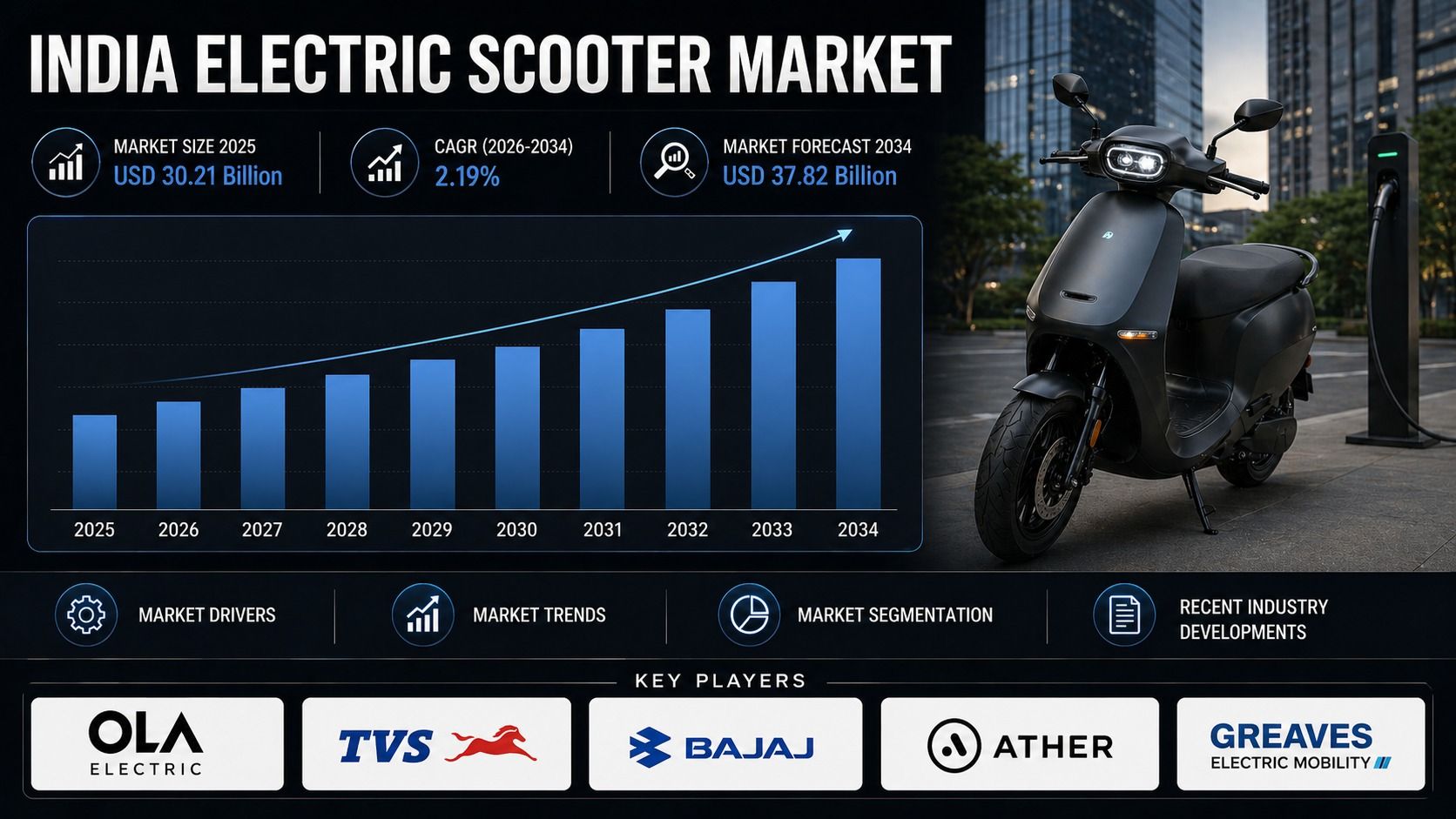
According to IMARC Group's report titled "India Electric Scooter Market Size, Share, Trends and Forecast by Drive, Battery, Product, Battery Fitting, End Use, and Region, 2026-2034", The report offers a comprehensive analysis of the industry, including market forecast, India electric scooter market growth, share, and regional insights.
The India electric scooter market was valued at USD 1.46 Billion in 2025 and is projected to reach USD 3.32 Billion by 2034, expanding at a CAGR of 9.22% during 2026-2034.
Validated by the latest India Electric Scooter Market Research Report 2026: Emerging Trends, 9.22% CAGR & Strategic $3.32 Billion Forecast by 2034], the subcontinent is aggressively transitioning from legacy internal combustion to scalable, electrified micro-mobility. For enterprise stakeholders, supply chain leaders, and institutional investors, this pivot unlocks high-yield capital deployment opportunities across indigenous manufacturing, battery integration, and smart charging infrastructure.
- Strategic Market Valuation: Driven by aggressive consumer and commercial adoption, the sector is securely forecast to reach a terminal valuation of USD 3.32 Billion by 2034, compounding at a highly lucrative 9.22% CAGR.
- B2B Fleet Electrification: Last-mile delivery aggregators and quick-commerce logistics networks are systematically converting to electric fleets to drastically compress per-kilometer OPEX and improve corporate ESG compliance.
- Localized Manufacturing Milestones: Propelled by stringent domestic sourcing mandates, Tier-1 OEMs are heavily de-risking supply chains by onshoring battery pack assemblies, motor manufacturing, and advanced power electronics.
- Battery Technology Evolution: The strategic pivot toward advanced lithium-iron-phosphate (LFP) chemistries is successfully neutralizing thermal runway risks, optimizing performance for tropical climates, and extending battery lifecycle ROI.
➤ Request Sample Report - Evaluate Core Statistics Driving Your Industry Trends
Why Invest in the India Electric Scooter Market: Key Growth Drivers & ROI
- Massive Consumption Base: India's aggressive urbanization and expanding middle class create an unprecedented, high-volume consumer base desperate for cost-effective micro-mobility. This demographic reality guarantees sustained, highly predictable demand, allowing investors to achieve rapid economies of scale and accelerated capital recuperation on localized manufacturing assets.
- Policy Support & Subsidies: Institutional capital expenditure is heavily de-risked by federal Production-Linked Incentives (PLI) and state-level EV procurement subsidies. These strategic financial frameworks aggressively lower localized production costs, neutralize early-stage R&D friction, and guarantee corporate investors superior payback periods compared to traditional manufacturing lines.
- Premiumization & Tech Upgrades: Modern consumers and commercial fleets are decisively migrating from low-speed budget variants to premium, high-performance connected scooters. This structural transition toward smart vehicles equipped with advanced telematics unlocks lucrative software-as-a-service (SaaS) revenue channels, significantly amplifying the profit margin per unit for stakeholders.
- Supply Chain Efficiencies: The rapid maturation of domestic component sourcing—particularly in specialized motor winding, chassis forging, and embedded electronics—is drastically reducing logistical bottlenecks. These optimized, localized supply chains minimize inventory holding costs, shield OEMs from global geopolitical friction, and stabilize long-term cash flows for enterprise investors.
India's Strategic Vision for the India Electric Scooter Market
- Eradicating Foreign Oil Dependency: The government's aggressive push toward mass e-scooter adoption is structurally designed to slash the nation's multi-billion-dollar crude oil import bill, permanently shifting energy reliance toward domestic grid infrastructure and renewable power generation.
- The Auto PLI & Advanced Chemistry Cell (ACC) Mandate: Federal Production-Linked Incentive (PLI) schemes are strategically incentivizing gigafactory expansions, compelling OEMs to onshore critical powertrain components and systematically dismantle reliance on volatile foreign supply chains.
- Phased Subsidy Restructuring: The calculated policy transition from FAME II to the Electric Mobility Promotion Scheme (EMPS) forces a necessary pivot from artificial price parity to genuine manufacturing efficiency, ensuring long-term, self-sustaining market viability without perpetual state capital injections.
- Urban Infrastructure & Smart City Integration: Institutional mandates are aggressively standardizing interoperable charging protocols and embedding high-density charging networks within emerging smart city frameworks, directly solving range anxiety while accelerating mainstream commercial adoption.
India Electric Scooter Market Trends & Future Outlook:
- Hyper-Localization of Cell Chemistries: To circumvent the volatility of global lithium and cobalt markets, top-tier OEMs are heavily deploying capital into proprietary battery architectures, optimizing for the Indian subcontinent's extreme thermal realities to reduce cell-level degradation and lower warranty costs.
- The Quick-Commerce Total Cost of Ownership (TCO) Shift: Corporate logistics and B2B last-mile delivery sectors are executing aggressive mandates to transition to 100% electric fleets by 2030, driven purely by the need to optimize TCO and comply with impending metropolitan zero-emission zoning laws.
- Software-Defined Vehicles (SDVs) & Telematics: Electric scooters are rapidly evolving into intelligent data nodes; advanced IoT integration allows for predictive maintenance, remote diagnostics, and over-the-air (OTA) performance upgrades, creating continuous post-sale monetization channels for fleet operators and manufacturers.
- Battery-as-a-Service (BaaS) Scalability: The structural decoupling of the battery from the vehicle chassis through standardized swapping networks is permanently altering acquisition economics, eliminating upfront capital barriers for commercial buyers and ensuring continuous operational uptime for delivery platforms.
- Consolidation & M&A Activity: As the market shifts from a fragmented startup ecosystem to an industrialized sector, expect aggressive B2B mergers and acquisitions; legacy automotive giants will systematically acquire agile EV startups to capture proprietary IP, advanced manufacturing capacity, and immediate digital market share.
➤ Request Full Brochure - Discover the Complete TOC and Data Coverage
By the IMARC Group, the Top Competitive Landscape & their Positioning:
- Ola Electric Mobility Ltd.
- TVS Motor Company
- Bajaj Auto Ltd.
- Ather Energy
- Greaves Electric Mobility Limited
Covering an in-depth analysis of the competitive landscape, market structure, key player positioning, competitive dashboards, top winning strategies, and detailed profiles of all major industry participants you will gain access to all these exclusive insights within the full research report.
Market Segmentation Breakdown and Share Analysis:
Analysis by Drive:
- Hub Motors (42.8% market share dominate due to low cost, minimal maintenance, and suitability for urban commuters)
- Belt Drive (34.6% Market share serves the premium segment with better performance and brand appeal)
- Chain Drive (22.6% market share remains relevant in budget and rural markets due to easy repairability and low cost
Analysis by Battery:
- Lithium-Ion (leads at 86.5%, driven by FAME II subsidies, longer range, and falling prices)
- Lead Acid (10.8% survives in ultra-budget segments with limited range needs)
- Others (2.7%) include emerging technologies like sodium-ion and solid-state batteries)
Analysis by Product:
- Standard (Most popular for daily commuting)
- Folding
- Self-Balancing
- Maxi
- Three Wheeled
Analysis by Battery Fitting:
- Fixed (Common in high-speed scooters)
- Detachable (Gaining popularity for convenience and swapping)
Analysis by End Use:
- Personal (Dominant segment driven by individual commuters)
- Commercial (Last-mile delivery fleets)
Regional Insights:
- North India (26.4%) growth is policy-driven, especially in Delhi NCR.
- West India (22.1%) benefits from Maharashtra's subsidies
- East India (19.0%) gains from existing electric mobility adoption trends.
- South India (32.5%) leads due to strong EV manufacturing clusters
Recent News & Developments
Fleet Electrification Accelerates Across Logistics Sector
• E-commerce and last-mile delivery companies are rapidly transitioning to electric scooter fleets, reducing fuel costs, improving operational efficiency, and aligning with sustainability and zero-emission urban mobility mandates.
Shift Toward Advanced Lithium-Iron-Phosphate (LFP) Batteries
• Manufacturers are increasingly adopting LFP battery technology to enhance safety, extend lifecycle performance, and improve thermal stability, particularly suited for India’s high-temperature operating conditions.
Expansion of Charging and Battery Swapping Infrastructure
• Government and private players are investing in scalable charging networks and battery swapping ecosystems, reducing range anxiety and enabling faster adoption of electric scooters across urban and semi-urban markets.
Note: If you need specific information that is not currently within the scope of the report, we can provide it to you as a part of the customization.
➤ Request Customization - Align the Report Insights with Your Strategic Goals
Frequently Asked Questions (FAQs):
Q1. What is driving the growth of the India electric scooter market?
Growth is fueled by rising fuel costs, government incentives, urban congestion, and increasing adoption of cost-efficient, eco-friendly mobility solutions among consumers and businesses.
Q2. Why are lithium-ion batteries dominating the electric scooter market?
Lithium-ion batteries dominate due to longer lifespan, faster charging, better energy density, and strong policy support under EV subsidy programs.
Q3. How is fleet electrification impacting market demand?
Logistics and delivery companies are rapidly adopting electric scooters to reduce operational costs, improve sustainability, and comply with ESG mandates, boosting large-scale commercial demand.
Q4. What role does government policy play in market expansion?
Policies like FAME II Scheme and Production-Linked Incentive (PLI) schemes are reducing costs and accelerating domestic EV manufacturing.
Q5. What are the emerging business models in this market?
Battery-as-a-Service (BaaS), subscription-based mobility, and connected vehicle ecosystems are emerging as key models, improving affordability and enabling recurring revenue streams.
Strategic Insight & Verdict
India’s electric scooter market is evolving into a cornerstone of the country’s clean mobility transition, driven by strong policy support, fleet electrification, and rapid advancements in battery technology; as OEMs localize supply chains and integrate smart, software-defined features, the sector is shifting toward a high-margin, tech-enabled ecosystem offering scalable growth opportunities for investors across manufacturing, energy infrastructure, and mobility services.
Tarang, Digital Insights Specialist at IMARC Group: https://www.linkedin.com/in/tarang-chauhan-31a82b265/
Verified Data Source: IMARC Group
Contact Us:
IMARC Group
134 N 4th St. Brooklyn, NY 11249, USA
Email: [email protected]
Tel No:(D) +91 120 433 0800
United States: +1-202071-6302