
India Corporate Training Market Overview
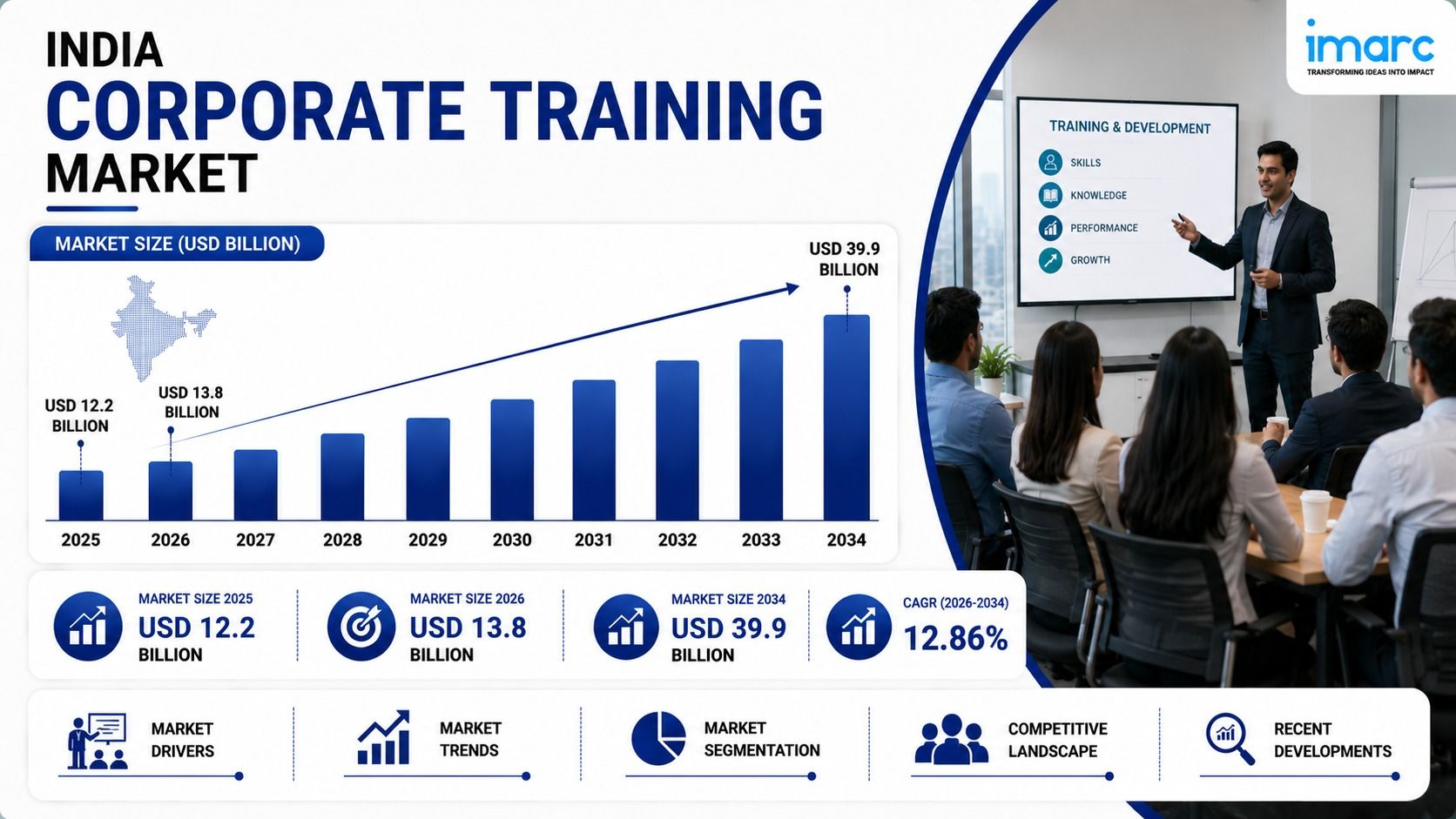
India's corporate training market stands as a critical driver of workforce readiness and organizational agility, encompassing technical training modules such as soft skills, quality training, compliance, and others, catering to diverse end-use industries including retail, pharmaceutical and healthcare, financial services, professional services, public enterprises, information technology, and others, spanning North India, West and Central India, South India, and East and Northeast India. The corporate training market size in India grew from USD 12.2 Billion in 2025 to USD 15.2 Billion in 2026, and is projected to reach USD 39.9 Billion by 2034, exhibiting a growth rate (CAGR) of 12.86% during 2026-2034.
The market is expanding due to rapid digital transformation, widening skill gaps, and the continuous need for upskilling and reskilling. Organizations across sectors are rapidly adopting advanced technologies like artificial intelligence (AI), cloud computing, and data analytics, necessitating a workforce that can seamlessly operate these new systems. Furthermore, as businesses expand globally and adopt hybrid work models, there is a pronounced focus on leadership and communication skills, augmenting demand for soft skills training. The increasing formalization of the workforce, high smartphone and internet penetration, and the shift from traditional classroom setups to blended and on-the-job digital learning models are heavily driving enterprise investments. Supported by government policies emphasizing skill development, corporations are integrating centralized learning management systems (LMS) and microlearning platforms to boost productivity, ensure regulatory compliance, and enhance employee retention.
Market Snapshot
- Current Market Size (2025): USD 12.2 Billion
- Market Size (2026): USD 15.2 Billion
- Projected Market Size (2034): USD 39.9 Billion
- CAGR: 12.86%
- Soft skills and compliance represent critical components within the technical training category, driven by hybrid work dynamics, global business expansion, and stringent regulatory standards across the BFSI and healthcare sectors.
- Information technology and financial services serve as leading end-use industries, propelled by continuous technology refresh cycles, massive software engineering workforces, and the need for frequent certification in cybersecurity and data management.
- North India and South India account for prominent regional demand, anchored by the massive concentration of Global Capability Centers (GCCs), IT hubs in Bengaluru and Hyderabad, and expansive corporate headquarters in the Delhi-NCR cluster.
What Is the Growth Rate of the Corporate Training Market in India?
The growth rate of the corporate training market in India is being supported by the increasing need for workforce upskilling, digital transformation, and continuous employee development. Organizations across industries are investing in structured training programs to strengthen technical capabilities, improve leadership skills, and help employees adapt to evolving business and technology requirements.
The rapid adoption of digital technologies is creating demand for training in areas such as artificial intelligence, data analytics, cloud computing, cybersecurity, automation, and digital collaboration. As businesses modernize their operations, employees increasingly require new skills to effectively use emerging technologies and remain productive in changing work environments.
The shift toward hybrid and remote working models is also influencing the corporate training landscape. Companies are increasingly adopting online learning platforms, virtual instructor-led programs, learning management systems, and blended training formats. These solutions allow organizations to deliver training to geographically distributed teams while providing greater flexibility in scheduling and participation.
Another important factor is the growing focus on employee retention, leadership development, and organizational performance. Businesses are using training and development programs not only to address skill gaps but also to strengthen managerial capabilities, improve employee engagement, and support internal career progression.
Overall, the growth of the corporate training market in India is being driven by workforce digitalization, changing skill requirements, technology adoption, hybrid work practices, and the increasing emphasis on continuous professional development. These factors are expected to continue shaping demand for corporate learning and training solutions across Indian businesses.
What Are the Latest Emerging Trends in India Corporate Training Market?
Integration of Artificial Intelligence and Personalized Learning:
Corporate training platforms are rapidly integrating artificial intelligence to transition from generic mass training to hyper-personalized learning experiences. AI-driven analytics evaluate an employee's current skill level, learning pace, and career trajectory to curate bespoke training modules and adaptive assessments. This personalization significantly increases training effectiveness and engagement by ensuring employees spend time only on relevant skills. Additionally, AI translation and voiceover tools are enabling the rapid deployment of multilingual content, making digital learning viable for India's massive regional-language workforce.
Rise of Immersive Technologies (VR/AR) in High-Risk Sectors:
The deployment of Virtual Reality (VR) and Augmented Reality (AR) is emerging as a transformative trend, particularly in sectors like manufacturing, healthcare, aviation, and energy. Immersive technologies provide safe, simulated environments where employees can practice complex mechanical procedures, surgical operations, or hazardous material handling without real-world risks. These simulation-based training tools drastically improve spatial awareness, skill proficiency, and muscle memory while minimizing operational downtime and equipment wear.
Focus on Microlearning and Bite-Sized Content:
To combat shrinking attention spans and tight work schedules, training providers are unbundling extensive courses into short, focused microlearning modules. Accessible primarily via smartphones, these 3-to-5-minute instructional videos, quizzes, and infographics allow employees to learn in the flow of work. This trend is especially prevalent in the retail and financial services sectors, where frontline staff require immediate product knowledge refreshers, quick compliance updates, and customer interaction scripts without leaving the sales floor.
Download Sample Report – TOC & Key Insights: https://www.imarcgroup.com/india-corporate-training-market/requestsample
What Growth Factors Are Driving India Corporate Training Market?
Rapid Digital Transformation and Technological Upskilling:
The primary catalyst for corporate training in India is the relentless pace of digital transformation across all major industries. As enterprises integrate artificial intelligence, machine learning, cloud architecture, and cybersecurity protocols into their core operations, a significant skill gap has emerged. Major Indian IT firms, global capability centers, and digital-first enterprises are investing heavily in structured, recurring eLearning programs and role-based reskilling to ensure their employees can operate advanced technical platforms. This continuous cycle of technological innovation means that one-time training interventions are no longer sufficient; organizations require ongoing, subscription-based digital learning solutions to maintain competitive productivity.
Shift Toward Digital, Blended, and Mobile-First Learning Models:
The delivery of corporate training has fundamentally shifted from traditional, instructor-led classroom sessions to highly scalable digital and blended learning frameworks. India's vast geography, dispersed workforce, and exceptionally low mobile data costs make mobile eLearning accessible even to frontline and field-based employees in manufacturing, retail, and logistics. Organizations are increasingly relying on Learning Management Systems (LMS) to deploy customized learning paths, microlearning modules, and real-time assessments that fit into the flow of work. This flexibility not only enhances knowledge retention but also dramatically reduces logistical costs, making large-scale training economically viable across thousands of employees.
Emphasis on Employee Engagement, Retention, and Soft Skills:
In a highly competitive talent market, robust learning and development (L&D) programs are critical tools for employee engagement and retention. Organizations recognize that providing clear career progression pathways through continuous training enhances loyalty and reduces attrition. Concurrently, the transition to hybrid work models has amplified the need for non-technical training, focusing heavily on leadership, communication, adaptability, and emotional intelligence. Soft skills development is increasingly integrated with technical training to build agile, cross-functional teams capable of navigating business uncertainty and driving customer experience excellence.
How will India Corporate Training Market Evolve in the Coming Years?
The India corporate training market presents robust growth prospects through 2034, driven by technological disruption, a massive working-age population, and the strategic elevation of Learning and Development (L&D) as a core business function. The market is projected to expand from USD 12.2 Billion in 2025 to USD 39.9 Billion by 2034 at a compound annual growth rate (CAGR) of 12.86%. The integration of advanced AI analytics, the mainstreaming of blended delivery models, and the imperative to deliver multilingual training content to Tier-2 and Tier-3 workforces will define the next phase of expansion. Service providers that can offer measurable return on investment (ROI), secure integration with enterprise HR systems, and scalable, outcome-driven learning pathways are strategically positioned to capture dominant market share over the coming decade.
Government Policy Support
- Skill India Mission: A sweeping national initiative aimed at empowering the workforce with industry-relevant skills, fostering strong collaboration between public institutions and private corporate training providers.
- Pradhan Mantri Kaushal Vikas Yojana (PMKVY): Government-backed schemes that provide financial incentives and structured certification frameworks to encourage formal skill development and vocational training across industries.
- Digital Skilling Platforms (Swayam and FutureSkills Prime): State-supported e-learning portals that democratize access to high-end upskilling in AI, cybersecurity, and data science, complementing corporate L&D investments.
- Implementation of New Labor Codes: Modernized labor regulations that emphasize worker welfare and compliance standards are compelling organizations across manufacturing and public enterprises to invest heavily in regulatory and compliance training.
Evaluate Market Opportunity with the Business Sample Report
How Is India's Corporate Training Market Segmented?
➤ By Technical Training
- Soft Skills
- Quality Training
- Compliance
- Others
➤ By End Use Industry
- Retail
- Pharmaceutical and Healthcare
- Financial Services
- Professional Services
- Public Enterprises
- Information Technology
- Others
➤ By Region
- North India
- West and Central India
- South India
- East and Northeast India
Request Customized Data Tailored to Your Interest
Note: If you require any specific information not covered within this report's scope, we will provide it as part of the customization.
Competitive Landscape — By IMARC GROUP
The market research report has also provided a comprehensive analysis of the competitive landscape. Competitive analysis such as market structure, key player positioning, top winning strategies, competitive dashboard, and company evaluation quadrant has been covered in the report.
Note: If you require any specific information not covered within this report's scope, we will provide it as part of the customization.
Request Report Customization: https://www.imarcgroup.com/request?type=report&id=23737&flag=E
Frequently Asked Questions (FAQs)
How big is the corporate training market in India?
➤ The India corporate training market grew from USD 12.2 Billion in 2025 to USD 15.2 Billion in 2026, supported by rapid enterprise digitalization, a widening skill gap, and the increasing formalization of the national workforce.
What is the projected growth rate of the India corporate training market?
➤ The market is projected to reach USD 39.9 Billion by 2034, registering a strong compound annual growth rate (CAGR) of 12.86% between 2026 and 2034, propelled by the integration of AI-driven personalized learning, hybrid work models, and government skilling mandates.
What are the key factors driving market growth?
➤ Key drivers include the urgent need for continuous upskilling in technologies like cloud and AI, the shift toward scalable digital and mobile-first learning platforms, and the strategic use of L&D programs to enhance employee retention and leadership capabilities.