
Market Outlook
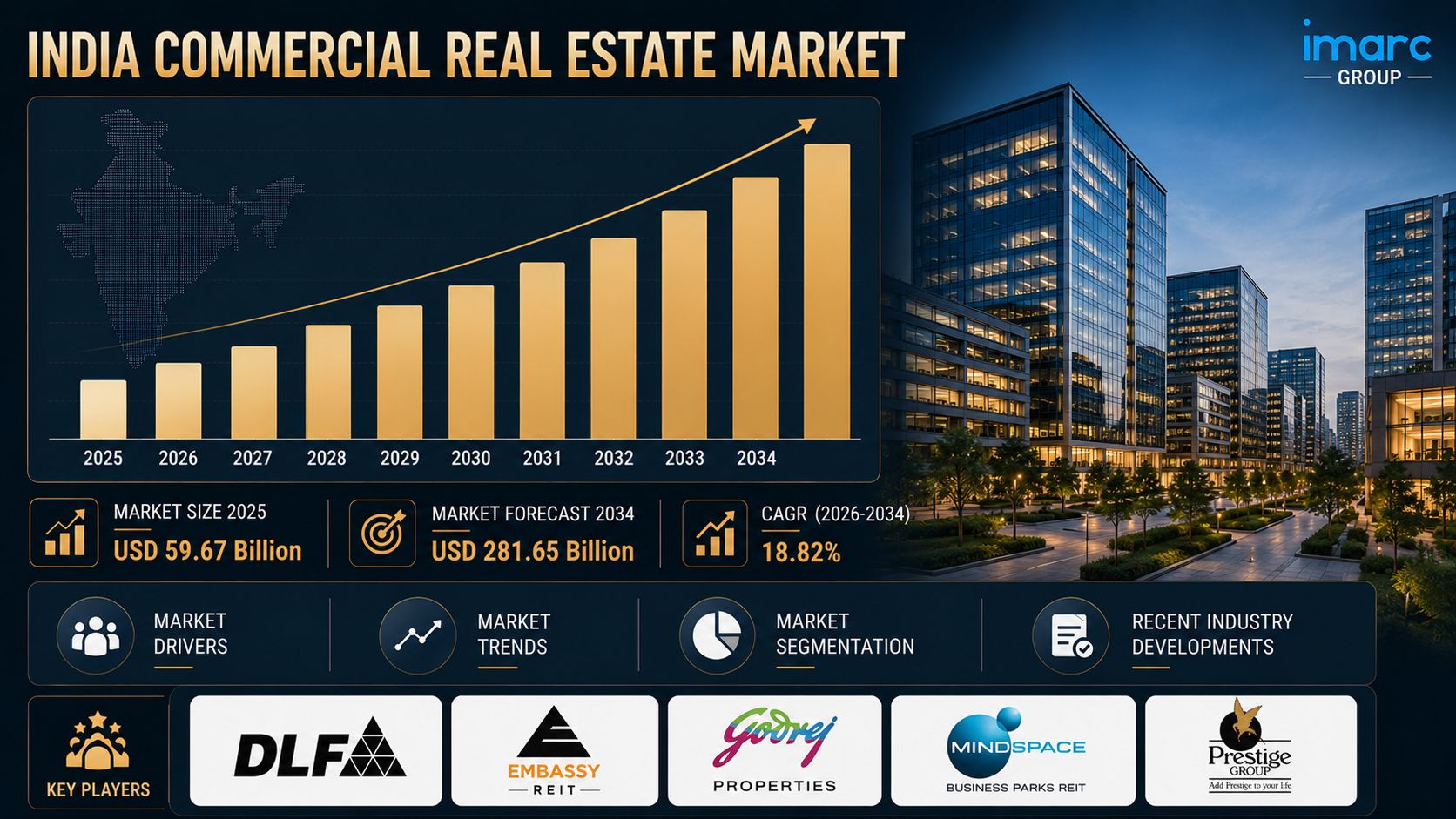
The commercial real estate market size in india was valued at USD 59.67 Billion in 2025 and is projected to reach USD 281.65 Billion by 2034, growing at a compound annual growth rate of 18.82% from 2026-2034. The market's structural expansion is heavily driven by the aggressive proliferation of Global Capability Centers (GCCs) and a rapidly scaling knowledge economy that continuously demands premium Grade A office spaces. Furthermore, the expansion of Real Estate Investment Trusts (REITs) is unlocking substantial institutional capital, establishing a more mature and transparent investment environment for both domestic and foreign stakeholders.
As the national economy accelerates, domestic enterprises, particularly within the banking, financial services, and insurance (BFSI) sectors, are rapidly expanding their operational footprints across both primary metros and emerging Tier-2 cities. The transition toward flexible, managed workspaces and the integration of highly sustainable, ESG-compliant green buildings further elevate the asset quality across the sector. Additionally, the digital infrastructure boom has introduced data centers as a critical new asset class, ultimately diversifying investment portfolios and securing robust, long-term commercial real estate demand.
Market Snapshot:
- Market Size (Current Year): USD 59.67 Billion (2025)
- Forecast Market Size (Forecast Year): USD 281.65 Billion (2034)
- CAGR: 18.82%
- Leading Segment by Type: Rental (64.8% share)
- Leading Segment by End Use: Offices (46.3% share)
- Leading Region: West India (34.5% share)
What are the Growth Factors of India Commercial Real Estate Market ?
Unprecedented Expansion of Global Capability Centers (GCCs):
India currently hosts over 1,800 GCCs, a figure projected to scale aggressively as global corporations establish their operational and technological hubs within the country. This influx represents the single largest structural demand driver for Grade A office real estate on a global scale. These centers employ millions of high-knowledge professionals, necessitating expansive, highly secure, and technologically advanced campus setups that ensure long-term leasing commitments.
Domestic Enterprise and BFSI Growth Accelerating Demand:
As the national GDP trajectory moves toward a USD 5 Trillion economy, it generates proportional operational expansions among domestic businesses. The banking sector is actively widening its branch networks, while insurance firms and domestic IT service providers are scaling their regional delivery centers. This collective expansion by homegrown enterprises creates a massive pipeline for commercial real estate absorption that operates completely independent of multinational GCC activity.
Emergence of Tier-2 Cities as Viable Commercial Frontiers:
Faced with infrastructural bottlenecks in traditional metropolitan hubs, corporate occupiers are increasingly targeting Tier-2 cities for their next phase of expansion. The formalization of the commercial real estate market in these regions is driven by GCC satellite offices, domestic retail chain expansions, and enterprise cost-optimization strategies. This geographic diversification broadens the overall market footprint and provides developers with fresh, untapped development corridors.
Institutional Capital Influx via REIT Expansion:
The maturation of the Real Estate Investment Trust (REIT) framework has fundamentally transformed how capital flows into the Indian commercial property sector. By allowing investors to gain exposure to premium commercial assets without outright property purchase, REITs have created sustained investor demand. This financial mechanism guarantees steady liquidity for large-scale developers and supports continuous capital deployment into major infrastructural and commercial projects.
➤ Request Sample Report (TOC & Charts): https://www.imarcgroup.com/india-commercial-real-estate-market/requestsample
What Are the Key Trends Shaping the Market?
Flex and Managed Office Spaces Reshaping Lease Structures:
Corporates, startups, and established multinational entities are systematically transitioning away from rigid, long-term fixed leases toward scalable, service-led occupancy models. Plug-and-play managed spaces allow organizations to efficiently handle headcount fluctuations, minimize upfront capital expenditures, and quickly establish operations across multiple business hubs. Consequently, landlords are adapting by offering revenue-sharing models and fitted-out office partnerships instead of traditional bare-shell leasing.
Proliferation of Mixed-Use Developments:
To maximize asset utilization beyond standard working hours, developers are increasingly launching integrated urban districts that combine offices, retail, hospitality, entertainment, and residential units. These "18-hour" destinations drive continuous footfall and create a highly engaging ecosystem for professionals and consumers alike. Institutional investors heavily favor this model as it provides strongly diversified revenue streams and mitigates the risk of long-term vacancy.
Rise of GCC-Driven Build-to-Suit Campuses:
Large-scale global occupiers are increasingly demanding pre-leased, tailor-made office assets that incorporate advanced data security, distinct employee-centric amenities, and strict ESG compliance. This shift strongly favors build-to-suit developments, reinforcing pre-commitment leasing structures in major tech hubs such as Bengaluru, Hyderabad, Pune, and NCR. For developers, this trend significantly reduces speculative vacancy risks and ensures immediate capital returns upon project completion.
Data Centers Emerging as a Premier Asset Class:
Surging cloud adoption, intensive artificial intelligence workloads, data localization mandates, and e-commerce expansion have created critical demand for digital infrastructure. Institutional investors and infrastructure funds are actively reallocating capital to secure exposure to the data center real estate segment. This rapidly scaling niche provides a highly specialized and lucrative asset category distinct from traditional commercial office developments.
What Are the Major Market Challenges?
Escalating Construction Input Costs Compressing Margins:
Persistent inflation in the construction cost index places immediate pressure on developer profit margins and actively delays speculative office development. As raw material expenses remain high, developers are compelled to prioritize pre-leased projects over open-market supply, which inadvertently creates structural supply shortfalls in highly preferred micro-markets despite incredibly strong underlying tenant demand.
Regulatory Burdens and Complex Property Taxation:
Commercial property transactions across India are subject to fragmented and elevated stamp duties, typically ranging from 5% to 7% of the total transaction value depending on the state jurisdiction. These substantial upfront transaction costs significantly burden outright real estate purchases, directly reducing the net investment returns for institutional buyers and making alternative financial vehicles like REIT unit purchases comparatively more attractive.
Severe Infrastructure Dependency Creating Micro-Market Saturation:
The premium Grade A commercial real estate sector remains heavily concentrated in eight primary cities that possess the necessary reliable power supply, talent availability, and metro connectivity required by multinational occupiers. However, escalating traffic congestion and urban infrastructure strain in primary nodes like Bengaluru complicate occupier location decisions, necessitating heavy, immediate public infrastructure investments to unlock alternative micro-markets.
How Is the Market Segmented?
- By Type: Rental dominates the market with a share of 64.8% in 2025, reflecting the lease-heavy structure where multinational GCCs and top-tier domestic IT firms prefer preserving operational capital over outright property ownership. The other key segment is Sales.
- By End Use: Offices lead with a 46.3% market share in 2025, operating as the undisputed engine of demand fueled by India's expanding knowledge economy and an unmatched concentration of global capability centers. Additional segments include Retail, Industrial, Hospitality, and Others.
- Regional Insights: West India commands the leading position with a 34.5% market share in 2025, anchored by Mumbai's irreplaceable status as the financial capital and Pune's dense concentration of enterprise GCCs. Other prominent regions include North India, South India, and East India.
Competitive Landscape:
The India commercial real estate market exhibits moderate concentration, with key developer entities and institutional REITs managing major Grade A office footprints, retail centers, and integrated business parks across top metropolitan corridors. Competition is heavily characterized by continuous enhancements to property amenities, strategic portfolio acquisitions, and an intensified focus on ESG compliance and green building certifications to attract global occupiers.
- DLF Limited: Dominates the commercial ecosystem with expansive, tech-enabled Grade A office parks and premium retail developments across North India, particularly in the Delhi-NCR region.
- Embassy Office Parks REIT: Operates as India's first publicly listed REIT, holding a massive portfolio of office parks and enterprise infrastructure in major technology hubs like Bengaluru and Mumbai.
- Mindspace Business Parks REIT: Features a strong presence across key commercial nodes including the Mumbai Metropolitan Region (MMR), Pune, Hyderabad, and Chennai, specializing in integrated ecosystem developments.
- Godrej Properties Limited: Focuses on developing modern, ESG-compliant commercial projects and mixed-use developments across primary metros, leveraging strong brand equity and institutional backing.
- Prestige Estates Projects Ltd.: Maintains a market-leading position across South India with extensive commercial office developments, IT parks, and high-street retail destinations.
Recent News or Developments:
• In the ongoing push toward sustainable real estate, the Indian Green Building Council (IGBC) has certified 15.79 Billion sq.ft. of green building space, positioning the country as one of the largest sustainability-focused real estate markets globally.
• The sector is witnessing a massive digital infrastructure shift, with data center operational capacity projected to effectively double, reaching 2,000-2,100 MW by FY2027 to support accelerating AI and cloud workloads.
• Domestic banking networks and insurance companies are actively scaling their regional footprints, directly boosting demand for high-grade commercial office spaces independent of multinational operations.
Customization Note: If you require any specific information not covered within this report's scope, we will provide it as part of the customization.
➤ Request Report Customization: https://www.imarcgroup.com/request?type=report&id=29653&flag=E
Frequently Asked Questions (FAQs):
What is the size of the India Commercial Real Estate Market?
The commercial real estate market size in india was valued at USD 59.67 Billion in 2025.
• What is the projected growth rate?
The market is projected to grow at a compound annual growth rate of 18.82% from 2026-2034.
• What are the key drivers?
Key drivers include the unprecedented expansion of Global Capability Centers (GCCs), domestic enterprise scaling driven by robust GDP targets, and the formalization of Tier-2 city real estate markets.
• Which region holds the leading position?
West India represents the largest segment, accounting for a 34.5% market share in 2025.
• Which end use dominates the market?
Offices constitute the cornerstone of the market, holding a 46.3% share in 2025.
Conclusion
The India commercial real estate market is positioned for exceptional structural growth through 2034, fundamentally anchored by the country's accelerating knowledge economy and the rapid proliferation of Global Capability Centers. Grade A office segments will continue to capture the bulk of institutional investment, while the expansion of data centers and managed flexible workspaces introduces highly lucrative, diversified asset classes. As domestic enterprises scale and infrastructure improves across regional hubs, the reliance on top-tier metropolitan areas will gradually decentralize. This ongoing institutionalization, supported by robust ESG compliance and green building initiatives, ensures the market will maintain its status as a highly attractive destination for both domestic developers and international capital.