
India Automotive Lighting Market: Industry Report 2026–2034
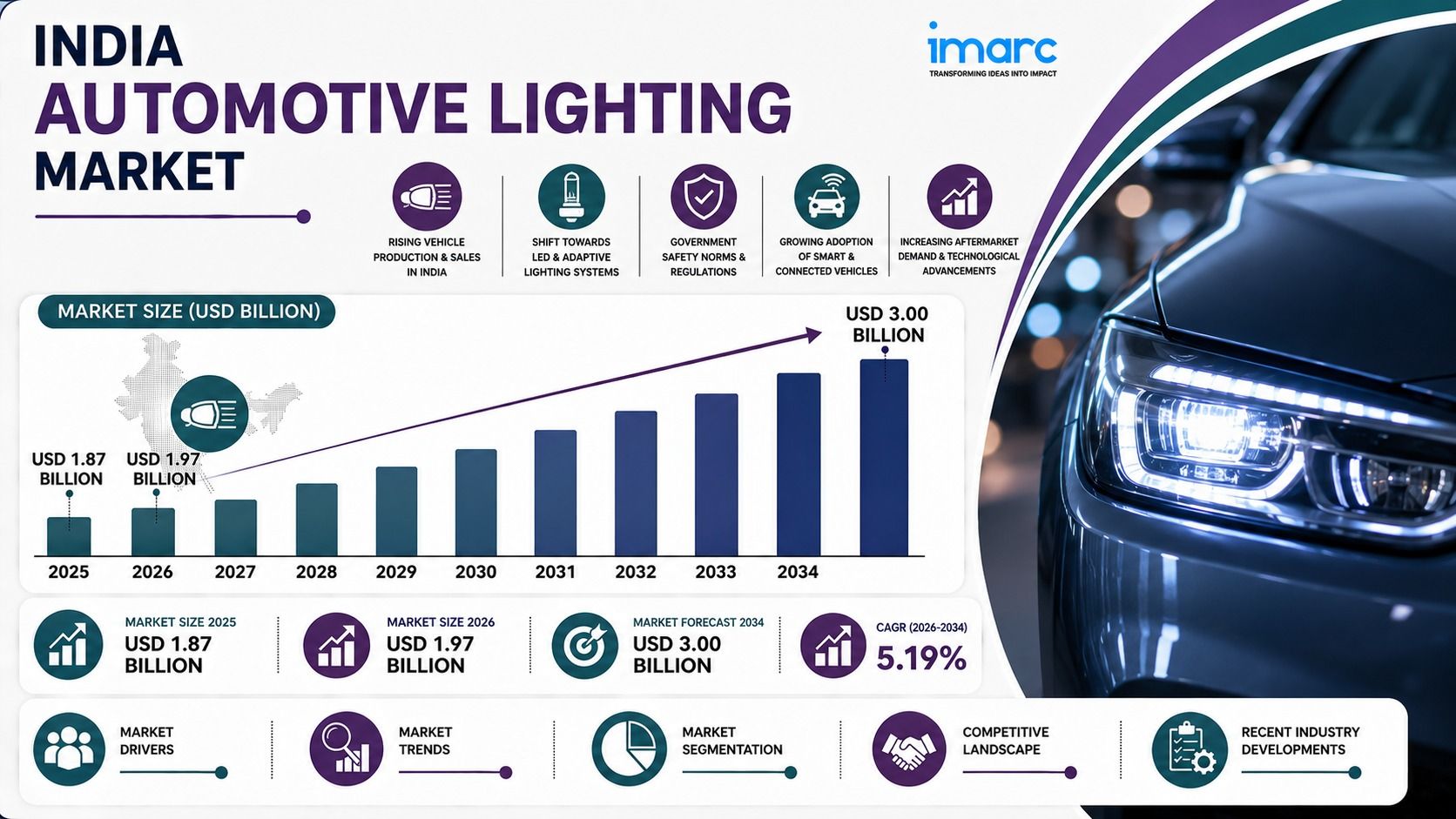
The India automotive lighting market size increased from USD 1.87 Billion in 2025 to USD 1.97 Billion in 2026 and is projected to reach USD 3.00 Billion by 2034, expanding at a compound annual growth rate (CAGR of 5.19%) during the 2026–2034 forecast period. The industry continues to advance as vehicle manufacturers and consumers prioritise energy-efficient, durable, and stylistically advanced lighting systems. Driven by the shift toward LED technology, strong passenger vehicle demand, expanding OEM networks, and rising safety and design expectations, automotive lighting remains a critical component segment within India’s automotive value chain.
What Is the Size and Growth Forecast of the India Automotive Lighting Market?
The market is exhibiting resilient, continuous expansion, fundamentally anchored by sustained vehicle production, the transition from conventional to LED lighting, and growing emphasis on safety and aesthetic lighting features across passenger and commercial vehicles.
- Market Size in 2025: USD 1.87 Billion.
- Market Size in 2026: USD 1.97 Billion.
- Market Forecast in 2034: USD 3.00 Billion.
- Compound Annual Growth Rate (CAGR): 5.19% during the 2026–2034 forecast period.
- Underpinning Momentum: Rising LED adoption, dominant passenger vehicle demand, strong manufacturing concentration in West and Central India, and continuous product innovation by domestic and global suppliers support steady long-term growth.
What Are the Latest Emerging Trends in the India Automotive Lighting Market?
Clear Shift Toward LED Lighting Technology:
LED systems are rapidly gaining share because of higher energy efficiency, longer service life, and greater design flexibility for headlamps, tail lamps, and signalling modules. Vehicle makers increasingly specify LEDs to meet both performance and styling requirements across a widening range of models. The technology supports distinctive light signatures that help brands differentiate products while improving visibility and reducing power consumption. As costs continue to moderate, LED penetration is expanding from premium segments into mid-range passenger vehicles, reinforcing its position as the leading lighting technology in the Indian market.
Continued Relevance of Halogen in Entry-Level Segments:
Despite the broader transition to LED, halogen lighting retains a meaningful presence in cost-sensitive and entry-level vehicles where affordability remains a primary purchase criterion. These systems continue to serve a large volume of basic headlamp and signalling needs for budget-conscious buyers. Manufacturers balance portfolio offerings by maintaining halogen options alongside LED upgrades, ensuring coverage across price tiers. This dual-technology landscape is expected to persist in the near term as the market gradually migrates toward more efficient solutions without abandoning the volume base of entry-level vehicles.
Strong Dominance of Passenger Vehicle Applications:
Passenger cars drive the majority of lighting demand through higher production volumes and greater emphasis on advanced styling and safety features. Consumers increasingly expect modern lighting signatures, better night visibility, and refined aesthetics that enhance both function and brand identity. OEMs respond by integrating more sophisticated headlamp and tail-lamp designs into new model launches. This passenger vehicle focus sustains the bulk of market value and encourages continuous innovation in LED modules, signalling systems, and related electronic controls tailored to car platforms.
Request Sample Report – TOC, Charts & Key Insights: https://www.imarcgroup.com/india-automotive-lighting-market/requestsample
What Growth Factors Are Driving the India Automotive Lighting Market?
Rising Passenger Vehicle Production and Feature Expectations:
High volumes of passenger cars create the largest addressable demand for headlamps, tail lamps, and signalling systems. Sustained consumer preference for better-styled and safer vehicles further increases lighting content per vehicle. As buyers place more weight on visibility, aesthetics, and modern design cues, OEMs upgrade lighting specifications across model ranges. This combination of volume and rising feature intensity underpins steady growth in the automotive lighting market and encourages suppliers to expand both standard and advanced LED offerings.
Accelerating Adoption of LED Technology Across Segments:
Automakers are progressively replacing halogen systems with LEDs to improve efficiency, durability, and design freedom. Regulatory and consumer expectations around visibility and energy use reinforce this technology shift. LED solutions also enable more distinctive brand lighting signatures that support model differentiation. As production scale improves and costs decline, LED adoption is moving deeper into mid-range vehicles, expanding the overall value and volume of the lighting market beyond premium niches.
OEM Focus on Safety and Styling Differentiation:
Lighting has become an important element of both safety performance and brand identity. Advanced headlamp technologies, clearer signalling, and carefully designed light signatures help manufacturers meet evolving safety expectations while standing out in a competitive showroom environment. This dual role of function and design drives continuous collaboration between OEMs and lighting suppliers on new modules, electronics, and optical systems, sustaining demand for higher-value lighting content across passenger vehicle platforms.
Expansion of Automotive Manufacturing and Supplier Networks:
Concentrated vehicle and component production in key regions, especially West and Central India, sustains strong local demand for lighting systems and supports efficient OEM–supplier relationships. Robust manufacturing ecosystems attract investment in lighting technology and capacity. At the same time, gradual growth in commercial vehicle requirements for durable, safety-compliant lighting adds incremental demand alongside the dominant passenger vehicle segment, broadening the overall market base.
Government Initiatives Supporting India Automotive Lighting Market Growth
- Automotive Manufacturing and Make in India Support: Policies promoting domestic vehicle and component production increase overall demand for automotive lighting systems and strengthen local supplier ecosystems.
- Vehicle Safety and Lighting Performance Standards: Regulatory requirements related to visibility, signalling, and lighting performance encourage the use of reliable and compliant systems, supporting the shift toward higher-quality and LED-based solutions.
- Electric Vehicle and Advanced Mobility Push: Initiatives supporting EV adoption create opportunities for specialised lighting designs suited to electric platforms, often incorporating modern LED and signature lighting features.
- Industrial Corridor and Supplier Ecosystem Development: Infrastructure and industrial policies that strengthen automotive clusters improve the operating environment for lighting component manufacturers and their OEM customers.
What Are the Key Challenges Facing the India Automotive Lighting Market?
- Cost Sensitivity in Entry-Level Vehicle Segments: A large portion of the market remains price-conscious, limiting the pace of full LED penetration in basic models and requiring careful balancing of performance upgrades with affordable pricing.
- Managing Multiple Technology Generations: Parallel demand for halogen, xenon/HID, and LED systems increases complexity in design, production, and inventory for suppliers serving diverse OEM requirements.
- Intense Competition Among Domestic and Global Players: Established Indian manufacturers and international technology providers compete for OEM contracts, making differentiation through innovation, quality, and cost essential.
- Dependence on Overall Vehicle Production Cycles: Lighting demand is closely linked to automotive sales and production volumes, so any slowdown in vehicle demand can temporarily affect order levels for component suppliers.
Deep-Dive Segment Insights
The market is meticulously segmented to address technology preferences, vehicle categories, and regional manufacturing patterns.
By Technology
- LED (48.3% share in 2025): Dominates due to energy efficiency, longer life, and design flexibility for headlamps, tail lamps, and signalling modules.
- Halogen (37.4%): Continues to serve cost-effective requirements in entry-level vehicles.
- Xenon/HID (14.3%): Supports premium applications needing high-intensity illumination.
By Vehicle Type
- Passenger Vehicle (78.6% share in 2025): Leads demand, driven by higher volumes and stronger focus on advanced styling and safety lighting features.
- Commercial Vehicles (21.4%): Reflect growing fleet interest in durable and safety-compliant lighting solutions.
By Region
- West and Central India (38.5% share in 2025): Leads due to concentration of automotive manufacturing hubs and strong OEM supplier networks.
- North India (27.8%): Supported by passenger vehicle demand and expanding dealership infrastructure.
- South India (22.6%): Driven by component manufacturing growth and rising EV-related activity.
- East and Northeast India (11.1%): Emerging with gradual automotive and commercial vehicle demand growth.
Competitive Landscape & Key Player Positioning
The India automotive lighting market exhibits moderate concentration, with leading manufacturers collectively holding a significant share of market revenue in 2025, reflecting sustained investment in product innovation and OEM reach. Varroc Group and Lumax DK Jain Group dominate through comprehensive product portfolios and extensive domestic OEM relationships. FORVIA, Hyundai Mobis, and Valeo compete through global technology expertise and specialised LED and intelligent lighting solutions.
Key players include:
- Varroc Group – Market Leader with extensive OEM supply portfolio in automotive lighting
- Lumax DK Jain Group – Market Leader with strong presence in two-wheeler and passenger vehicle lighting
- FORVIA (HELLA) – Strong Challenger specialising in advanced lighting technology with Indian manufacturing presence
- Hyundai Mobis Co., Ltd. – Challenger offering LED and intelligent lighting modules
- Valeo SE – Challenger focused on full-LED system applications and global lighting solutions
Recent Developments
- Ongoing 2025–2026: LED lighting continued to gain share as OEMs expanded energy-efficient and design-oriented headlamp and signalling systems across passenger vehicle models.
- Technology Mix: Halogen retained relevance in entry segments while xenon/HID served select premium applications.
- Regional Strength: West and Central India sustained leadership through dense automotive manufacturing and supplier networks.
- OEM Focus: Leading domestic and global suppliers continued investing in product innovation and local manufacturing capacity to serve evolving vehicle platforms.
- Market Outlook: Passenger vehicle growth combined with the ongoing LED transition remains the primary driver of long-term demand for automotive lighting in India.
Note: If you need specific information that is not currently within the scope of the report, we can provide it to you as a part of the customization.
Frequently Asked Questions (FAQs)
Q1. What is the current size of the India automotive lighting market?
The India automotive lighting market size increased from USD 1.87 Billion in 2025 to USD 1.97 Billion in 2026.
Q2. What is the projected market size by 2034 and the growth rate?
The market is projected to reach USD 3.00 Billion by 2034, expanding at a compound annual growth rate (CAGR of 5.19%) during the 2026–2034 forecast period.
Q3. Which technology holds the largest share?
LED leads with a 48.3% share in 2025, driven by energy efficiency and design flexibility.
Q4. Which vehicle type dominates the market?
Passenger Vehicle accounts for the largest share at 78.6% in 2025, supported by higher volumes and advanced lighting feature demand.
Q5. Which region accounts for the highest market share?
West and Central India leads with a 38.5% share in 2025, backed by major automotive manufacturing hubs and OEM networks.